|
|
Battery Grubbs
|
 |
| The tours of Corregidor don't visit Btty. Grubbs, nor do they suggest at the existence of many of the fortress' other fascinating installations. Surprisingly, hikers can find Btty. Grubbs very easily. Instead of turning left towards Btty. Hearn, take the right fork, and you'll find Btty. Grubbs at the end of the road. | |||

|
Unfortunately for the purposes of posterity, President Clinton visited Corregidor not too long ago and the battery suffered from a coat of paint and the installation of handrails. There are some things that really should be left to appear that they are rusting in peace. There's no room for "prettying-up" the wreckage of history with cans of jungle-green paint. |
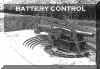
A battery for two 10 inch disappearing guns, Grubbs is located well inland in the west central part of the island, firing towards the northwest sector . Unlike the other batteries, the atmosphere changes markedly as you approach Grubbs through a Spanish-style arch at the road's end. It had the 10 inch guns emplaced in the Manila Harbour defences. Work was done from November 1907 to early 1909. The Battery was completed for transfer on 2 February 1911 at a cost to Uncle Sam of $212, 397.88. The 10 inch guns were Model 1895M1 guns on Model 1901 disappearing carriages (Watervliet #25 / #14 and #22 / #16). These were apparently never changed during the service life of the Battery. |
|

|
The Japanese apparently attempted to restore the Battery into a useable state, but before they could complete the work, the US bombardment of the island in 1945 heavily damaged the installation. |
Grubbs was not manned at the start of WW2, and it was not until the transfer of Battery C of the 91st Coastal Artillery from Morrison in early April 1942 that the Number 2 gun could be put into action. The Number 1 gun had suffered some mechanical failures and had never been commissioned. On 11 April, an aerial bomb hit the power plant, and put the battery out of service. Five days later a direct hit took out the number 2 gun, and also destroyed the Battery Commander's station, and the Battery was abandoned. |
|
| The Battery commemorated Lt. Hayden K. Grubbs of the 6th US Cavalry who died during what used to be known as the Philippine Insurrection in 1899. ( I now understand that as the result of discussions held between their respective governments, the "Insurrection" is hereinafter to be referred to as a War.) | |||
|
|
|