|
|
Battery
Crockett |
|
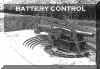
 Btty. Crockett's No. 1 gun |
 Btty. Crockett's No. 2 gun |
 Crockett in 1945 |
|
The main armaments of Corregidor were the 12-inch disappearing guns of Battery Crocket, located about 400 yards to the southeast of the centre of the barracks and across the golf course. These monsters of the U.S. Army's Coast Artillery had a 360-degree traverse and could hurl a 900 pound projectile more than 16 miles. A crew of 30 men was required to service each weapon, and a well-trained crew could get a round off every 40 seconds. On 24 April, a 240 mm howitzer, which had been moved from Cavite because it's high trajectory could seek out the guns in their protective pits, scored a direct hit and knocked out both of Crockett's guns. Even then, with the prospect of the guns falling into Japanese hands and being capable of being repaired, Captain Herman Hauck put a link of chain in the recoil cylinder of one of Crockett's operational 12-inch guns. If it were ever fired by the Japanese, it would have self-destructed immediately. |
|||
After the Japanese captured the island, they proceeded at a leisurely pace to clean it up. It never occurred to them that they would ever have to fight for it again, and consequently American P.O.W. working parties who remained on the Rock to clean up the various bombed positions and to gather scrap and munitions were treated fairly and adequately. It seemed to some that so long as there was a good show put on for the Japanese dignatories who visited from time to time, they were tolerated. It was only later that the P.O.W.'s were required to dig fresh defensive tunnels. Even as late as August 1944, the 14th Army had stationed only three companies of troops (one infantry and two artillery), about 300 men in all. As of 12 May 1944, there were only 21 P.O.W.'s remaining on the island. Rumor has it that there were 15 still on the island at the time it was recaptured, though no trace of P.O.W.'s was ever found. |
The tour bus always takes the tourists to a core of Batteries, of which Crockett is one. With between 50,000 to 65,000 tourists coming to the island ech year, that's a lot of traffic and the path to (and over) Btty Crockett is well worn. The effect is pretty anticeptic and there's very little character left to see. The guns have been cleaned up pretty severely - the twisted work platforms used to maintain the guns were cut away to prevent visitors from climbing over the guns (and presumably from falling off). When LBJ visited the guns, they weren't painted and retained much of their character. Unfortunately there was paint splashed all over the island when Clinton came to visit and what real character Crockett had disappeared in the process. None of this seems to worry the crowds, who swarm over the guns and pose "firing squad" like in their colourful tropic garb, as if the guns were their shiny new car. Though the island management likes to see itself as tending a sacred memorial, the carnival-like atmosphere at Batteries like Crockett, Hearn and Way reminds one more of an "If it's Tuesday, then this is Belgium" approach. Mind you, it's hard to think whay I would do differently as an alternative to what the Corregidor Foundation Inc has done, but I do feel that they should be reviewing what their true role is - conservators, historians or tourist operators. |
||
|
|
|