|
Battery Commander’s narrative report of Battery HARTFORD's Action during the War Period from November 29, 1941 to the surrender of Corregidor, May 6, 1942. |
|
|
| December 8th- 15th 1941 |
Battery on alert. No action over Corregidor. Worked on camouflage and revetment of Battery position. Observed plane formations going to Manila and vicinity from the direction of Pampanga Bay and the Cavite shore line. |
| December
15th 1941
"The Japs knew exactly where the fixed guns were even before the war broke out, but they didn't know the co-ordinates of the anti-aircraft emplacements, because we'd only just dug them in. Captain Starr figured that they sent some aircraft towards our positions so they could observe where our anti-aircraft fire was coming from. " Al McGrew |
Battery on alert. Thirteen planes approached Corregidor from Naic, flying from Fort Hughes over the North Channel toward Mariveles. They were low, approximately 5500 yards in altitude. All A. A. batteries on Corregidor fired on these planes. Many machine guns, and small arms were also fired, without effect. All 3-inch gun fire was low, and short in range. The planes had bomb bays open, and flew a shallow V bombing formation. They dropped no bombs. It is the opinion of this officer, that the planes were empty of bombs from bombing Manila vicinity, and flew a course near Corregidor in an attempt to test our A. A. fire. "H" Battery fired 159 rounds of 3-inch ammunition at the course on December 15th. We got no direct effects other than the fact that all fire changed the course of the bombers away from Corregidor. The fact that all A. A. fire that day was short in range and ineffective, caused the belief that possibly the muzzle velocity used was in error for the rather old ammunition we were using, and it was decided within the Regiment to hold test firing to determine the actual developed muzzle velocity. This test was made on No. 1 Gun at battery "H" position, some time during the period December 15th to 24th. Four powder lots of ammunition were fired. It was found that: for powder lots 8218-4 and 8218-5, the developed M. V. was 2690 f/s. For powder lots 6339-15 and 2927-1 the developed M. V. was 2740 f/s. Since most of the ammunition at H Battery was 6339-15, a M. V. of 2740 was used with good results for later firing. |
| December 24th 1941
Gun
drill at an AA Battery.
"The first air raid taught us fast how to improve our foxholes, and how to bury the data cables deeper." Al McGrew |
Frequent flights of planes were seen circling Manila Bay area, maneuvering to and from Manila area. Three Messerschmidt type 109 fighter planes operated for a short while over the South channel area, two of them strafed the ration boat Neptune between Fort Hughes and Fort Drum. Batteries B and H fired on these planes flying out the south channel with good results, causing their very fast maneuvering. It was evident at this time, that the equipment we had to use was very efficient, and if operated correctly would give very accurate, effective fire on any target within range and the limits of the tracking of the Director. Later in the day a flight of eighteen heavy bombers, type 98, with twin motors and tail assembly, flew to Corregidor from the east, between Monkey Point and Port Hughes. Batteries D and H fired on these plane's while they were over Caballo Bay, D battery from the right flank, and H battery from the front. This fire caused the formation to break their shallow V formation. They split into two flights, taking flight formation, one flying clear of Corregidor to the north and out the North Channel; and one flying clear of the Island and out the South Channel. H Battery continued to fire on the latter. The fire was effective; close enough to cause their abrupt change of course and abandonment of objective. One plane was observed to be hit by the fire of the Battery. It trailed smoke as long as observed. These planes flew at 6100 yards altitude. H battery fired 98 rounds of ammunition. All batteries on Corregidor fired on the two flights as they passed the Island, and further fire caused one other plane to leave formation and lose altitude. The planes had their bomb bays open when they approached, and if their mission was to bomb, it was destroyed. The battery was able to observe fire closely enough to determine some corrections needed to bring fire more closely on the target. A lateral lead of 12 mils and a vertical lead of 4 mils were used, and later increased with continued firing and engagement of faster, more maneuverable targets.
|
| December 24th to 28th 1941 |
No aerial activity over Corregidor. Continued bombings of Manila and vicinity.
|
| December
29th 1941
|
The first concerted aerial bombing attack of Corregidor by the enemy took place on this day. About 11:30 A.M., 18 fighter planes flew in the Cavite shore line on the far side of the South channel, and maneuvered to the east of the Island. In Manila Bay, Northeast of the Island, they split into two flights of nine and flew towards Corregidor. One flight of nine planes, which were thought to be the German Messerschmidt 109 type, flew towards Battery H position from Monkey Point, very low in altitude and flying fast. Director and Height Finder had been tracking them out in the bay, but as they neared the Island , it was found impossible to track their low, fast course, and the rate setter found it impossible to set in a diving rate fast enough to accommodate their course, straight in, about 500 yards or less in altitude. Three of the planes flew straight over H battery position, strafing as they came. Their small fire was over our position, was seen to bear into the tops of the rubber trees within our position. They dropped bombs on the upper side of Herring Field, demolishing the 60th C.A.(A.A.) garage and truck sheds. Several men were either killed or injured at that location. Machine gun fire was heavy on these planes entirely across the Island, and two of the three observed in the battery position were seen to have been forced down in the China Sea very close to Corregidor. Immediately after the fighter planes cleared the Island, many large, high flying bombers began a raid of Corregidor, from several directions, which lasted in intensity until 1:30 P.M. and occasional flights the remainder of the afternoon until about 4 P.M. Approximately fifty-four bombers, type 97 and 98 participated, usually flights of nine, flying courses nearly every direction of the compass. Antiaircraft fire was very effective; causing an increase in their altitudes of from 6000 yards at the beginning of the raid to 7500 yards or more before they finished. Bombing was less effective as their altitude increased. We had previously gotten information that the enemy was usually expected to bomb from 5500 to 6000 yards altitude. Several planes were seen hit by A. A. fire and leave formation, losing altitude rapidly Hits were made on three planes by H battery during this raid; the planes were seen to trail smoke, leave formation and lose altitude. We fired 77 rounds of 3-inch ammunition this day. Damage by the bombing raid to the island of Corregidor was small, considering, the concentrated material and installations on the Island. |
|
January 2-3-4-5-7th 1942
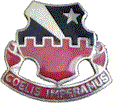
"This is our distinctive insignia of the 60th Artillery Regiment. The 60th had been organised 23 December 1917, and the motto "COELIS IMPERAMUS" means 'We Rule the Heavens.' I wore this badge on my campaign hat throughout the war, through the prison camps, the work details at Pasay, through the hell-ship ordeal, right through my time in Japan - until some bastard stole it off me whilst I was in Okinawa on my way home from Japan. " Al McGrew
Japanese
Heavy Bomber
|
There were heavy mid-day raids of two to four hour duration on Corregidor on all of these days. Number of planes participating varied from 18 to 100; all heavy bombers, types 97 and 98. No strafing or dive bombing planes were present. During these raids, bombs set fire to the freighter Don Jose, President Quezon’s yacht, and disabled several auxiliary Army and Naval craft in the north and south dock areas. Some damage was done to the docks at Bottomside. A large fuel dump at Kindley Field was destroyed. Several ordnance buildings at Topside, many barracks and officers quarters, topside water towers, and some buildings at Bottomside area were destroyed. Damage to defensive positions on the Island were not heavy. Battery H had no damage or casualties up to this time. We fired normally about 75 rounds each day. One day, the 4th of January, I believe, the battery did no firing. At the beginning of the raid a large oil store at Bottomside was set on fire by bombs and the wind moved the heavy blanket of dense black smoke directly over the battery, very low and obscuring our upward vision for the entire period of the raid. Flight altitudes were increasing every day, the enemy evidently realizing the inadequacy of the smaller type 98 bomber. This type gradually disappeared, and the altitude for the courses were reaching the extreme ranges of the 21 second fuzed ammunition. For this reason, firing courses were short, usually at the very extreme vertical elevations. Many of the courses were straight over head, incoming, causing very few rounds fired before the guns and director would be in vertical lock and have to be traversed 180 degrees. Accomplishing this would sometimes cause the flight to be lost for further fire, when the tracking was resumed. The type 98 bomber was very vulnerable to our fire, as its extreme altitude seemed to be less than 7000 yards with a full bomb load of about 2200 pounds. Their cruising speed in bombing formation seemed to be much slower than the type 97, about 150-175 mph., while the type 97 seemed to do about 175 to 200 mph. Later in the war, the type 97 bomber was improved, and flew very high altitudes and cruised in excess of 200 mph. During January 2-7th raids, altitudes flown were 7800 to 8300 yards. They continually used the formation of an extended, shallow V, with the planes flying about 80 yards apart. Flights usually were nine planes, which first appeared in flights of three, echeloned to the rear. When they approached the target they would draw up into the shallow V formation for bombing. Some flights were observed to lose 100 to 300 yards in altitude in flying a bombing course across the Island. It appeared that they came in with a sort of a glide, presumably to surprise ... (missing line)... ability to their course. During these days, H battery obtained hits on four planes and fired about 350 rounds of 3-inch ammunition. Pvt. Roy E. Joplin, machine gunner, was wounded slightly in the left arm by a bomb fragment. He was treated at the Medical aid station and his case is on record.
|
| January 8th to 19th 1942- |
Aerial activity over Corregidor was limited to occasional flight of observation planes, flying very high and fast, not a worthwhile target for 3-inch A.A. fire. During this time the enemy diverted his aerial activity to dive bombing in the Bataan area. |
| January 19th 1942
|
On this day two flights of planes came to Corregidor. The first, a flight of nine, type 97 bombers, approached from the west over Mona Island, altitude 9300 yards. They were too high for fire by H battery. They flew a straight course across the full length of the Island and dropped their load of bombs very promiscuously from Mona light in the China Sea, on practically all sides of Corregidor and into Caballo Bay on the east. Damage done was slight. Two of the bombs dropped into and destroyed the Quartermaster building at the left-rear of our position, destroying part of our field kitchen and areas adjacent at the head of Ramsay ravine. This building had just been emptied of 3-inch A.A. ammunition, hand grenades, fuzes and small arms ammunition two days before by the Ordnance Dept. Two bombs dropped in our position on the right side, destroying some camouflage and two or three small houses built by the men for sleeping. One bomb, landing in the vicinity of No.4 gun, caused the slide on the gun to be burred by fragments, but the slide was filed down, and was soon back in action. The second flight of planes, came in over Mariveles and flew northeast up the North Channel. They were eight- type 98 bombers, flying 6400 yards altitude, making a very good firing course. Battery C-9lst CA (PS) fired first, Battery C-60th CA next, and H battery fired later as they came up the channel. H battery fired 44 rounds at this flight, and damaged one plane to the extent it was seen to leave formation, glide down to and land in the vicinity of Cavite. Three planes were damaged badly in this flight of eight, from all battery fire.
|
|
January 19th to March 24th 1942
Japanese
Heavy Bomber |
No aerial attacks of Corregidor during this period. Artillery shelling of the position from Cavite (Ternate) destroyed one pyramidal tent and made the battery take cover occasionally, but did practically no damage. Occasional dive bombers came over the Island without bombing. Two strafed Topside area from low clouds over Corregidor one day. Observation planes were very active. Patrol ships regularly flew around the Island, and in and out the south channel to the South China sea daily. Due to high manoeuvrability of these single planes, (not our normal target), little firing was done during... It was apparent that they respected the AA fire and tried to fly above range and harass with ineffective, promiscuous bombings. One day during this period two planes appeared to the east, flying toward Corregidor. Battery H began tracking these planes. They soon altered course and flew out the South channel, reversed and flew east to Port Drum area. They then turned abruptly and flew directly north toward Corregidor dock area. Their maneuvering was strange. The battery had been tracking their full flight, and as they came in at 6600 yards altitude we were ready to open fire. Their course was a crossing course at a little above optimum range. Our data was correct, and the rates were settled down for effective opening fire. An AA battery could not hope for a better firing course. These planes came into range of H battery first. We had fired ~2 rounds and both planes were trailing smoke, when D battery opened fire from their right flank. Almost immediately C battery, B battery and F battery opened fire. When we had fired about 32 rounds, there was a terrific barrage of fire around the planes and both were on fire. H battery ceased firing; Soon one plane exploded in right motor and the end section of the wing came off. The motor hurdled down. The plane immediately went into a spiralling nose dive into the north channel. The second plane was on fire, losing altitude and came down in Manila Bay towards Pampanga bay. This incident was very gratifying and fulfilled the AA artilleryman's best hopes of shooting planes down actually in the near vicinity. H battery fired 32 rounds and obtained effective hits on both of these planes.
|
April 1st to April 9th 1942
|
From April 1st to 9th bombing was concentrated on Bataan. Very few planes came over Corregidor. It was evident the enemy was making a very determined deliberate drive on the front lines of Bataan with heavy, bombing attacks. AA protection was limited in that vicinity and enemy bombing was very effective. Mariveles area was heavily bombed during this period, including Hospital No. 19 Flights of planes up to 27 were used. Incendiary bombs were used in the Mariveles raids. Many zero type fighter planes, and fast, two motored observation ships were being used over Bataan and Corregidor.
|
|
April 8th to 13th 1942
The 12" coastal rifles in action |
On April the 8th, the Bataan front line broke, and the enemy moved rapidly towards Cabcaben and Marivales. All nite of April 8th, Batteries Smith and Hearn fired alternate interdiction fire on the Limay road. On April 9th, the enemy had advanced down to and located several gun batteries in the vicinity of Cabcaben and the near beach area. They immediately began firing at the more prominently located beach defense batteries on Corregidor. Battery Keyser, Keys, Morrison, James, and Hanna were fired upon. These batteries began counter-battery fire on the enemy's positions in Bataan and received considerable damage the first day. This enemy fire from Bataan was the beginning of an enormous artillery barrage of Corregidor by the enemy. It increased in intensity with the surrender of Bataan on April 9th. Bombing of Corregidor was again resumed also. By the 13th of April our battery position was well enough located by the enemy, that, prior to planes coming in for bombing, the position was frequently shelled. Any time the battery was put into action and the gun muzzles elevated above the walls of the pits, the position was immediately shelled. Much of the camouflage was immediately destroyed and left the general area open to observation. Aerial bombardment of Corregidor continued by use of a new improved type of 97 enemy heavy bomber. The majority of the courses at this time were too high in altitude and extreme in range to permit our battery to fire. We were firing normally 20 to 30 rounds of 3- inch ammunition per day, when a course over-head would come into range for a short while and 8-10 rounds could be gotten off. From the periods March 24th to April 13 the battery fired about 250 rounds of 3-inch ammunition and obtained effective hits on five enemy planes.
|
| April 13th to May 6th 1942
On May 2, Battery Geary, 12-inch Seacoast Mortar Battery, was blown up due to the enemy artillery fire penetrating the powder magazines. This Japanese photograph gives the best view of the desolation remaining.
|
Action by the enemy was maintained about the same as previously, with some aerial bombing every day and artillery fire from Bataan most every day and night. Counter-battery fire from Corregidor and the Fortified Islands was instigated several times during this period, but the fire power of the enemy was far greater. They had sufficient guns available, apparently, to engage all of our batteries, and many left for very destructive barrage of the Corregidor and Fort Hughes positions. They even fired on Fort Drum from Bataan. All of the A. A. gun positions were heavily shelled. Battery D and Battery C were shelled most severely, being in the more exposed and more accessible locations to the enemy fire. At Battery H, all camouflage was gone, and it was necessary to rebuild, during the night, the earthen and sandbag walls used to protect men and equipment, which had been destroyed during the days by enemy artillery fire. It was also necessary to sandbag vulnerable gallery doorways of Battery Ramsay to prevent their shellings from exploding shell and powder rooms. On April 28th, an enemy 105mm. shell exploded above No. 1 gunpit, wounding three men of the battery. Corporal Jim Bible, had both legs mangled by shell fragments, one being amputated at the position during the shelling. He died later on May 3, at the Corregidor hospital. Pvt. Earnest Petty, and Pvt. Robert Gordon were also wounded at this time. The Battery was put out of action many times due to shell and bomb fragments injuring the cable system. The stony nature of the ground at the position prevented adequate burying of the cables. Mending cables caused the battery to be out of action considerable of the time. Within the Regiment, cables had been destroyed to the extent that there were no spares available. Shelling of the position had become very regular. The director and height finder were the heart of the fire control equipment. On April 29th they were moved to a new location separate from the gun position, at the rear of the Quartermaster stables. This reduced considerably the amount of shelling received by these units of the battery and was considered justifiable, since there were no replacements available.All activity of the battery was carried on under exposure to sudden attacks by the enemy. The height finder was put out of action twice, once repaired at the position, and once taken to the. Ordnance shop for repairs. We missed no action due to these repairs, obtained our altitude readings from the other batteries of the Regiment. Corregidor was being besieged by the enemy at this time by heavy bombers, dive bombers, zero type fighter planes, and heavy artillery barrages. Three Naval seaplanes operated at dive bombing during the period May 1st to May 6th. Planes dove bombed A.A. 3-inch and 50 calibre machine gun positions daily. Heavy bombers, and dive bombers extensively bombed the small naval and army ships anchored in Caballo Bay, the majority of the craft being either sunk or severely injured by~ their action before the surrender. On May 2, Battery Geary, 12-inch Seacoast Mortar Battery, was blown up due to the enemy artillery fire penetrating the powder magazines. Flying concrete from this explosion, landed in our battery position. One five hundred pound piece landed on a fox hole within the battery position, injuring one Pvt. Floyd E. Goode, to the extent that he died on the way to the Hospital. Another large block of about 10 tons landed between the director and height finder and buried itself level with the ground. On May 4th, PFC Clifford Arnold was killed and the machine gun pit he was in destroyed by a bomb from a dive bomber. On May 5th, 1st Lt. Charles V. Haven was wounded at the Battery position by a shell exploding in the trees overhead while he was exposed in the artillery barrage extinguishing a fire ignited by artillery shells in the No. 3 gun pit of Battery Ramsay. This fire was threatening a powder magazine.
|
| May
6th 1942
"I had set up my water-cooled .30 calibre machine gun on the ravine side of the road junction, to cover the approach to Herrick Field. The order to surrender hit us like a brick. We just couldn't believe it, though we knew it to be true. We were entirely ready to fight our second Alamo, for everyone of us was prepared to die. We took our dog-tags, and threw them away in disgust. We were ordered to go and seek shelter in the Middleside Tunnel. Until then, I hadn't even known there was a Middleside Tunnel. The Japs still continued bombing. The bastards. I spent my last night of freedom there. Our spirits were shattered by the surrender order, though we were still in good health then, but by the end of the war, every one of my friends would be dead." Al McGrew
|
On the morning of May 6th, our battery kitchen was completely destroyed, and our food stores destroyed by artillery fire. Our orders were to fire at aircraft as long as possible, fire on water craft if within our range and field of fire, and in event that the battery was completely put out of action, to report to Major Matheson of the U.S. Fourth Marines for aid in Beach Defense. Plans for our participation in the beach defense of the south shore line, Ramsay Ravine, and Governors Ravine, had beforehand been discussed with Major Matheson. The Japanese had already landed on Monkey Point and further attempted landings were expected. As the kitchen operations of the battery were destroyed, field type C ration for the day were issued the men this morning and it was planned to use the same until some arrangements for other kitchen equipment could be made. The battery was out of action three times during the morning due to cable destruction. Between this and the high altitude of the enemy plane formations, about 25 rounds of 3-inch ammunition were all that were fired. At 11:20 A.M., orders were received from Battalion headquarters to destroy all equipment; that the Fortified Islands were being surrendered at 12 o'clock noon and to await further instructions at the battery position. All speed was made in attempting to destroy everything possible. The director and guns were destroyed with dynamite. The height finder was destroyed with axes, along with all small arms ammunition. Battery records, property, and fund books were destroyed. The 3-inch ammunition was not destroyed, as there was not time to do it with axes; we had about 1000 rounds on hand, &~ it could not be blown up as it was in the magazines with the Battery Ramsay shell and powder. To explode Battery Ramsay position would have created an explosion too great and~ of too much danger to personnel in the vicinity to be practicable. The enemy continued to shell and bomb Corregidor beyond the surrender time. One Seaplane, consistently dive-bombed our position. There was not sufficient protection against such action for the unarmed men of the battery. We had received no orders since the Battalion switchboard ceased operation. About 4 P.M. the Battery Commander ordered small groups of men to seek cover in the near surrounding small tunnels that offered. A Runner was sent to Middleside tunnel to find if ... remained for the battery personnel. At about 5 P.M. it was decided that what personnel that remained would go to Middleside tunnel for protection. This had barely been accomplished when three of heavy bombers bombed middleside area and our position. We were taken over by the Japanese occupational troops early on the morning of May 7 and taken to concentration area at the 92 CA (PS) Barracks area.
|
| The
Surrender
This is a fake photo. The real flag had been lowered and destroyed by Colonel Bunker. See Article |
At the surrender, H battery had 117 men, three were previously killed in action, ten (?) wounded in action, and one wounded, not in action, but in line of duty. The battery fired about 875 rounds of 3-inch ammunition, and obtained observed hits on 14 planes. Equipment lost included one 30-calibre machine gun and materiel of the field kitchen. Battery Ramsay was completely out of firing order at the surrender. All three 6-inch D.C. Guns had been hit by bombs or artillery and the fire control system badly damaged.
|
| Organization
of the Battery
|
The organization of the firing battery at our position was somewhat different than the usual A.A. position. The whole of the position was about 75 by 125 yards. This contained sleeping quarters, field kitchen, 3-inch guns, machine guns, director and height finder. The 3-inch guns were in a shallow, half-moon line along the Ramsay Cliff, about 30 yards apart. The Director was offset to the west from the center of the line about 25 yards. The BC station was located adjacent to the Director. Machine Gun protection was located rectangular in shape, close at the corners of the position. Besides the four 30-calibre machine guns, two 50 calibre M.G.’s and a section of men from L-6Oth CA (AA) were located at our position. One Lewis machine gun was also mounted. Battery personnel and equipment being located so close together made possible a firing organization more simplified and more direct than usual in A.A. Batteries. The Height finder was located about 20 feet to the left rear of the Director and BC station. Guns were in front of and in full view of the BC. Director and Height-finder were contacted verbally. All fire orders and reports were sent directly to and from the guns to BC. Battery executive officer was detailed to remain along line of guns, observing action of and instructing the gun crews. Much time was saved by B.C.’s being able to contact Director verbally and phone direct fire orders to guns. Local protection by machine guns was under charge of asst. Exec. officer, 2nd Lt. Kenneth Seitler, who was also mess officer. |

Japanese troops march through Malinta, with arms shouldered, whilst surrendered troops stand by attempting to come to terms with the unthinkable.
|
Range officer remained in the Director pit within speaking distance of the Battery Commander. Within the BC Station, A C&GS Map of the Manila Bay and Bataan Area was located on the wall, radiating from the battery position. This map was also equipped with a scale arm containing on the battery location. With this, flash messages from Naval and air warning reports were interpreted into actual bearings and area locations for the tracking instruments, enabling more rapid location of targets. The Director Station had a blackboard for recording met messages. This information was kept to date in a log book, latest message always on the blackboard, corrections determined and recorded with set in the director. On days when bad weather prevented taking met. readings, a "canned" message was determined from past messages of similar altitudes and time of flight~. Method of computing met. messages was a short and simple rule, memorized by all officers and responsible EM of the range section. Duties of the men of the battery are listed in a Battery Roster, by artillery sections, at the close of this report.
|
| Personnel
Hundreds of surrendered troops mill around awaiting orders as to their fate. The true circumstances of the surrender will not be known in the West for until 1943-44. Dispirited and directionless, many not knowing why they have been surrendered, groups of men stand around waiting for orders. Some units maintained cohesiveness due to strong leadership, but others fell apart from lacklustre officers more interested in themselves than the welfare of their men.
|
Officers and men of the battery performed excellently during the war. In fact, it was very gratifying to the Battery Commander to see the fine cooperation, integrity and valor shown by the men, during the long siege of Corregidor. A few instances occurred where men had to be shifted from one working position to another because of mental stress. These moves mainly occurred during the last 6 weeks of the war, when action was heavy, food limited, and obtaining sleep and rest difficult. One man, Pvt. Charles Mills, was transferred to Bataan Hospital No. 1, a mental case, from "cracking" under the strain. He is one of three men of this organization still unaccounted for. Four other men had to be changed in duty from tracking scopes to gun sections, where they were in plenty of action during raids, and were not so aware of exact course and location of planes. 1st Lt. Tony B. Lloyd, executive and range officer while in the battery, was excellent in his performance of duty. He was very well trained in all fire control, and was constantly on the job during all action. He was never frustrated by fear, was calm and performed well during the heaviest of action. He is capable of holding next higher grade. 1st Lt. Charles V. Haven, Supply and Ammunition officer, was cool and efficient during height of action. He had exceptional "guts" for performance under fire. He continually went beyond normal call of duty in caring for wounded, and accomplishing odd jobs and functions around the battery. He kept sanitation satisfactory, supervised construction installations, kept supplies available during times of heavy action & danger to himself. He is capable of accepting promotion to next higher grade. 2nd Lt. Kenneth L. Seitler, asst. executive and mess officer, did a fine job during his time with the battery. Very well trained in Army organization, discipline. He was exceptionally good at battery administration. 1st Sgt. Bezalee 0. Fooshee, was competent and entirely satisfactory during the entire campaign. He is at present some 15 months past retirement, and is deserving of promotion to highest grade possible at time of discharge. Staff Sergeant Seth L. Westbrook, now deceased, did well during the war. He was an excellent A. A. artilleryman and did much to keep equipment functioning and in good repair. He continually went beyond call of duty in first aid to wounded. He died in Prison Camp of run down condition following pneumonia. Sgts. Clyde L. Martin, Wm. E. Gardner, James S. Taylor, and Alex Bila, Gun commanders, were all relatively inexperienced men at the beginning, but accomplished their duties faithfully. These men all performed well under strain of war condition. Sgt. Wm. E. Gardner is deserving of promotion to the grade of Staff Sergeant, and is capable of performing duties of such in AA artillery. Sgt. Leanard D. Naylor, Chief of Range Section, did an excellent, thorough job. He was well trained in AA fire control and demonstrated his ability continually to perform under the most severe of wartime action. He is deserving of promotion to grade of staff sergeant.
|
| Equipment
Btty. Ramsay's magazine suffered a direct hit by the Jolly Rogers
Btty. Ramsey No. 1 was upended
The No. 1 Gun in 2000 |
Equipment functioned very well during the war. The Director functioned properly the entire time without breakdown. Range Section ...on this machine were very well trained, and had no trouble. Observing the fire control over the entire campaign, it appeared that there was an inherent lag, either in the machine or in tracking operations, which necessitated a constant lateral and vertical ... . Normally, corrections of 12 to 20 mils lateral, and 4 to 8 mils vertical, were used on firing courses to get good results. The. higher figures were used on the faster, more maneuverable craft The Height finder operated very satisfactorily. Twice it was damaged by bomb fragments, but was repaired rapidly. Sgt. Charlie Jackson, stereoscopic observer, was exceptionally good with the machine. He had exceptionally cool nerve, which enabled him to stay with his machine and deliver sure, accurate, readings during bombings and shellings of the position. He was never observed to hurry his readings or appear nervous during action. He was very satisfactory and dependable. The 3-inch guns functioned normally during the campaign. No.3 gun developed excessive recoil during the last two weeks of action, and occasionally recoiled into the platform. No ordnance repair on the recoil cylinder could be obtained. The oil piston recoil ... was compensated with increasing air pressure in the cylinder. It was thought better to have the gun in action as long as possible at that time.
|
| Finance
|
To the best knowledge of this officer, the account of funds of the battery at the time of surrender was as follows:
This narrative history of action at Battery "H" position 60th Coast Artillery (M), Fort Mills, Corregidor, P. I., has been prepared to the best of memory and a limited amount of notes by the Battery Commander. /s/ |




|
||
Thanks to Al McGrew and George Munson who made this page possible, and to the many men who hid this history from the prison camp guards at the risk of their lives. Captain Starr died in the sinking of the Arisan Maru. |