"Woody"

Pfc. Elwood H. Hearne
Company D
503rd Parachute Infantry
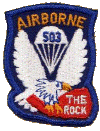 My
name is Elwood Hearne. I am 22 years old and have been ever since 1945. My
father died just before my fourth birthday so I grew up as an only child with
my widowed mother Hattie Hearne in Ridgewood, N.J.
Ridgewood
is a nice, rather affluent town of about 15,000 people, located in northern
New Jersey about 30 miles from New York City. It has a very strong
infrastructure with good schools, lots of churches and great recreational
facilities. I took advantage of all of them. I went through the entire
Ridgewood public school system and in high school I was known as El. I was a
member of the student council and was active in track, soccer, bowling and
basketball. We went 6-6 in my senior year, thanks to some heavy snow that
canceled two tough games. My church was the West Side Presbyterian Church,
just a block from where I lived. I was confirmed there in April 1936 with 30
other 8th & 9th graders. They had a great minister
and a good youth program. I was also active in the YMCA and was a Boy Scout. I
was a busy kid. When I graduated in 1940, my high school year book quotation
was “Laugh and be well” and that’s pretty much how I looked at things.
After
high school I decided to go to Rutgers University in New Brunswick because it
was far enough away from home for me to be independent but still it was only
an hour from my mother in Ridgewood. My nickname was now and forever after
would be Woody. I was an oarsman on the Rutgers crew and joined Delta Kappa
Epsilon. Greek life was fun and I had lots of friends – Neuman, Everett,
MacFarlan, Bill Van Nuis, Jack Herrick, Frankie Travisano, Chick Hatch. We
called ourselves the Golden Saber - and we had lots of parties. I kept my
fraternity pin with me until I died. But it wouldn’t be long before the
parties were over and we were spread all over the world. In 1942 we all
registered for the draft. I signed up at Local Board No. 3 at the Beech Street
School in Ridgewood.
My grades were pretty good, too. I did most of my studying in the Deke house
and in 1942 my 3.3 GPA earned me a partial scholarship from the State of New
Jersey. I spent three years at Rutgers until, like many other young men at
that time, my number came up and I got called to war so that in the future we
could all “laugh and be well”, could be boy scouts and oarsmen. I left for
the Army on February 3, 1943 fully intending to return to Rutgers to get my
degree.
After
basic training, I was assigned to anti-aircraft artillery training at Camp
Stewart, Hinesville, Ga. in August 1943. Military life was good for me because
I lost 20 pounds. But I could still party! To the hilt! I got lucky and was
asked to escort a prisoner to Fort Jay in New York which gave me the chance to
spend a day at home with my mother. Then I was assigned to The Citadel in
Charleston, S.C. in September 1943 for the Army’s Special Training Program (ASTP).
I got home for the first week of January and went back to Charleston to finish
up. We were so good they broke the mold and ASTP was disbanded on March 28,
1944. Actually, the Army was preparing for the invasion of Europe and realized
that they needed riflemen instead of egg-heads. Some of the guys were accepted
for medical training; I was off to the 100th Division, 397th Infantry, an
anti-tank company at Fort Bragg, Fayetteville, N.C. I was awarded a medal for
good conduct and made Sergeant but I lost a stripe when I decided to become a
paratrooper. Then I picked up a special medal as an expert infantryman. So it
was off to Fort Benning in Columbus, Ga. in September 1944 as a member of Co.
B, 541st Parachute Infantry. That’s where I got my paratrooper’s wings on
October 7. It was also there that I met many of the men with whom I would go
to war, including Chuck Stribling with whom I spent the rest of my life. All
this time, I was very grateful to receive regular Rutgers Undergraduates On Leave newsletters and my church’s Service
Supplement newsletters, bringing news from home that I read with
enthusiasm.
After
a 10 day furlough in early November, I got a troop train ride all the way
across America. Christmas 1944 found me doing my final training at Fort Ord in
Monterey, California, a Port of Mobilization. We then went to Camp Stoneman in
Pittsburg, Cal. and from there by ferryboat down the river to San Francisco. I
went overseas in the middle of March 1945 on the troop ship USS General Hayes
to New Guinea and then on to Leyte in the Philippines. After being on a ship
crossing the Pacific and being herded around the replacement depots, I was one
of 27 new guys that arrived on March 24, 1945 at San José Mindoro,
Philippines to replace losses suffered during the February 16th parachute
assault on Corregidor Island. I ended up on the island of Negros with Company
D of the 503rd Parachute Infantry.
I
was proud of my unit. The 503rd Parachute Battalion was activated at Fort
Benning, Georgia on August 21, 1941 and was the third of four Parachute
Battalions formed prior to World War II. The 503rd Parachute Battalion was the
foundation on which the 503d Parachute Infantry was formed. During more than
three years service in the Southwest Pacific, the 503rd served in five major
combat operations.
The
first was Markham Valley, New Guinea where, on September 5, 1943, they
performed the first successful Airborne Combat Jump andforced the Japanese to
evacuate the major base at Lae and take a retreat route that proved to be
disastrous for them.
Next,
two rifle Battalions of the 503rd Regiment jumped on the Island of Noemfoor
off the coast of Dutch New Guinea early in July 1944, followed by an
amphibious landing by another rifle Battalion a few days later. The Regiment
helped eliminate the Japanese garrison on that Island. Airfields constructed
on Noemfoor after its capture played a significant role in supporting the
advance of Allied troops from New Guinea to the Philippines.
Then,
following a non-combat landing on the Island of Leyte in the Philippines, the
503rd made an amphibious landing on the Island of Mindoro on December 15,
1944.
The
Combat Team jumped on Corregidor on February 16, 1945 to liberate that Island
from Japanese forces in the most vicious action that the combat team had ever
engaged in. Corregidor had withstood a fierce Japanese siege for almost five
months in 1941 and 1942, thereby interrupting the Japanese advance toward
Australia. The 503rd recaptured the Island. Of the estimated 6,550 Japanese on
the Island when the 503rd landed, only 50 survived. The 503rd lost 169 men
killed and many wounded or injured. The 503rd was awarded the Presidential
Unit Citation for its actions.
Finally,
almost immediately after returning to Mindoro from Corregidor, the combat team
was called upon to bolster the 40th Division that was bogged down on the
Island of Negros, in the Central Philippines. This was where I came in. But
our targets, a strategic bridge and a large lumber mill, had been destroyed by
Japanese forces, thereby eliminating our first objectives. We engaged in
fierce battles against frantic Japanese resistance in the mountainous areas of
Negros for more than five months. The 40th U.S. Division was moved to Minanao,
leaving the 503rd to fight the Japanese alone. It is estimated the 503rd
killed over 10,000 Japanese troops during its combat operations in the
Southwest Pacific. But we also lost a lot of good men.
My
parachute rifle company had 6 officers and 137 men. We did not have exactly
the same organization as other parachute infantry regiments. It was slightly
altered by MacArthur's headquarters. Each company had four platoons, three
rifle platoons and a 60mm mortar platoon. A lieutenant led each platoon and
the rifle platoons each had three rifle squads. The rifle squad had a staff
sergeant squad leader, a sergeant assistant squad leader, one rifle man
designated as first scout armed with a sub machine gun, a BAR (Browning
Automatic Rifle) man armed with the BAR and a .45 caliber pistol, an assistant
BAR man, and six riflemen. I was a BAR man. Most everybody who knew me called
me "Woody".
Chuck
Stribling was my assistant BAR man. As sharp shooters we were the first ones
the enemy wanted to take out. We were told “Don't look conspicuous: it draws
fire.” Generally, all the other men were armed with a .30 caliber M1 rifle
and had the rank of PFC or PVT. The BAR team is supposed to lay down a base of
fire, while the rifle team maneuvers to eliminate the enemy. All of us were
volunteers. All of us were dirty. All of us were hungry. Even creamed celery
would have looked good then.
Ironically, after many months of paratrooper training and anticipation, my
jump on to Negros was canceled and we arrived by landing craft at the
provincial port of Pulupandan on April 8. Three days later, the 2nd Battalion
was ordered to attack a heavily fortified defensive position in the rolling
open plain leading to the mountains that ran down the center of the island.
The enemy had a series of carefully prepared positions on the treeless ridges
of Tokaido Road that had once been a narrow gauge rail line serving sugar
plantations. It seemed like the battle raged over a large area but it actually
was confined to a small group of forested ridges at the very base of massive
mountain peaks at the end of Tokaido Road.
Trooper
John Reynolds said April 20, 1945 was a day he would never forget. At about
13:30, the 1st Platoon secured one hill and advanced to the next hill on the
right front. The Japanese were stubbornly defending each hill. They were dug
in in well-prepared defensive positions and had a variety of automatic
weapons. They constructed inter-locking fields of fire, making it nearly
impossible to flank their positions. Surprisingly, only mild resistance was
encountered on the assault, but as soon as the hill was secured the enemy
countered with very heavy machine gun and small arms fire from the front with
both flanks supplemented by accurate mortar fire. One by one, enemy fire
killed two men and slightly wounded another, including the first of our group
of replacements assigned to "D" Co. A few minutes later, another man
was slightly wounded by mortar fragments. Shortly thereafter, an enemy sniper
killed the Lt. in command of the attached MG platoon. About half an hour later
the 2nd Platoon joined the lst; one squad aided in securing the ridge and the
other two squads acted as litter bearers.
I
had become very close friends with Chuck Stribling. He agreed that the night
of April 20 to the morning of April 21 was one he would never forget. He calls
it the longest night he had ever endured. We had dug in on top of the ridge
and the Japanese were shouting in perfect English “Americans, you will all
be dead by morning” and “we will kill you all”. We wondered if the
Japanese knew something that we didn’t. We threw grenades at the sound of
the Japanese creeping into our positions, exchanged fire with them and it was
then that Stribling asked God to help him through the night. We had been told
that the enemy invariably attacks on one of two occasions: When you're ready
for them or when you're not ready for them. It was on this ridge at about 4:00
a.m. that several enemy came charging into our positions with a machine gun
spraying fire, killing two of our buddies. The position they hit had
originally been one of their own gun positions so they knew its lie exactly.
Reynolds
feels his basic training saved him. He was constantly told that the ground was
his friend. At the beginning of the mortar attack he was lying on his back but
wanted to move to a more covered position. He knew from his training that to
get on his feet was to invite certain death. He could hear the
"cough" of those knee mortars as they left the tubes just a short
distance away and could see them as they arched over towards his position on
the hillside. When Reynolds could not watch any more, he rolled over on his
stomach, face down against the ground and thought "I’m going to get
killed on my mother’s birthday." He was not of course, but his life and
approach to life were never the same after this experience. Stribling learned
to recognize the sound of the knee mortars too and managed to avoid them but
was deafened for a time by their explosion.
The
prolonged, bloody attack lasted for two and a half rainy weeks. On April 28th,
at 12:45, we advanced through F Company's perimeter to secure a ridge junction
800 yards to the front. There was very little artillery support so the attack
on the Japanese was limited to mortar and machine gun fire for support with an
occasional air strike by Army A-20 attack bombers or Marine or Navy aircraft.
The 2nd platoon moved up the ridge on the right. The 1st platoon was on the
ridge to the left. We were slightly to the rear on the right ridge in the
intervening valley. As the 2nd platoon advanced, they received intensive small
arms fire from both flanks. Small arms fire from my platoon neutralized the
enemy fire from the left and 60mm mortars silenced the fire on the right. In
the advance, one soldier was killed and another wounded in the wrist and leg,
both by enemy snipers. When the 1st platoon was stopped by small arms fire, a
heavy concentration of enemy mortar fire wounded the Lt. in the legs, one
soldier in the hip, another in the arms and foot and another in the back. The
Lt. was wounded again in the neck by rifle fire and another soldier was hit in
the legs. Several men lay alongside the trail, wounded and bleeding and being
cared for by medics. We moved over to the 1st platoon's position, incorporated
the remainder of the 1st platoon as a squad and, with the aid of Company E of
the 2nd platoon, overran the Japanese positions. It felt like things were
spinning out of control. To the hilt!
 We
then continued along the valley to the ridge junction to relieve pressure on
the left flank of the 2nd platoon that again had come under intensive enemy
fire. As we assaulted enemy positions on the forward slope of the junction,
enemy hand grenades slightly wounded two more soldiers. Chaos! “The quick
and the dead”.
A
SGT of the attacked machine guns was wounded in the hand by rifle fire. We had
gained control of the ridge junction overlooking the Tokaido Road and gave
fire support to the 2nd platoon, which had come under heavy fire. Stribling
and I advanced to the edge of the road. I was firing my BAR down the road to
support the 2nd platoon and was crouched on the edge of the road while
Stribling lay at my feet, passing ammunition up to me as I would empty one
clip after another at enemy positions. When in doubt
empty the magazine. My weapon was hot from continual rapid firing and,
as often happened with BARs, it jammed. Damn! Someone once told me to always
remember your weapon was made by the lowest contract.
As I crouched to clear the
weapon, I felt a sharp, burning thud in my head. I was killed instantly. At
least I got a lot of them before they got me. My body was pulled from the road
immediately and taken to the rear of the position. Stribling took my BAR and
smashed it to pieces so that nobody else would be tempted to use it. There was
no longer a BAR man in the squad. My minister taught me to believe in life
after death. I just wish I could have laughed and been well a bit longer.

Elwood
Hearne was awarded the Combat Infantryman Badge, Bronze Star and the Purple
Heart. He was buried in the U.S. Armed Forces Cemetery Bacolod No. 1 on Negros
Occidental and 9 months later in the U.S. Armed Forces Cemetery in Leyte near
Palo in the Philippines. His mother had his body repatriated on the U. S. A.
Transport Dalton Victory and buried in the family plot at Valleau Cemetery in
Ridgewood on September 25, 1948. Mrs. Hearne, now twice widowed, had nobody
left. A brave woman, she agreed to unveil the memorial when the Phi Chi
chapter of Delta Kappa Epsilon at Rutgers dedicated a plaque to her son - and
13 other fraternity brothers - who died in the war.
About
the Author:
-
Christopher Stout began researching members of the congregation of
the West Side Presbyterian Church in Ridgewood, N.J. who died in
service. In his day job, he is a senior executive of a
multinational Bank.
|
Sources:
|
-
Rutgers University Archives;
-
Rutgers University Class of 1944 Military History Book;
-
Crandon Clark, Rutgers ’44;
-
Charles Stribling Company D 503rd Parachute Infantry – eye
witness;
-
Tony N. Sierra Company D 503rd Parachute Infantry;
-
The Drop Zone Virtual
Museum
-
Department of the Army U.S. Total Army Personnel Command.
|
-
Order of Battle – U.S. Army
World War II. Shelby L. Stanton, Presidio Press;
-
West Side Presbyterian Church, Ridgewood, N.J - Sunday Bulletins,
the West Side Sun (Newsletter)
and its “Service Supplement” ;
-
Phyllis Smith, Jim McGilvray, Harriett Modemann - West Side
Presbyterian Church historians;
-
Ridgewood High School Arrow;
-
Ridgewood Public Library - the microfilm of the Ridgewood
Herald and the Sunday News
|
Copyright
2000 Christopher C. Stout
