| by Dr. Mike Thomas | Copyright 2000 |
|---|
 |
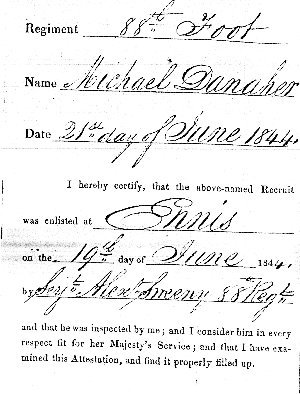
Articles of militaria, particularly those made of metal, seem to survive the passage of time fairly well. After much neglect such items can generally be restored to an acceptable condition. Under the same circumstances paper documents might not be expected to last so well in private hands. All the more remarkable therefore is a series of documents which came to light recently, having languished for the past 130 years or so in the bottoms of drawers and cupboards, and throughout several house moves. Although somewhat the worse for wear, they are still readable and provide a fascinating insight into the life of an Army private during the early part of the 19th century. The documents are concerned with the Army service of my Wife's Great-grandfather on her mother's side, before and during the period of the Crimean War. As additional corroborative material, I have also managed to obtain photocopies of his original Army Records held at the Public Record Office. These also provide additional detail not mentioned in the original material. The Army Records show that Michael Danaher, born in Croom in the parish of Croom in Countv Limerick, enlisted in the Army in the 88th Regiment of Foot (The Connaught Rangers) on the 19th of June, 1844 at Ennis in County Clare. At the time he was aged 17 years and 6 months; was five feet 7� inches in height with a fresh complexion, brown eyes and sandy hair. This sandy hair seems to be a feature of the family, as our niece (Michael's great-great-granddaughter) has the same ginger coloured hair! On enlistment, he was paid a bounty of �4. Presumably at this time he was illiterate, since his attestation carries 'his mark' as his signature, his name being written in the same hand as the magistrates clerk. 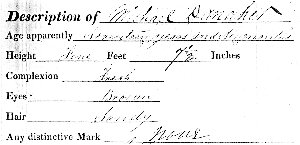 At this time Ireland was a desperately poor place. Families tended to be large and, during the 1830s and 1840s, there was a population explosion in rural Ireland because of the intense cultivation of the potato (yielding two crops per year) which required a great deal of manual labour (Michael's attestation states that his trade was labourer'). The potato crop itself provided sustenance for these numbers. Most rural Irishmen were tenant farmers, working a few acres of land. Michael Danaher was lucky because the second potato crop of 1845 failed due to a fungus infection, giving rise to the infamous Irish Potato Famine from which tens of thousands of his countrymen perished. The first of the documents we have is in Michael's own hand. In it he gives a detailed account of his Army service from his enlistment to his discharge from wounds received in 1856. This letter, dated 1888, is actually a draft. By this time he had become a dockyard policeman (we also have his police badge, made of cloth and worn on the arm or breast) in Newport Docks, Monmouthshire. The purpose of the letter is to apply for a pension to which he believes he is entitled. He mentions that he served in Malta and Halifax, in one of named garrisons as a Barrack Policeman, and that he sailed with the Regiment to the Crimea, participating in the relief of 'Silistra' (actually Silistria) and the battles of Alma, Inkerman and Sebastopol. It was at the last of these that he received a grape-shot wound in the upper left arm during the (abortive) attack on the Redan fortification, as well as another more minor wound in the thigh. This document is reproduced in full below, preserving the original spelling and punctuation. Newport. October 15th, 1888
The contents of this letter are substantiated by the Army Records. Thus, the medical report shows that he was "Rendered unfit for further service from the loss of left arm near the shoulder joint by amputation, after grape shot wound above the elbow. Also a gun shot wound through outer part of right thigh... Both wounds received on 8th Sept." According to the same hospital report, Michael had recovered sufficiently to be discharged after 40 days treatment! The Regimental Board document concerning the cause of discharge of "No.1852 Private Michael Danaher" shows that he served for 13 months in Malta, nearly 3� years in the West Indies and a further 13 months in North America.  The next document that we have is his Army Discharge certificate, written on parchment. This has been damaged by a large black ink stain which was acquired many years ago. On the bottom of the document in the space reserved for slating the conduct of the soldier, is written the single laconic comment "Good" - not much after over 11 years service to the Crown! Interestingly enough, Michael's record of service shows that he was awarded a Good Conduct Badge on 28th June, 1851, but that sadly (with - tantalisingly - no reasons given) he forfeited the same on 25th August 1853! This may have happened when he was stationed in Canada, where perhaps the cold of the Canadian winter led him into taking a drop too much of the 'warming liquid'! 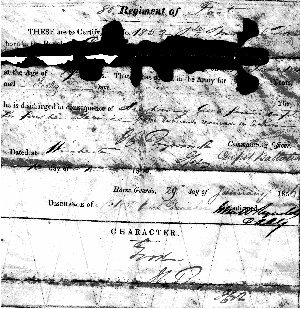 The third document is much creased and somewhat difficult to read; it has evidently spent a long time inside a wallet or some such. It purports to be a reference written by the Commanding Officer of the 88th Foot, and is reproduced below, again with the original spellings and line breaks.
Evidently this small token of his Commanding Officer's esteem was actually written in the Crimea. Colonel Shirley was himself wounded in the same attack in which Michael lost his limb, he was "severely contused in the face immediately on leaving our trenches, and had to retire". (Quoted in Cadogan's Crimea, p.254, published by Editor Books, 1979, first published under the title ‘Letters from Headquarters by a Staff Officer’ in 1856.) From the poor spelling and untidy nature of the writing one can perhaps surmise that the Colonel was still suffering from his wound. The next piece of paper, or rather card, in this little collection is an invitation to attend a reunion dinner of veterans of the Crimean War and the Indian Mutiny which was held on Saturday, 25th November, 1893 at the Park Hall, Cardiff, where the Chair was taken by the Right Honourable Lord Windsor (then the Lord Lieutenant of the County).  Finally, there are a number of documents relating to Michael Danaher’s funeral. He died in 1897, aged 71 and was buried in St. Woolos Cemetery, Newport. It cost his widow, Mary, eighteen shillings and six pence to buy the grave, and a further �5-12-6 to the undertaker to bury him in fitting style, in a coffin with all the brass trimmings and a hearse pulled by four horses; not an inconsiderable sum of money in those far off days. Mary survived him until 1919, when the cost of her funeral had risen to �17-15-0, which included the Minister’s fees! 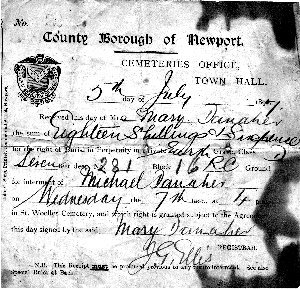 And there the story ends. Unfortunately we have no photographic record of Michael, although my late mother-in-law once told me she had a vague memory of a large photograph of him on horseback, but this evidently vanished when the house was demolished. She did remember her father (i.e. Michael's son) saying that Michael Danaher used to be seen walking down the street, swinging his one good arm and marching along as if he were still on parade. One final mystery concerns Michael's campaign medals. His Army Record makes no mention that he was ever awarded any and I have been unable so far to trace the medal roll of the 88th Regiment. It became the Connaught Rangers following the Cardwell Army reforms of 1881, and was finally disbanded along with many other fine Irish Regiments in 1922. He should have received the Crimea Medal with three clasps, namely those for the Alma, Inkerman and Sevastopol. Presumably he would also have had the Turkish Crimea Medal which was issued to British Troops. If he ever did receive the medals it is ironic that, whereas they seem to have disappeared, these flimsy pieces of paper, card and parchment have survived so well. |
|