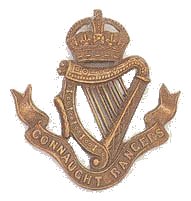
88th/94th
CONNAUGHT RANGERS
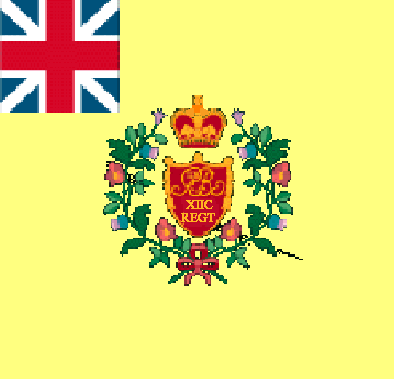
| 88th/94th | |
The year 1922 saw the foundation of the Irish Free State, later the Republic of Ireland. It also saw the disbandment of five famous regiments of the British Army that had recruited in the provinces of Leinster, Munster and Connaught, now all part of the new state. The most famous of these was the regiment sometimes affectionately known as 'The Devil's Own'; that fierce fighting regiment, the Connaught Rangers. This webpage has been created to perpetuate its memory.

|
Shona Heffernan |
Devil's Own website |
The Connaught Rangers were, from their being raised in 1793 until the Army reforms of 1881, the 88th Regiment of Foot. Under Cardwell's reforms, a 2nd battalion of the Rangers was created from the 94th Regiment of Foot, the onetime |
|
|||
|
|||
|
|||
|
|||
|
|||
|
| DATES | PLACE | BATTLE HONOUR | REMARKS |
|---|---|---|---|
| 25th Sept 1793 | . | Regiment raised as the 88th by Col de Burgh | |
| 1793-1794 | High Germany | . | Operations against the French |
| 1796 | . | Two companies only in Saint Lucia & Grenada | |
| 4 May 1799 | Col Arthur Wellesley 2nd I/C | ||
| 1801-02 | . | March made from the Red Sea to the Nile | |
| 1802-06 | . | Garrison duties 2nd Battalion raised | |
| 1806-07 | . | Garrison duties in South Africa | |
| 1808 | Buenos Aires | . | Defeat of British forces by nascent Argentine Republic in war against Spain, then allied to France |
| THE PENINSULAR WAR 1807-1814 | |||
| Sir Arthur Wellesley in Command (Later the Duke of Wellington) British & Spanish victory over the French under King Joseph | |||
| In Picton's 3rd Division of Wellington's army. Successful delaying action over the French under Massena | |||
| Defeat of French attempt under Massena to relieve Almeida | |||
| Successful assault on the frontier fortress city | |||
| Assault, capture and sack of another fortress city | |||
| Crushing defeat of the French under Marmont | |||
| Sweeping victory over Jourdan and Joseph after an outstanding flank march through the Tras os Montes | |||
| A series of manouevre battles in mountain passes | |||
| Forcing of a French frontier river line | |||
| A costly victory as Napoleon abdicates | |||
| A battle honour awarded in recognition of long and victorious service in the Peninsula | |||
| . | Unsuccessful expedition against US forces at Plattsburg in War of 1812 | ||
| THE CRIMEAN WAR 1854-1856 | |||
| Frontal assault on the Heights of the Alma. | |||
| Defeat of an Russian attempt to break the Siege of Sebastapol | |||
| Siege operations and assault; allied with the French | |||
| The Indian Mutiny | |||
| SOUTH AFRICAN WARS | |||
1877-78-79 | Zulu War | ||
| Second Boer War | |||
1899-1902 | Second Boer War | ||
| THE GREAT WAR 1914-1918 | |||
| First encounter | |||
| Desperate rearguard actions | |||
| The German advance stopped | |||
| Counter-offensive | |||
1917 | The Race for the Channel Ports A stunning victory alongside Ulstermen | ||
| Establishment of trench warfare | |||
1915 1917 | First Battle of Ypres Second Battle of Ypres: Gas Third Battle of Ypres: Slaughter in the mud | ||
| . | |||
| . | |||
| Blooding of K1 | |||
| In the Ypres Salient | |||
| . | |||
| Order, counter-order, disorder | |||
1918 | Futility militarised: July 1918 Counter-offensive | ||
| The National Volunteers(6th Batt.CR) conquer .... | |||
| .. and die. | |||
1918 | . | ||
| Forward with the Americans | |||
| Towards the Hindenberg Line | |||
| . | |||
| Peace in sight | |||
| . | |||
| In defence of Serbia | |||
| In defence of Serbia | |||
| In defence of Serbia | |||
| . | |||
| . | |||
| . | |||
| . | |||
 | To be continued | To be continued | To be continued |
| . | . |
|---|---|
on behalf of Elizabeth Longford. Copyright (C) Elizabeth Longford From 'Wellington- The Years of the Sword' |
The Battle of Busaco 27 Sep 1810: The Sierra Busaco is one of a succession of ridges that lie across the path of an invader advancing on Lisbon. Massena's army, after a difficult march, appeared to be at last confronted by Wellington's army, formidably posted on the high ridge. It was the 26th September 1810. The French Marshal expected that once again the 'leopards' would retreat and slink away to their ships. But Wellington had every intention of standing fast and inflicting an overdue defeat on the French. But he had insufficient troops to man the whole of the eight-mile length of the ridge and his anticipated line of attack of the French columns was in error for he had left a gap of nearly two miles between Picton's 3rd Division and the 5th Division of Leith, far to the right of the summit line. This gap was fortuitious for Reynier's twin attacking columns, which, as dawn was breaking, burst up out of the mist that clothed the mountainside, and began to establish themselves on the summit, attacking the flank of the British and Portuguese battalions of the 3rd Division. Elizabeth Longford tells the story of what happened next. "Wellington ordered down two more six-pounders to blast the French flanks with grape-shot and canister. Picton, splendidly eccentric in his undiscarded night-cap, personally rallied the disordered light companies and brought them back to support the brave men who, from right and left, were fighting the battle of the gap. These were the 8th Portuguese, Major Gwynne's half of the 45th and above all that great fighting regiment of Irishmen, some of whom only knew enough English to get by on parade, the 88th Connaught Rangers. Into the enemy's front the Portuguese musketeers poured their steady volleys, while Alexander Wallace, the Connaught Ranger's fiery colonel, used a modern variant of his famous ancestor's speech beforethe battle of Falkirk - I haf brocht you to the ring, hop if you can- to inspire his men for the charge. 'Now, Connaught Rangers...' he shouted, 'when I bring you face to face with those French rascals, drive them down the hill - don't give the false touch, but push home to the muzzle!' The long, sharp bayonets went home as he drove obliquely into the French column. Though there were eleven French battalions against only four Anglo-Portuguese, Merle's men were exhausted by their steep fast climb through the boulder-strewn scrub. Under Wallace's onslaught their foremost ranks toppled backwards on to those behind, until suddenly the whole mass broke and rushed headlong down the mountainside, Allies and enemy, bayonets and bodies, drummers and drums, bouncing from rock to rock pell-mell to the bottom.'Upon my honour, Wallace,' cried Wellington riding up, 'I never witnessed a more gallant chargethat that just now made by your regiment.'" The Battle of Fuentes d'O�oro 3rd-5th May 1811 The baffled Prince of Essling, Massena, eventually withdrew his starving and wretched army from the Lines of Torres Vedras in March 1811. Wellington pursued him and for some weeks there were desultory combats as Massena rested, reformed and augmented the Army of Portugal. At the end of April he felt strong enough to attempt the relief of Almeida, the northen Portuguese frontier fortress that was invested by the British. Wellington stood in his way at the border village of Fuentes de O�oro, Fountains of Honour. On 3rd May a frontal attack was bloodily repulsed by the 71st and 79th Scottish regiments. The following day, Massena, belatedly appreciating that another frontal attack against Wellington had to be supported by a flanking movement, commenced a attack against the British right on 5th May. The newly-arrived and inexperienced 7th Division was badly mauled and in extreme danger. It was saved by one of the most brilliant displays of the superiority of British infantry squares against cavalry as General 'Black Bob' Crauford's Light Division repeatedly executed drill-book movements, assisted by their own cavalry and horse-artillery, and brought both divisions back to the safetyof the British lines. The retirement of the British right encouraged Massena to again launch a frontal attack upon the town. This was again replused. Further attacks were made as the French artillery relentlessly pounded the narrow streets and alleyways of the whitewashed little town. Elizabeth Lonford describes the crucial point of this bloody struggle. "The decisive moment came at noon, when the allies had lost the village and the huge plumes of Bonaparte's Grenadiers seemed to be everywhere, even up to Wellington's command post on the plateau above. Below, piles of gory kilts showed where the flower of the Highlanders had died. All now depended upon the Connaught Rangers, those 'wild Irishmen' who had been the favourite butts at Dublin fancy-dress balls when Wellington was a boy. Pakenham had been sent by General Mackinnon to ask if the 88th, with the indomitable Wallace at their head might clear the village. Wellington gave the order and Pakenham galloped back. 'He says you may go - come on!' With ferocious yells and plunging bayonets the Irishmen charged, sweeping all before them. At last, by 2 p.m., the assaults petered out. The once picturesque Spanish village was in ruins but victory was won. Massena had fought his last battle and lost." |
RAF Expedition Leader "La Marcha Forzada a Talavera de la Reina 1985" | A Lucky Meeting, January 1812 Wellington's successes in the Peninsular War were based upon an early appreciation of the necessity of securing supplies for his army. As he himself observed "In Spain, a small army gets beaten while a large army starves". His supply lines stretched back to English ports across seas in which the Royal Navy was ascendant. Wellington also was aware that keeping the good-will of the population was critical. For that reason he issued stern orders that sought to curb his soldiers' propensity to pillaging the countryside. These orders were rigidly enforced. Many a marauding soldier, caught in the act, was subjected to a swift drum-head court martial followed by a short one-sided meeting with the Hanging Provost. However, on one occasion, a lucky member of the 88th Connaught Rangers, the Devil's Own, got away with it. It was on the march following the successful siege of Ciudad Rodrigo. Wellington,accompanied only by an aide-de-camp, was hurrying to catch up with the advance guard provided by Picton's 3rd Division. Unexpectedly, a figure of a lone infantryman with yellow tunic facings, emerged from the cork trees that grow profusely in Extremadura and re-joined the line of march a few hundred yards ahead. The soldier did not hear the approach of the two horsemen, possibly due the the squealing of the ginger-haired pig that he was clutching under one arm. The stentorian voice of the Duke suddenly addressed him. "You, sirrah! Where did you get that pig?" Half turning ,this bold son of Erin, struggling to keep the pig under control, gazed up at the horseman, who was wearing his customary unadorned blue civilian frock-coat. "Over dare, sor!" he said, in a rich Galway brogue, nodding towards the cork trees, "over de hill." Then he urgently added,"But you'd bether be quick. Dare nearly all gone!" Wellington was very much aware of the part the 88th had played in the bloody assault at Ciudad Rodrigo and he and his aide were much amused at the reply of the naive Ranger. No hanging took place. History does not tell us if the pig ended up as chops in a Ranger's skillet, became carr� de porc in an officers' mess, or was set free to join its ginger-haired brethern roaming the cork groves of Extremadura.. |
Reproduced with permission from Kosturino 1915 | The Battle of Kosturino, 10th November 1915On 6th October 1915, Austrian and German armies resumed their offensive against the Serbs. Forcing a crossing of the Danube coupled with a flanking attack across the Drina, they drove the Serbs southwards. As Serbian resistance, assisted by the weather, was slowing the Central Powers' advance, two Bulgarian armies struck westwards into southern Serbia. The Entente Powers hurriedly diverted troops from Gallipoli to Salonika where there was a rail link up the narrow valley of the Vardar to Serbia. Elements of three French Divisions (57th, 122nd, 156th) and the British 10th(Irish) Division advanced up the Vardar. However, the troops were in poor condition with inadequate supply lines. The Bulgarian 2nd Army closed the gap. After heavy fighting in the Vardar-Crna Loop the Entente divisions withdrew towards the Greek border. On 10th November the 10th(Irish) Division, commanded by Brigadier General Nicol, was ordered to hold the right flank at Kosturino, a small village in rocky, almost trackless country broken up by steep hills and ridges. The troops had little protection from the frost and high winds; some were without greatcoats. Nearly 1700 men had had to be evacuated to Salonika. By 3 December the weather improved and Nicol received some replacements from the newly arrived 20th Division. His most critical shortage was the lack of mountain artillery and howitzers for dropping shells into the ravines. The Kosturino Ridge was held by 30 Brigade (L-Col Cox); 7/R.Munster Fusiliers on the left, 5/Connaught Rangers in the centre and 10/Hampshire on the right. 7/R.Dublin Fusiliers, less one company which linked up with the French on the left, were in reserve. To the right of the ridge was 31 Brigade (B-Gen King-King) with one company of 5/R.Irish Fusiliers in an outpostposition known as 'Rocky Peak'. By December the Bulgarian 2nd Army (Gen.Todorov) had 10 Brigades totaling 80 battalions on the ground. Opposite Kosturino were 3 brigades of the 2nd Division (24 btns.). The attack on the ridge was allocated to the 14th, 28th and 44th Regiments (6 btns.) with divisional artillery support. At 2.30pm a heavy bombardment preceded a limited attack on the Connaughts which was halted 60 yards from the wire. An attack on Rocky Peak was partially successful before being driven out with the bayonet. At dusk Rocky Peak was reinforced. Just before dawn the Bulgarians attacked Rocky Peak in dense fog and evicted the defenders at bayonet point. Several machine guns were sighted on the Peak giving fire support, together with a mountain battery, to a mass attack by the 14th and 28th Regiments on the Connaught Rangers. This attack was driven off with rapid fire. At 2pm an attack by the 48th Regiment on the Hampshires resulted in a breach of the line and companies on the right fell back to the second line of defence at Crete Simonet. With their right flank partially exposed the Connaughts faced a further determined attack. After fierce hand to hand fighting they were overwhelmed. The Munsters on the left were under less pressure and they retired when the Bulgarians occupied the Connaught Rangers' trenches. The divisional reserve, 6&7/R.Dublin Fusiliers, moved up to Crete Simonet and with 31 Brigade straightening the line, a new position was consolidated. The French ordered two battalions and a mountain battery to support. The withdrawal was aided by a less than vigorous Bulgarian pursuit, presumably due to their casualties in taking the ridge. Pinning attacks on Crete Simonet masked a move around the right flank of 31 Brigade resulting in a general British withdrawal. The Bulgarians did not immediately pursue and this time aided by the fog British and French units engaged in a fighting retreat to Lake Dojran. There were curious sequels to the story of Kosturino. After the war, when a British representative proceeded by aeroplane to Sofia, one of the first questions King Boris asked was about the 5th Battalion, The Connaught Rangers. Another testimony from a gallant enemy to the stand made by the Rangers was made when a Bulgarian officer, who came to London after the war, declared that when the men of his regiment were ordered to bury the dead and mark the graves of the fallen,they declared that they would prefer first to decorate the graves of the gallant regiment, 5th Battalion Connaught Rangers, that had stood for so long and bravely barred the way. |
Copyright permission sought for this article reproduced in "The Ranger" in 1946 |
|
Dr Mike Thomas has provided fascinating details of the career of Michael Danaher, a relation, who served in the 88th Foot from 1844 to 1856. The details are based on the many documents relating to this Crimean war veteran that have remarkably survived. Mike has carried out much detailed research on Private Danaher. Read his findings by using the link. |
The story of Private Michael Danaher of the 88th Regiment of Foot 1844-1856. A Irish soldier of Queen Victoria |
Peter Hunt provided the interesting obituary that you can access through the link on the right. Joe Ryan was then able to illuminate the career of this famous member of the 88th, a veteran of campaigns in India and the Crimea. |
died 1860: Obituary from Hampshire Gazette from Quartermaster-Serjeant 31st Foot 21 May 1852; Asst. Quartermaster Prov. Depot Bn. 14th December 1855; Appointed Quartermaster 15th April 1856. Served with the 31st Regiment(East Surrey) in the First Afghan War 1842 (Cabul-medal) and First Sikh War and Second Sikh War (Sutlej Campaigns); medal and two clasps. Served with the 88th in the Crimean War 1854-5, present at the
Battle of the Alma, when he volunteered to be a subatlern in one of the
centre companies and was wounded. Awarded:
Apparently, he was the ideal "scrounger" and always came back with goods that were unobtainable to anyone but him! One GOOD Quartermaster! |
| . | . | . | . | . |
|---|---|---|---|---|
| TEST | TEST | 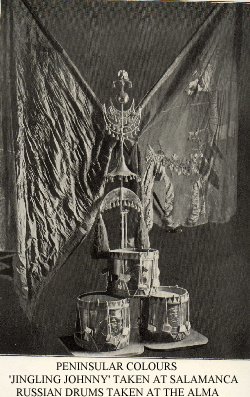 | TEST | TEST |
| . | . |
|---|---|
Irish poet |
The Connaught Rangers I saw the Connaught Rangers when they were passing by, A last look at old Ireland, a last good-bye maybe, Three years have passed since that spring day, sad years for them and me. |
Mutiny in 1920 by members of the 1st Battalion Connaught Rangers stationed in India, far from a homeland tortured by the pangs of the rebirth of their nation |
The Connaught Rangers To the tiny homesteads of the West And the drums they were a beating time While serving in a far off land And the Colonel stood before his troops Those men got penal servitude |
THE CONNAGHT RANGERS In our army we're the best Chorus Now allow me here to state, Chorus T'was Bonaparte who said as the Frenchmen on he led Chorus Now you haven't far to search, for the lads who best can march Chorus |
|
| Mine Enemy Mine enemy, mine enemy! Why lie so still? Hear you not the angry drone Of speeding shell? The rifle splutter, the weeping moan, The stricken yell? In the hush of the silence now Hear you the tears From out mine eyes ashamed to start, Burst through the vessels of my heart And drench my soul? You heed me not but I weep for the thee Mine enemy, mine enemy! Mine enemy, mine enemy! The crescent moon, your nations sign Now lighting up our battle line And flinging shadows o'er the dead, Whilst slashing hail of whistling death Sweeps overhead I'm weary mine enemy, I see as in a dream A broad leaf palm, a silvered stream, Sitting by the running water, Weeping there an eastern daughter, I weep with her, in sympathy, Mine enemy, mine enemy! Mine enemy, mine enemy! Reproach me not, I know not why it is That I should live and you should die, For surely, He who gave us breath Tis he controls both life and death Farewell! When Gabriel's bugle tone Sounds to parade the quick and slain Farewell! Tis then we'll meet again Before the Judgement Throne Farewell! Farewell! I'll pray for thee Mine enemy, mine enemy! |
|
| Regimental March: Brian Boru 1st Battalion (88th Foot) The Connaught Rangers Quick March: St Patrick's Day Slow March/Troop: ???? 2nd Battalion (94th Foot: The Scotch Brigade) The Connaught Rangers Quick Marches: 1. Blue Bonnets Over the Border Slow March/Troop: 1. The Maid of Athens 2. The Irish Emigrant |
| . | . |
|---|---|
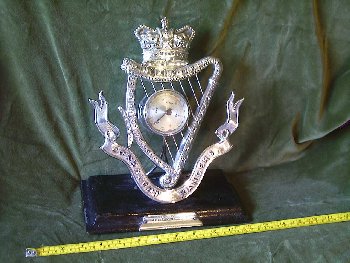
Lucy Laird. This silver harp was presented to her husband's grandfather, Major W W Roche, when the regiment was disbanded. The harp originally carried a clock but this has been replaced by a barometer. The inscription reads: PRESENTED TO THE OFFICERS 1st BATTN. THE CONNAUGHT RANGERS BY COLONEL LIONEL BROOKE C.B. 1880 - 1901 Netscape users can obtain a larger image by clicking the Right mouse-button to obtain 'View Image' |
 |