USS Twining |
||
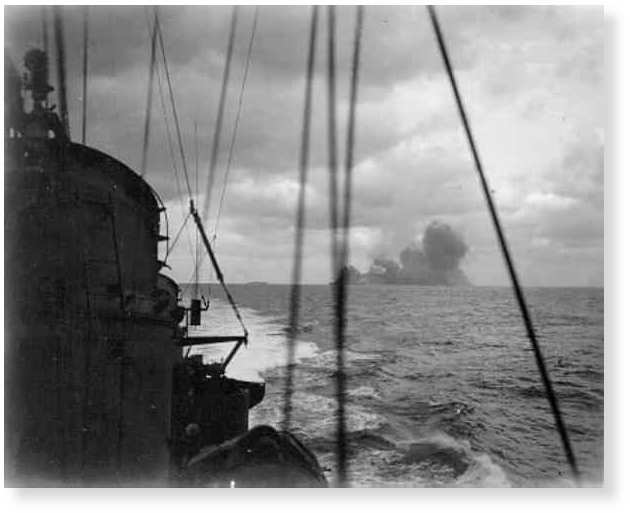
Our special thanks to Pete Clinch, son of Ensign Bob Clinch, for contributing these photos of the USS Twining DD540.
FROM TWINING HISTORY FILE In mid-March, Task Force 58 departed Ulithi to conduct strikes on the airfields near Kyushu on the 18th. The next day, as the group was en route to Kobe, carrier Franklin (CV-13) suffered extensive damage when hit by two bombs. Twining helped to protect the damaged vessel as she withdrew. On the 20th, a Japanese plane attempted to finish off the battered carrier only to be chased off by a hail of fire from the escorting ships. On the 22d, having safely conducted Franklin out of danger, Twining set her course for Nansei Shoto. On 27 March, Twining screened destroyer Murray (DD-676) Which had taken an aerial torpedo through her bow above the water until that ship had completed temporary repairs. The next day, Twining headed north in search of the Japanese fleet, then returned to Okinawan waters on the 31st, and resumed duty as a picket for carrier operations. ======================================================= FROM THE FRANKLIN HISTORY FILE Before dawn on 19 March 1945 Franklin who had maneuvered closer to the Japanese mainland than had any other U.S. carrier during the war, launched a fighter sweep against Honshu and later a strike against shipping in Kobe Harbor. Suddenly, a single enemy plane pierced the cloud cover and made a low level run on the gallant ship to drop two semi-armor piercing bombs. One struck the flight deck centerline, penetrating to the hangar deck, effecting destruction and igniting fires through the second and third decks, and knocking out the combat information center and airplot. The second hit aft, tearing through two decks and fanning fires which triggered ammunition, bombs and rockets. Franklin, within 50 miles of the Japanese mainland, lay dead in the water, took a 13° starboard list, lost all radio communications, and broiled under the heat from enveloping fires. Many of the crew were blown overboard, driven off by fire, killed or wounded, but the 106 officers and 604 enlisted who voluntarily remained saved their ship through sheer valor and tenacity. The casualties totaled 724 killed and 265 wounded, and would have far exceeded this number except for the heroic work of many survivors. Among these were Medal of Honor winners, Lieutenant Commander Joseph T. O’Callahan, S. J., USNR, the ship’s chaplain, who administered the last rites organized and directed firefighting and rescue parties and led men below to wet down magazines that threatened to explode, and Lieutenant (junior grade) Donald Gary who discovered 300 men trapped in a blackened mess compartment, and finding an exit returned repeatedly to lead groups to safety. Santa Fe (CL-60) similarly rendered vital assistance in rescuing crewmen from the sea and closing Franklin to take off the numerous wounded. Franklin was taken in tow by Pittsburgh until she managed to churn up speed to 14 knots and proceed to Pearl Harbor where a cleanup job permitted her to sail under her own power to Brooklyn, N.Y., arriving on 28 April. Following the end of the war, Franklin was opened to the public for Navy Day celebrations and on 17 February 1947 was placed out of commission at Bayonne, N.J. On 15 May 1969 she was reclassified AVT 8. |