
Tractor-factory at Stalingrad.

Stalingrad was a large industrial city producing
armaments and tractors, it stretched
for 30 miles along the banks of the Volga River.
Tractor-factory at Stalingrad.
Army Group B consisted of 6th Army, under Paulus
( 2 panzer, 1 motorised infantry
and 15 infantry divisions ) and Group von Weichs,
under von Weichs ( 1 motorised
infantry, 4 German and 2 Hungarian infantry divisions
), 2nd Hungarian Army, under
Jany ( 4 Hungarian infantry divisions ) and 4th
Panzer Army, under Hoth. (3 panzer,
2 motorised infantry and 6 infantry divisions
).
Part of directive #45 :
"The task of Army Group B is, as previously
laid down, to develop the Don defenses
and, by a thrust forward to Stalingrad, to
smash the enemy forces concentrated
there, to occupy the town, and to block the
land communications between the Don
and the Volga, as well as the Don itself.
Closely connected with this, fast-moving
forces will advance along the Volga with the
task of thrusting through to Astrakhan
and blocking the main course of the Volga
in the same way.
These operations by Army Group B will be known by the cover name "Heron"."
6th Army faces 4 Russian armies, 21th, 62nd, 63th
and 64that the Russian bridgehead
across the Don at Kalach. Also the first and
the 4th Russian Panzer Army. The 4th
Panzer Army are ready to encircle XIVth German
Panzer Corps. Fifty-first Army corps
of General Von Seydlitz-Kurzbach is in a dangerous
position. It is short of ammunition
and fuel. Infact the complete 6th Army is short
of munition and fuel. Because Hitler
divided Army Group South in two smaller armies
and these two smaller armies are
marching away from each other, the supply-lines
are too long. Also the organisation
of the supply-lines needs too much time. The
Germans are losing valuble time in their
race to the Volga.(Stalingrad) Hitler's adjudant,
Major Engel, is visiting Weichs
and Paulus. They both explain that 6th Army is
too weak for jobs assigned to them.
They are not able to withstand strong counterattacks.
As Jodl said and as Halder said six days before,
Hitler takes away 4th Panzer Army
from the Caucasusfront to Army Group B. He's
ordering Hoth to attack the Kalachfront
at Stalingrad. Hitler now understands that 6th
Army is not strong enough to capture
the Stalingrad area.
Order of battle of the German 6th Army - 12 augustus 1942
24th Panzer Corps
16th Infantry Division
295th Infantry Division
51st Army Corps
44th Infantry Division
71st Infantry Division
11th Army Corps
100th Jaeger Division with Croatian Regiment
369
14th Panzer Corps
60th Motorized Infantry Division
16th Panzer Division
3rd Motorized Infantry Division
8th Army Corps
384th Infantry Division
305th Infantry Division
389th Infantry Division
376th Infantry Division
17th Army Corps
22nd Panzer Division
Italian "Celere" Division with Bers. Regiment
6
79th Infantry Division
113th Infantry Division
The Germans attacking to take the Don river bridge at Kalach.(Map)
By the end of August the 4th Army's northeastward
advance against the city was
converging with the eastward advance of the 6th
Army, under General Friedrich Paulus,
with 330,000 of the German Army's finest troops.
The Red Army, however, put up the
most determined resistance, yielding ground only
very slowly and at a high cost as
the 6th Army approached Stalingrad. On August
23 a German spearhead penetrated
the city's northern suburbs, and the Luftwaffe
rained incendiary bombs that destroyed
most of the city's wooden housing.
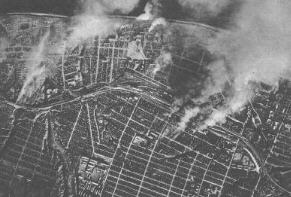
The luftwaffe is bombing Stalingrad.
The Soviet 62nd Army was pushed back into Stalingrad
proper, where, under the
command of
Vasily I. Chuikov, it made a determined stand.
 Vy
I
Vasily I.
Chuikov
Meanwhile, the Germans' concentration on Stalingrad
was increasingly draining reserves
from their flank cover, which was already strained
by having to stretch so far 400 miles
-640 km on the left (north), as far as Voronezh,
400 miles-640 km again on the right
(south), as far as the Terek River (Caucasus).

From Voronezh to the Terek River.
A 800 miles - 1280 Km frontline.
By mid-September the Germans had pushed the Soviet
forces in Stalingrad back until
the latter occupied only a nine-mile-long strip
of the city along the Volga, and this
strip was only two or three miles wide. The Soviets
had to supply their troops by
barge and boat across the Volga from the other
bank. At this point Stalingrad became
the scene of some of the fiercest and most concentrated
fighting of the war; streets,
blocks, and individual buildings were fought
over by many small units of troops and
often changed hands again and again.
ers had their
The most critical moment came on October 14,
when the Soviet defenders had their
bk so close to the Volga that the few remaining
supply crossings of the river came
under German machine-gun fire. The Germans, however,
were growing dispirited by
heavy losses, by fatigue, and by the approach
of winter.
In the factories, German troops battle through
workhalls and narrow streets. Armored
vehicles are trapped and disabled by Soviet anti-tank
guns that fire at point-blank
range from the rubble. The 6th Army is rapidly
becoming exhausted. 6th Army has
inched its way forward to the point where it
is now in control of more than 90% of
the city.
There was no compelling military reason in the
battle for the Soviet Union during
World War II why the German army should have
bothered with capturing the
Soviet city of Stalingrad. When it didn't fall
quickly, they probably should have just
guarded it and continued toward the Soviet oilfields
of Baku.
But for some reason Hitler became mesmerized by
this little town on the Volga River,
and insisted upon attack after attack upon it.
Maybe it was because the town
was named after his arch-foe, Joseph Stalin.
In any case, the Russians held on tenaciously
and the fighting was ferocious.
Hundreds of thousands were killed.
While the Germans exhausted themselves for a few
bits of worthless ground the
Russians were building a huge army on their side
of the Volga River.
On November 20, the Soviet army struck not the
Germans, but their weaker
Romanian allies on either side of the city. The
Romanians collapsed and the
Soviets surrounded the German Sixth Army.
Friedrich Paulus, the commander of 6th Army wanted
to break out of the encirclement,
but German dictator Adolf Hitler forbad
it. The air force, he said, would keep the
army supplied.
But it couldn't, and the rest of the German army
could not break back into Stalingrad
to rescue the surrounded army. The Sixth Army
starved and froze and in January
1943 it surrendered, despite Hitler's orders.
It was a great victory for the Soviet Union and
a national tragedy for Germany.
It was also the turning point on the Eastern
Front. From that point on the
Germans were generally on the defensive and the
Soviets on the offensive.
Click here for a day by day overview of the Battle for Stalingrad.