Click here to read more about : Enemy
at the Gates - the newest Stalingrad movie !
The
Red Army Snipers
Read more about the Stalingrad snipers
in my newest Stalingrad book.
Stalingrad,
behind the scenes. (with my book comes
a free poster)
"...await the right moment for one, and only one
well-aimed shot"
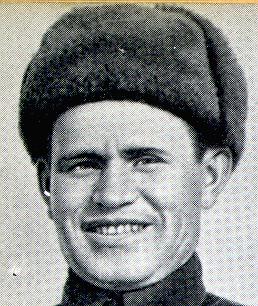
Vasiliy Zaitsev
Already Russian newspapers had made the name Vasiliy Zaitsev famous.
In but ten days' time he had killed nearly forty Germans, and correspondents
gloatingly,wrote of his amazing ability to destroy his enemies with
a single
bullet. It was a skill he had learned while shooting deer in the forests
around
Elininski, his home in the Ural Mountain foothills. A shepherd in the
summers,
Zaitsev, at the age of fifteen, went off to technical school in Magnitogorsk.
On September 20, 1942, the broad-faced Zaitsev came to Stalingrad with
the
284th Division. Now he was a national hero, and as his fame spread
across
no-man's-land, the Germans took an inordinate interest in him.
SS Colonel Heinz Thorwald
was dispatched to Stalingrad from Berlin for the express
purpose of eliminating top Soviet snipers, especially
Vassily Zaitsev, who was
being lionized in Soviet propaganda. The Soviets
were tipped off to Thorwald
mission by a prisoner. Like Zaitsev, Thorwald
first made a careful study of the
terrain and of his victims before attempting
a kill. When two Soviet snipers
were killed by single rifle shots, Zaitsev began
counter-stalking Thorwald himself.
The duel lasted for several days. During this
time Thorwald shot a
political officer named Danilov who was "covering"
the duel for Soviet
propaganda (Danilov accompanied Zaitsev and stupidly
gave away their
position). Zaitsev finally got Thorwald
by
offering another sniper, his
assistant Zulikov, as bait. Zulikov positioned
himself and lifted his
helmet over a wall, where Thorwald
put a bullet through it.
Kulikov cried out as if hit. Thorwald
made the fatal mistake of exposing
himself to confirm the kill, and Zaitsev shot
him dead.
Next lines are taken from Antony Beevor's Stalingrad,
The fateful siege : 1942 - 1943.
The telescopic sight of his prey's rifle, allegedly
Zaitsev's most treasured
trophy, is still exhibited in the Moscow armed
forces museum, but this dramatic
story remains essentially unconvincing. It is
worth noting that there is absolutely
no mention of it in any reports.*
*Indeed, the whole
story of the sniper duel is fiction. There is absolutely no trace in
the German military archives or SS records of
SS officer Heinz Thorwald.
Also there is absolutely no report of the duel
in the Red Army files which concentrated
on sniper activities (the daily reports of the
Political Department of Stalingrad Front to Moscow)
This great story can be classified as Sovjet
propaganda.
Other snipers at Stalingrad.
Vasiliy Zaitsev
W.W. II
Russia
400 kills
(149 Kills at the battle of Stalingrad, some
sources telling me he shot 232 German soldiers
at Stalingrad)
A sniper reaching forty kills would receive the
"for bravery" and the title of
"Nobel Sniper".
The highest scorer only identified as "Zikan"
killed 224 Germans by 20 November 1942.
Sergeant Passar of 21st Army was credited with
103 kills.
Kucherenko, an Ukrainian, killed 19.
An Uzbek from 169th Rifle Division killed five
Germans in three days.
Anatoly Chekov killed 17 Germans in two days
!
Corporal Studentov killed 170 Germans.
"Noble Sniper" Ilin, a commissar from a Guards
rifle regiment, was credited
with 185 kills.
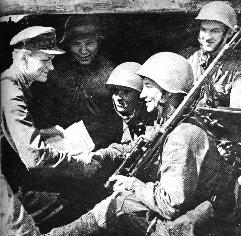
Sniper V. Kozlov, just being decorated
for his 30th kill.
The same Zaitsev - Thorwald story :
The ruins of Stalingrad were the natrual habitat of snipers, and each
army had its recognized
champions. For the Russians, Vasily Zaitsev was the onetime shepherd
who had perfected his
marksmanship hunting deer in the Ural foothills. In one ten day period,
he had killed no fewer
than 40 Germans and his fame had spread into enemy lines. The Germans
retaliated by flying
to the scene SS Colonel Heinz Thorwald, head of their snipers' school
near Berlin. Zaitsev
soon heard talk of the deadly Thorwald, and he set down a tense account
of their dual to
the death.
"The arrival of the Nazi sniper set us a new task," wrote Zaitsev. "We
had to find him, study
habits and methods, and patiently await the moment for one, and only
one, well-aimed shot."
For two days, Zaitsev stalked his rival, trying to locate his precise
whereabouts. On the third
day, Zaitsev was accompanied in his search by a political instructor
named Danilov. As the
two lay hidden, peering intently through their telescopic sights, Danilov
suddenly said: "There
he is! I'll point him out to you!" Recalled Zaitsev: "He barely, literally
for one second,
but carelessly, raised himself above the parapet, but that was enough
for the German to
hit and wound him.
"For a long time I examined the enemy positions, but could not
detect his hiding place.
To the left was a tank, out of action, and on the right was a pillbox.
Where was he?
In the tank? No, an experienced sniper would not take up position there.
In the pillbox,
perhaps? Not there, either - the embrasure was closed. Between the
tank and the pillbox,
on a stretch of level ground, lay a sheet of iron and a small pile
of broken bricks. It had
been lying there a long time and we had grown accustomed to its being
there. I put myself
in the enemy's position and thought - where better for a sniper? One
had only to make a
firing slit under the sheet of metal, and then creep up to it during
the night."
To test his theory, Zaitsev rasied a small plank with a mitten
attached to its end. A shot
rang out and a bullet smashed into the plank. "Now," wrote Zaitsev,
"came the question of
luring even a part of his head into my sights." Before that could be
done, however, Zaitsev
would have to change his own position, which had clearly been marked
by the German.
Zaitsev and a fellow sniper, Nikolai Kulikov, spent much fo the night
working their way
to a new vantage point. By dawn they were ready.
"The sun rose," Zaitsev recalled. "We had decided to spend the
morning waiting, as we
might have been given away by the sun on our telescopic sights. After
lunch our rifles
were in the shade and the sun was shining directly on the German's
position. At the
edge of the sheet of metal something was glittering: an odd bit of
glass - or telescopic
sights? Kulikov carefully, as only the most experienced can do, began
to raise his helmet.
The German fired. For a fraction of a second Kulikov rose and screamed.
The German
believed he had finally got the Soviet sniper he had been hunting for
four days,and half
raised his head from beneath the sheet of metal. That was what I had
been banking on.
"I took careful aim. The German's head fell back, and the telescopic
sights of his rifle
lay motionless, glistening in the sun until night fell." Russian sources
credited Vasily
Zaitsev with killing 144 (232 ?) Germans before the end of the battle
of Stalingrad. Then he
was blinded by a detonating land mine. |