Engineers : Missions and plans in preparation of Operation Uranus |

Engineers : Missions and plans in preparation of Operation Uranus |
If you want to see a good and clear map of Operation Uranus click here(328kb)
The mission of the main forces of the front was to break through the
enemy defense line and,
jointly with the units of the Southwestern and Don Fronts, to encircle
and destroy the German
6th Army at Stalingrad. In accordance with this, the engineer troops
of the Stalingrad Front
had to solve a number of missions involving a great deal of responsibility.
(The engineer troops of the Stalingrad Front
were commanded by Major General of Engineer
Troops I. A. Petrov.)
In the preparatory period (from November 1-19, 1942) their missions were :
to make possible an uninterrupted crossing of the troops over the Volga
river and of all the
necessary materials and technical equipment to be used in the offensive
operations.
to carry out a careful engineering reconnaissance of the forward edge
and depths of the
defenses of the enemy in the area of breakthrough
to organize the areas of the concentration of troops before the crossing,
to restore, reinforce, or construct bridges
to assist the troops in occupying the areas of concentration after the crossing
to prepare the jump-off position for the attack of the rifle troops
and artillery; to clear of
mines the area before the main line of defense
to provide a supply of water for the troops operating in the desert
steppes on the right
bank of the lower Volga.
In the period of operations (November 20-December 5, 1942) their mission
was to make
an engineering breach: to determine and prepare passageways for the
movement of the
combat formations of rifle troops, tanks, and artillery through the
main line of defense of
the enemy in the period of the attack.
to accompany the troops into the depths during the attack and to protect
reserves crossing
the Volga and make possible an uninterrupted flow of supplies for the
field forces.
Ten days preceding the beginning of the offensive the engineers worked
out a plan for the
necessary work for each army and presented it to the responsible authorities
eight days
before the beginning of the offensive. The engineer plans for the crossing
were worked
out much earlier and were turned over to the responsible authorities
20 days before
the beginning of the operation.
The plan for the engineering works of the Front called for the execution
of the following
basic measures. For crossings the plan fixed the order of movement
of the troops
armament, ammunition, and food and gave the following for the crossing
from the east
bank of the Volga River to the west bank:
| Name of the loads | In preparatory
period |
In operational
period |
Total |
| Men | 135.000 | 70.000 | 205.000 |
| Tanks | 430 | 120 | 550 |
| Motor vehicles | 10.000 | 2.500 | 12.500 |
| Guns | 500 | 200 | 700 |
| Horses | 3.000 | 1.200 | 4.200 |
| Vehicles | 4.500 | 600 | 5.100 |
| Ammo in tons | 6.000 | 6.000 | 12.000 |
| Food in tons | 4.000 | 4.000 | 8.000 |
In accordance with the established order for the movement of troops
and their operational
assigment, nine crossing sectors were fixed, three of which were basic
sectors: for the 64th
Army, Lesobaza, Shchuche, for the 57th Army, Tatianka, Svetly and for
the 51st Army,
Kenennyi Iar, Solodniki.
In view of the broad scope of the approaching crossing work and the
difficulties due to the
drifting ice and the stoppage of ice floes, the staff of the engineer
troops of the Front worked
out beforehand a plan for providing all the crossings with floating
equipment, and outlined a
number of measures for assuring normal conditions of operation.
For this purpose and in accordance with the orders of the Military Soviet
of the Front,
there were detailed from the system of departmental river organizations
of the Volga basin
59 power-driven and nonpower-driven vessels : two icebreakers with
a total of 1,600
horsepower; 25 tugboats with a total of 7,130 indicated horsepower;
three passenger boats
(560 indicated horsepower), one ferryboat (240 indicated horsepower),
and 28 nonself
propelled vessels with a load capacity of 5,100 tons.
The Department of River Steam Navigation was obliged to provide all
the vessels with full
crews, supply rigging, tackle, and spare screw propellers and organize
repair shops.
The administration of the rear of the Front was to provide these workshops
with motor
vehicle transport. From the military flotilla we planned to assign
a diver station. The
supplying of the crews of the vessels and repair shops with all kinds
of supplies was to be
a function of the military units maintaining the crossings.
In the working out of the plan of organizational measures for the crossings,
the most critical
problem was supplying the vessels with fuel. The total requirements
in fuel for the vessels
to be used were estimated at 118 tons per day, or 3,550 tons (178
2-axle tanker cars)
per month. The supplying of such a large quantity of fuel with the
shortage of motor
vehicles transport was very difficult; hence, the staff of the engineertroops
of the Front took
steps to find fuel in the immediate area. Over a period of several
days a careful investigation
was made of all sunken tanker vessels and vessels that had run aground.
As a result, we
discovered four half-submerged barges with supplies of fuel amounting
to 6,000 tons.
The vessels were assigned to these improvised "bases" for supplies.
When the ice began to drift, the supplying of the vessels with fuel
became very complicated,
because some of them failed to accomplish the trip against the current
in order to get the fuel.
On some occasions the vessels spent two days on such a trip, through
stretches with big
ice floes. In view of this, it was necessary to plan to transport the
fuel by tank trucks.
We organized several of such columns, but even these could not supply
all the fuel needed.
In the way of engineer reconnaissance, the plan called for the following :
To carry out an engineer reconnaissance in the main directions of 62
kilometers of the main
line of resistance to an average of 10 kilometers into the depth of
the enemy defenses and to
organize an this stretch 53 observation points and posts
To organize 25 engineer-reconnaissance groups and to plan joinly with
the cavalry, tanks,
and motorized units up to 25 deep raids into the rear of the enemy
for the purpose of
reconnoitering their rear lines and system of defenses.
For the covering of the areas of concentration of our troops plans were
made to provide
maine reinforcements for the nine antitank centers, to lay 15 flank
and switch mine fields,
and to reinforce all of the existing mine fields along the main line
of resistance on the sectors
where the enemy was most likely to strike.
In mine clearing, the plan provided for the making of 70 passageways
in our own mine fields
by taking up 12,500 mines of various systems and making 38 passageways
through the main
line of resistance of the enemy over a total of 22 kilometers of front.
For passage of tanks,
artillery, aid other heavy loads on the sector of the 57th Army, the
plan provided for
the construction of five bridges and 12 grade crossings over railway
lines.
On the waterless steppes where the troops of the Stalingrad Front operated,
the water
supply was a very important factor in determining the combat ability
of the troops. The left
wing and the 28th Army, in particular, were in a serious situation.
The minimum water
requiremeits of this Army on November 1, 1942, were estimated at about
2,000 cubic
meters per day. The amount supplied by all the sources on this same
date amounted to
about 600 cubic meters. To compensate for this water shortage, the
plan provided for
digging 45 new wells in the zone of the 28th and 51st Armies and the
restoration of
six old sources of water. In addition to this, plans were made for
the restoration of
wells in the towns and villages captured from the enemy.
On the whole, the plan was drawn up and presented to the troops in due
time. It took into
account all of the basic problems of providing adequate engineering
means both in the
preparatory period of the Front operations and in the period of their
execution.
The plan gave most consideration to problems of river crossings, since
they were he most
important in the operations and the most difficult to solve. The preparation
of the areas
of the crossings and distribution of the crossng equipment at them
was carried out in
accordance with the missions of the troops.
The Distribution of Forces and Means
For accomplishing this engineering plan in time, we made the proper
disposition of the
engineer forces of the Front. From the available forces, the following
were assigned 38
battalions and three independent companies. For operating the crossings
over the Volga,
nine battalions (one motorized engineer and eight pontoon), for the
work connected with
mining/engineering entanglements, eight battalions, for the work in
preparation for ice
crossing, three engineer battalions, and for defensive work, 14 engineer
battalions.
In reserve and for preparation of the personnel for participation in
the breakthrough of
enemy defenses there were left four battalions and three companies.
Of the total number
of engineer units of the Front, 15 battalions were assigned directly
to the armies for
preparatory work.
(The total forces of the front included 30 engineer
battalions as well as the divisional engineer
battalions. Other sources lists 29 battalions
and three brigades.)
At the beginning of the work of the preparatory period, the engineer
units, especially the
pontoon units, were far from being at full strength, having only 55
percent of the authorized
personnel and only 26 percent of their motor vehicle strength. The
combat engineer battalions
of the divisions were in the same situation, if not worse, as to personnel
strength and
equipment.
The pontoon bridge units of the Front did not have any of such important
engineering
equipment as electric welding sets, compressors, wood saws, and diving
gear. Without these,
the work of lifting, repairing and setting in place the crossing material
for the construction of
bridges was much slower.
Due to the losses in equipment in the preceding period, the pontoon
units did not have sufficient
equipment during preparation for the operation. The vessels detailed
from the Department of
River Transport Systems arrived very slowly. Before the beginning
of the preparatory work
for the crossings we received four self-propelled vessels out of the
31 called for in the plan
and three nonself-propelled vessels out of the 28 which we were to
have in accordance with
the plan. It was only after insistent demands of the staff of the engineer
troops that we
suceeded in obtaining ten self-propelled vessels and one nonself-propelled,
after a delay of
12 days. The motor cutters (VMK-70) made available by the Main Administration
for Military
Engineers did not arrive until after the crossing had been made.
To speed up the work, the staff of the engineer troops mobilized all
crossing cutters, lighters,
platforms, rafts, fishing boats, and pleasure boats to be found in
the area of the crossing.
Extensive use had to made of all these means for the arrangement of
ferry crossings.
In addition to this, we used armored cutlers of the Volga Flotilla
for the crossing of people,
ammunition, and food.
The conditions under which the engineer units operated, especially at
the crossings of the
Volga, were exceptionally difficult. In view of the great amount of
engineer work, it was not
possible to place engineer units in reserve for replacements and training.
All the engineer
units of the Front had to be furnished replacements in the course of
operations, while fighting
was in progress, and these consisted of unprepared or poorly prepared
personnel, the
employment of which sometimes led to serious consequences. Thus, during
the period of the
operations, in one of the armies, 21.6 percent of the total losses
of the engineer units were
due to being blown up by their own mines in the demining of a jump-off
line for ihe attack.
Work of the Engineer Units in the Preparatory Period of the Operation
Crossings
The crossings of the Volga River of troops, equipment, and ammunition,
and food, as well as
the evacuation of wounded and equipment to the rear, was done by ferrying
on barges,
pontoons, cutters, and rowboats. (The places of the crossings are given
in the map.) The
crossings in the area of Stalingrad for the 62nd Army were under direct
enemy bombardment
by artillery, mortars, and small arms.
It was impossible to prepare bases and loading points on the left bank
opposite the destination
points of the vessels. The loading of the vessels was done upstream
or downstream,
lengthening in this way the trips of the vessels, lessening the turnover,
and creating special
difficulties at the beginning of the ice floes. Thus, with the approach
of the enemy to the
banks in the area of the "Krasnyi Oktiabr" and "Barrikadi," the use
of moorings opposite the
plants became difficult. By day the enemy subjected these moorings
to intensive bombardment
and to bombing from the air, and at night he kept them under artillery
and mortar fire.
The majority of the boats destroyed were knocked out at the wharves
while loading and
unloading and while moored in the daytime. Hence, from November I the
main loading and
unloading points and bases for the crossing equipment were moved to
Verkhne Akhtuba,
making the trip from 1.3 to 25 kilometers longer. Beginning on November
11, the ice floes
obstructed the movement of vessels from Akhtuba and the base was transferred
to Tumak.
From November 11 the crossings of the 62nd Army operated along the Tumak-Krasnyi
Oktiabr
march route for a distance of 22 kilometers and Tumak-Spartakovka fur
a distance of
32 kilometers. Throughout the month the vessels operating in the crossing
of this Army were
under flank artillery-mortar and machine gun fire of the enemy. Crossing
was possible only at
night. The supplying of replacements, ammunition, rations, and forage
to one of the rifle divisions
cut off from the 62nd Army was carried out along the Denezhnoi Voizhka,
and in order to reach
it, the armored cutters first had to neutralize the enemy fire positions
on the banks. Oftentimes
the enemy released floating mines from airplanes. These between Kamennyi
lar and Solovniki
the steamer "Altai" was also sunk by a mine. At the end of November,
German aviation units
mined the main stream of the Volga at Glukoi Farmstead, and this prevented
the powerful ice
breaker tug of the type "Dzerzhinskii" from reaching the Svetlyi lar
crossing.
The greatest hindrances to crossing were the hydrometeorological conditions;
the most intense
period of work coincided with the most unfavorable season of the year.
At the beginning of
November the level of water on the Volga rose sharply; thus, from November
1-6, the water
rose to 50 centimeters and the total rise in the level of the water
from the middle of October
to November 13 was 196 to 220 centimeters.
Due to the rise in the level of the water, the trestles of the bridges
and the moorings were
flooded with water. Some of the landing places had to be raised as
many as six times
(the crossing at Tatianka). Since in the construction of the landing
places we had not planned
to raise them, this work required a great deal of time and labor. The
heavy winds which we
had in November made the mooring of vessels difficult and made impossible
the trips of
the small vessels and boats. The crossing work involved great difficulties
and, at places,
had to be interrupted.
On November 6-7 in the area of the Front, we had a rainy spell accompanied
by winds.
The waves in the river rose to 1.2 meters. On November 7, a big wave
overflowed 60
pontoons of a bridge over the Sarpinskii River. The bridge was torn
away from its anchorings
and was carried by the current to a distance of 500 to 700 meters.
This forced us to weaken
the crossings of the 64th Army, by taking from them the steamer "Mikhail
Vlasov."
The fall ice floes started November 10. The water continued to rise.
The strong winds
forced the ice first to the left side of the river and then to the
right side. Near the banks
there were formed unbroken belts of ice having a width of 100-600 meters
and moving
along slowly with the current. Under these conditions the crossing
work was very
complicated, because the small vessels were squeezed by the blocks
of ice and had to
select places that were free of ice. Crossings of small vessels were
possible only in the
daytime. The steering of the vessels, steamers, and boats required
able and well-organized
crews.
The solid belts of ice forming near the banks made it difficult for
the vessels to approach
the landing places. It took some of the vessels whole hours to make
their way to the landing
places, at times with the help of engineers who arranged passageways
by blasting the ice.
For these reasons the time required for a trip was greatly increased;
for example, the barge
"Zarnitsa," lowed by the icebreaker "Dzerzhinskii" of 800 horsepower,
made the trip in one
day with great difficulty. Oftentimes a trip required 30 to 35 hours.
There were numerous
cases in which small vessels were squeezedbetween the blocks of ice.
Such vessels were
released by stronger ones, or placed by them in a channel, the ice
broken around them by
hand and, farther away from the vessels, by means of explosive charges
or hand grenades.
The number of damaged vessels increased with the drifting of ice and
this required
additional work in repairing them.
Despite the unfavorable conditions (the drifting of ice, an insufficient
number of crossing
vessels of the ice-cutting type, a lack of pontoon units, and shelling
by artillery, mortars, and
light machine guns on the front of the 62nd Army), the engineer units
coped with the task of
preparing crossings during the preparatory period. All the units and
freight arriving in
November were crossed in time. During the period from November 1-20,
1942, the following
were crossed :
| Load Designation | To the Right Bank | To the Left Bank | Total |
| Men | 114.476 | 38.109 | 149.585 |
| Wounded | none | 10.970 | 10.970 |
| Tanks | 427 | 1 | 428 |
| Guns | 556 | 42 | 598 |
| Motor vehicles | 9.282 | 4.760 | 14.042 |
| Tractors | 136 | 51 | 187 |
| Wagons | 2.993 | 1.740 | 4.733 |
| Horses | 7.903 | 2.428 | 10.331 |
| Ammo in tons | 6.562 | 191 | 6.753 |
| Class 1 supplies | 3.760 | 190 | 3.950 |
| Other in tons | 1.696 | 432 | 2.128 |
| Livestock - large | 398 | 24 | 422 |
| Livestock - small | 5.195 | 402 | 5.597 |
(One authoritative Soviet source lists somewhat
different figures as 160,000 men; 430 tanks;
600 guns; 14,000 trucks; and 7,000 tons of ammunition.
In any event, the number is
representative of an impressive feat given German
air superiority.)
By practical work done during this period, we learned that even when
there are difficult freezing
conditions the use of standard and small crossing equipment, both towed
and that operated by
oars, is readily possible. The use of pontoons N2P or small metallic
barges towed by motor
launches proved to be very effective under these conditions.
Crossing in rowboats played a great part in supplying the 62nd Army
and the groups cut off
from it. Under the aimed fire of the enemy we crossed reinforcements,
ammunition, and food.
Large numbers of boats were used for the evacuation of the wounded.
For example, on the
night of November 28-29, 360 wounded soldiers were crossed to the left
side in boats.
After we determined the direction of the main blows of our units, we
organized in these areas
observation posts and obeservation points. We arranged a total of 75
points. On an average
on the shock sectors depending upon the importance of the sector and
the character of the
locality, we had from one to three observation posts on each kilometer
of the defense strip
of the enemy. During the period when we carried on reconnaissance in
force, the network
of observation points on these sectors was increased two- or threefold.
The greater part of the observation points were located on the forward
edge of our defenses.
Each of them consisted of a heated blindage-dugout and a rifle pit
with a cover for observation.
Twenty-three observation points were equipped with optical devices,
field glasses, and
telescopes borrowed from the artillery men and the mortar crews. To
each of these
observation points, we assigned a group of three to four engineers
under a junior officer or an
educated private, whose duty it was to direct the group and keep a
record of the observations.
Observation was conducted on a 24-hour basis. The observation data
were plotted on a map
and presented each day to the unit engineer who summarized the data,
put it on a general
map, and in his turn gave the information each day to the higher engineer
chief. On the basis
of the reconnaissance of the defense depths of the enemy from October
l-November 18, we
organized and carried out in the main directions 27 engineer reconnaissance
raids in the rear
of the enemy for the purpose of determining their system, of antilank
and antipersonnel
obstacles and for finding the nature of the rear lines.On the sector
of the 51st Army, this deep
reconnaissance was carried out jointly with the cavalrymen and tankmen.
In the area north of
Stalingrad, we organized seven engineer reconnaissance groups, which
went out under cover
of night to a distance of five kilometers into the depths of the enemy
defenses; camouflaged
themselves there in haystacks, straw, or deep shell holes; and during
the daylime carried on
observation of the engineers and other activities of the enemy. One
group consisting of three
men, under the command of Sergeant Nikolenko, was within the defenses
of the enemy for
three days, moved over a front of 11 kilometers, and made a detailed
field sketching of all
the defense systems on this sector.
After the breakthrough of the enemy defenses by our troops and the capture
of enemy
defense lines, it was possible to study in more detail on the spot
the system of engineer
obstacles and the placing of the defensive installations and to compare
them with the data of
the engineer reconnaissance. For example, in the zone of the 57th Army,
on the sector
intended for the breakthrough, the engineer scouts of one Guards Division
ascertained
correctly the location of all the minefields of the enemy. With a fair
degree of precision, the
engineers on another sector ascertained the outline of the minefields
over a stretch of 11
kilometers and the defensive installations consisting of barbed-wire
entanglements over a
stretch of 3 kilometers.
In the area of Khalkhuia, engineer reconnaissance of the 28th Army discovered
a total of
37 trenches, 32 fire positions, and 10 mortar positions. In this area,
we discovered a total of
45 defense positions out of a total of 102, which we found later in
the system of enemy
defenses. On this sector, we also discovered the location of three
minefields however,
after the capture of the area, we found four additional fields not
noticed by the scouts.
In the direction of the main blow of the 57th Army, in the area of Tundulovo
and Balka-
Tarnovaia, engineer reconnaissance obtained precise information as
to the location of 35 fire
positions for submachine guns, five earth-and-timber pillboxes, 12
mortar positions, and 28
artillery positions (of these five were concealed). We discovered 70
defense installations out
of a total of 95 that we found to exist after thecapture of the line.
In these directions, at a
depth of up to 3 kilometers, engineer reconnaissance correctly pointed
out the defenses of the
second echelon of the enemy.
Hence, in the main, engineer reconnaissance discovered the system of
German-Rumanian
defenses in the directions of the main attack, thus facilitating to
a considerable extent the
success of the breakthrough of the enemy defenses.
Among the weaknesses in the planning of engineer reconnaissance, we
should mention the
following, the absence of systematic duplication and checking of the
reconnaissance data of
the groups concerning the location of the minefields in the defense
system of the enemy,
and the failure to make use of such methods of reconnaissance as photography,
and in
certain cases, the interrogation of the prisoners.
Covering of the Areas of Concentration
From November 1-15, 1942, the Stalingrad Front carried out a regrouping
and concentration
of troops. The following arrived for reinforcement of the front: 15
rifle divisions, 11 tank
brigades, five motorized rifle and mechanized brigades, and six cavalry
regiments.
For concentrating these forces, we assigned 18 areas. In these areas,
the engineer units of the
front prepared large antitank obstacles. For example, in the zone of
the 64th Army, on the sector
of the Krasnoarmeisk-Beketovka railroad, we provided over a stretch
of 8 kilometers a special
fortification consisting of railway cars fastened together one after
the other to form a powerful
antitank barricade. In combination with minefields and natural obstacles,
this barricade provided
a reliable cover for the zone between the railroad and the Volga.
In the area of Kuporosnoe we constructed five antitank mine centers
and three antitank switch
minefields. In the zone of the 51st Army, in the area of Khargate and
Zurgan, we constructed
five antitank centers and laid eight switch minefields. On the sector
of Malye Derbetyi, Zakhar-
ovo, and Khuslin-Ziur, we constructed three antitank centers and nine
minefields in combination
with barely perceptible obstacles.
In the zone of the front, we prepared minefield coverings for a total
of 19 areas of troop
concentration. We prepared 13 antitank centers and laid 23 minefields.
We laid up to 10,000
mines of various kinds and put out more then 100 packages of barely
perceptible obstacles,
reinforced by landmines and booby traps. These measures enabled us
to carry on concentration
work without being disturbed.
For the passage of the troops from the areas of concentration to the
jump-off lines, the engineer
units of the Front carried out a great deal of work in the making of
passageways through the
engineers' mine obstacles. On the front, in the main directions, we
made a total of 73
passageways having a width of 35 to 400 meters; we removed 12,405 mines
of various kinds and
more than 1,500 bottles with "KS" liquid fuel.
The making of passageways in minefields involved great difficulties.
The work was carried out
exclusively at night, oftentimes under the mortar and machine gun fire
of the enemy. After
rains came freezes. The upper, covering layer of earth was converted
into a solid crust which
froze to the mine covers. Due to the moisture the body of the "lam-5"
swelled and the cotter of
the fuse froze to the side walls of the body of the mine, as a result
of which the modern
simplified fuses oftentimes could not be drawn out. The majority of
mines had to be removed
with the help of grappling-hooks or crowbars. The destruction of the
mines by explosives
was possible only during the time of artillery and mortar fire.
The passage of the troops to the jump-off lines, through the passageways
made, was organized
in the following manner. The commanders of the combat zones and the
unit engineers received
beforehand sketches of the minefield with the passageways indicated
and got acquainted with
them on the spot. For this purpose, we detailed as guides members of
the engineer units who
had a good knowledge of the location of the minefields and the passageways
through them.
From the concentration areas of the units to the minefields, we made
some cross-country routes
of march with signs every 50-100 meters. On these cross-country marches,
we placed traffic
regulation posts. The passageways themselves were marked out accurately
and guarded
by sentries.
The extraordinarily difficult conditions of work in the removal of mines
required miners with
great knowledge, skill, caution, and determination qualities that many
of them lacked because
of their poor training. The unit engineers in particular were poorly
trained. Despite these
weak nesses, however, the engineer units of the front were still able,
before the beginning of
the offensive, to provide the troops the necessary safety measures.
Water Supply for the Troops
The left-flank armies operating in the Kalmuk Steppes encountered serious
difficulties
securing supplies of water.
(It was due to this fact that German forces did
not expect an offensive from this area.)
Some of the units were at a distance of 20 to 25 kilometers from sources
of water.
The water in the "ponds" and lakes was salty or brackish and was unfit
for drinking, preparing
food, or for other purposes. The wells dug by the troops in several
places, even to a depth of 8
meters, gave bitter, salt water. Deepbored wells could not be sunk
because of the lack of the
necessary engineering equipment. Hence, for the units far from a source
of water, it was
necessary to transport water in barrels and drums carried by horses
or camels.
In order to provide a supply of water for the troops, we adopted the following measures :
an inventory and investigation of all the sources of water in the armies was made
the army and Front engineer water supply companies began to dig wells
in order to increase
their supply of water
the 28th and 51st Armies, which were in the most unfavorable situation,
were reinforced
with Front specialists for the equipping of the water supply stations
on the routes followed
by the units
in order to supply water for the military hospitals, the evacuation
points, and the reserve
regiments in the service area of the Front, we detailed one engineer
water supply company,
which, from November 1-20, repaired nine wells and dug 50 new ones.
The aforementioned
measures, which were carried out by the engineer units of the Front,
made it possible to
supply the troops with water. The difficulty in carrying out this task
was due not so much to
the dryness of the region as it was to the fact that the Front was
poorly supplied with the
means of water supply. The Front and the army engineer water supply
companies did not
have their full strength of personnel and equipment. Experience has
shown that in regard
to the field conditions it is extremely important to have special units
with equipment for
boring deep wells and pumps and filters. It is also necessary to supply
the front with standard
reservoirs.
Work of the Engineer Troops in the Period of the Operation
Supplying Engineer Installations for the Breakthrough
In order to improve engineer preparation for breaking through the defenses
of the enemy, we
selected ahead of time some small engineering units to participate
in the operation and assigned
these to the attacking units. A total of 45 engineer companies were
selected.
From the units selected, we organized 85 groups, each consisting of
10 to 25 men, depending
upon the character of the mission assigned. The basic missions of these
groups were surmounting
the engineer-mine entanglements of the main line of enemy defenses
and accompanying the
attacking units through these entanglements. Each commander heading
a group of engineers,
jointly with the commander of the small unit attacking, studied beforehand
the engineer
reconnaissance data of all their combat sector, planned the route of
movement, and specified
in a concrete manner the missions of the engineer groups as to time
and lines.
Early in the morning of November 20, 1942, several hours before our
troops started their attack
against the main line of enemy resistance, the engineers, under a reinforcing
cover of
submachine guns, light machine guns, and heavy machine guns of the
rifle units, started
clearing the minefields and scattered barbed-wire entanglements of
the enemy. In three and
one-half hours the engineers had made 64 passageways and drawn out
and disarmed more
than 5,000 enemy mines. Where they were not able to construct passageways,
they planned
37 of the most convenient routes for bypassing the minefields.
The minefields of the enemy consisted of metallic German and Rumanian
mines. The basic
and most effective means for discovering them was the mine detector.
However, mine
detectors were used only to a limited extent because of the absence
of BAS-60 batteries.
The operation of searching for the mines and rendering them harmless
was carried out
by probes or grapplers, a method that slowed up the rate of work considerably.
The engineer
-mine entanglements of the enemy were overcome under exceptionally
difficult circumstances
and oftentimes under heavy fire.
At dawn on November 20, 1942, the troops on the front on the main sectors
assumed the
offensive. There was a thick fog. Before the beginning of the attack,
all the passageways
in the minefield and the detours of minefields were designated by markers
with inscriptions
on them. In the center of each passageway, in narrow trenches having
a depth of 1 to 1,5
meters, there were engineer controllers, provided with signal searchlights,
stakes with flags,
or bunches of straw, by means of which they gave signals upon the approach
of the small
units.
Despite the excellent manner in which this work was planned, precise
coordination between
passage of the combat machines through the minefields and the discipline
of movement over
them was still absent on several sectors. As a result of this, we suffered
unnecessary losses in
equipment.
Accompanying the attacking troops
After the breakthrough of the enemy defenses, the accompanying of the
tanks was entrusted
to the army and front engineer units, the rifle troops and artillery,
however, were accompanied
by regimental and divisional engineers.
(Engineer units were employed to screen the flanks,
and later to cover the front of the 51st
Army during the defensive phase of the Kotelnikovo
operation. Their tasks included
building emplacement and the laying of antitank
minefields.)
The mission of the accompanying forces consisted of providing a passageway
through the
minefields of the enemy. For accompanying the tanks, two or three engineers
mounted a tank,
by external signs, the engineers detected by visual examination the
minefields of the enemy.
When they detected a minefield, they signaled the tank to stop by a
blow with the butt of their
guns upon the armor. They would then demine a passageway, after which
the movement
continued.
In the planning for accompanying the motor-mechanized troops, the failure
to provide the
engineer units with transport proved to be a weakness. After passing
through the minefields
of the enemy, the engineers, in the course of the advance, became separated
from the tanks.
The engineers accompanying the artillery and rifle troops moved with
their units all the time,
carrying out their missions of reconnoitering and removing entanglements,
conducting
reconnaissance of the rear defense lines, and participating in the
blocking of the
earth-and-timber pillboxes of the enemy. It was ascertained that the
enemy had no defensive
installations and entanglements in the rear. We discovered only separate
minefields or groups
of mines on the approaches to inhabited localities and near bridges.
Securing Crossings
Starting on November 18, crossing operations became more complicated,
due to the sudden
worsening of the ice situation and accompanied by a drop in the level
of the water. The rate
of drop of the level of the water on December 20 reached 17.5 centimeters
per day, and by the
end of December it was 26 centimeters. The ice floes in this ten-day
period increased in
diameter up to 40 centimeters and in thickness up to 30 to 40 centimeters.
By the end of the
month, the shoals on the Volga began to affect navigation.
The fall ice floes lasted longer than was predicted. In November and
up to the middle of
December, the hydrometeorological conditions on the Volga in the area
of the front made the
construction of even foot crossings impossible and created great difficulties
in the operation
of ferry crossings. The only foot crossing on the ice was at Astrakhan.
This crossing, which
had a length of 1,600 meters, started operations beginning on the morning
of November 30.
Starting November 18, the drop in the level of the water of the Volga
caused shoals at the
landing places, a condition that was felt acutely toward the end of
the month. In approaching
the landing places, the vessels and barges were disabled temporarily
by running on shoals
and it required a great deal of work to get them off the shoals. The
movement on the Volga
of vessels with a large draft was limited. The abrupt drop in the level
of the water required
at first a lowering of the landing places, and after this due to the
formation of shoals it was
necessary to lengthen them or construct new replacements for those
destroyed by the ice
floes. Thus, at the Kamennyi lar crossing, the ice destroyed 12 landing
places. At this place,
it was necessary to construct four new landing places for loads of
60 tons to replace those
that had been torn up or rendered unfit for use by shoals. The average
length of the trestles
of the landing places was 350 meters.
To prevent losses of navigation material and to keep the crossings in
operation, we put into
effect the following measures :
The brigades organized from the workers of the vessel repair plants,
which repaired the
damaged boats at the crossings themselves, made repairs up to and including
the replacement
of rudders and the welding of boilers.
When it was impossible to bring the vessels up to the landing places,
the loading and unloading
was done on the ice itself (the Tatianka crossing had two ice-landing
stages for the loading of
men and freight on N2P pontoons).
For a better utilization of the cutters and the tugs, we increased the
number of pontoons so that
in addition to the pontoons en route there might be pontoons loading
and unloading at the same
time. Such a continuous method of work made it possible for the VMK
cutters at the crossing
of Tatianka lo make 12 lo 19 trips during the daytime.
Under serious ice conditions, the crossing was made on the decks of
self-propelled vessels
without low barges or ferries, and the loading area was increased by
removing a number of
deck superstructures. On November 28, due to the rapid formation of
shoals, the crossing of
wheel and caterpillar loads on barges was temporarily suspended on
all sectors of the Volga,
except at Kammenyi lar. There, the shallowness was not so serious,
and the ice floes were
not as large as a result of theformation of obstructions upstream.
As a result of a number of organizational measures for adapting the
vessels for crossing in the
presence of ice, we soon put the other crossings in operation. For
example, the crossing at
Svetlyi lar continued its work with the paddle-wheel tug "Krasnoflotets"
and other vessels right
up to the freezing of the river. Then the thickness of the ice reached
12 centimeters, and the
temperature of the air went down to minus 16 degrees. Work under such
conditions was
carried out in the following manner: a steam icebreaker of the "Samara"
type went ahead
breaking a channel, and behind it came the powerful tug, "Krasnoflotets,"
followed by all the
other small vessels. In this way, we had a caravan of vessels that
moved in the ice without
any special difficulty. While providing crossing facilities in the
presence of ice floes, we
carried out the preparatory work for the construction of ice roads
for
motor vehicle transport and medium loads. For solving this problem,
the
engineer units at the Front did the following work:
a reconnaissance was made of the points of crossing over the ice in
the areas of Shchuche,
Tatianka, Svetlyi lar, and Krasnyi Oktiabr
in the area of the prospective crossing, more than 10,000 cubic meters
of materials were
collected for reinforcement
in order to provide for pedestrian traffic and the crossing of loads
at the beginning period of
the freezing, we started the construction of sledrope paths for loads
up to 100 kilograms.
By November 30, we had prepared the sleds, set up and tried out the
drive wire on both
banks, prepared cable, and so on
carried out reconnaissance and selected a place for the construction
of a low-water bridge
across the Volga in the area ofTalianka for loads of 30 tons and prepared
timber for this
purpose in the amount of 6,000 cubic meters.
The number of loads crossed in the initial period of the operation (November
20-December 5,
1942) is shown by the following table :
| Load Designation | To the Right Bank | To the Left Bank | Total |
| Men | 64.193 | 11.364 | 75.557 |
| Wounded | none | 14.196 | 14.196 |
| Tanks | 177 | none | 177 |
| Guns | 251 | 1 | 252 |
| Motor vehicles | 2.363 | 345 | 2.708 |
| Tractors | 39 | none | 39 |
| Wagons | 766 | 53 | 819 |
| Horses | 1.589 | 139 | 1.728 |
| Ammo in tons | 5.332 | 51 | 5.383 |
| Class 1 supplies | 4.309 | 19 | 4.328 |
| Other in tons | 2.404 | 88 | 2.492 |
On the basis of the crossing experience in the period of the offensive,
we may draw the following conclusions :
1. Despite the extremely difficult conditions of work in the course
of the operation, the Volga
crossings supplied the front with everything necessary without interruptions,
and in the main,
they did the work within the time set by the command. However, there
were gaps in their
operation, as a result of which, in particular at the crossing Svetlyi
lar, the 300th Rifle Division
was held up for several days.
2. Contrary to assumptions, experience showed that it was entirely possible
to use paddle-wheel
tug steamers in the ice floes (because broken blades could be quickly
repaired on the spot) and
during the loading-unloading operations. When there were rather thick
ice floes traffic was
possible even when the majority of the blades were broken. These paddle-wheel
tugs were
shown to be superior to the screw tugs in the case of which the repair,
and all the more so the
replacement, of the screw caused long interruptions in the work.
3. For urgent crossings, it was necessary to have at each place one
vessel to serve as a leader,
from 150 to 800 horsepower, depending upon the conditions, preferably
shallow draft, and some
large barges. At places where the crossings were made with large barges
and tugs, the urgent
crossings could be carried out satisfactorily, and where these means
were not available, such
crossings were hampered.
4. In crossings over wide streams in the fall and winter, it was necessary
to use icebreakers
(preferably with small draft).
5. The moorings and trestles of the bridges should be constructed so
that they can be quickly
raised and lowered, depending upon the level of the water (like the
supports of the
bridge RMM-2).
6. In the employment of large vessels for the crossings of loads in
bulk, it was necessary to
organize permanent loading-unloading crews.
7. In crossing broad streams, it is necessary to have a group of captain-instructors,
familiar
with the channel of the river and the area of the crossings. Jointly
with them we should select
the place of the crossing, the distribution of the vessels at the crossings,
and the selection of
routes of march to the crossing.
Command of the Engineer Troops
The staff of the engineer troops of the Front organized close and permanent
signal
communications with the operations and reconnaissance sections and
commands of the staff
of the Front and with all of the Volga crossings. For this purpose,
the staff of the engineer
troops created an operational group of three men. For these we provided
(at the post of
the operations section of the staff of the front) a shelter equipped
with telephone and radio
connections with all the crossings. Among the duties of the aforementioned
commanders
were regular information briefings to the chief of the engineer troops
and the chief of staff
of the engineer troops concerning all of the changes in the operational
situation and the
daily work of all the crossings. In certain cases, they were given
the right to make
independent decisions in questions pertaining to crossings.
For carrying out operational direction of a large number of crossings
over the Volga, we
assigned to the staff of the engineer troops a cable-pole company of
signal communications
with four radio stations, by means of which the staff had constant
wire and radio connections
with the crossings. In the decisive directions, for rendering assistance
and checking the
adequacy of engineer work on the spot, we detailed responsible staff
commanders. At the
most important crossings, there was at all times a chief of the operations
section. The chief
of the engineer troops and the chief of staff of the Front also went
to these places repeatedly.
The command of the engineer troops was carried out chiefly through
liaison officers, radio,
and telephone.
Owing to close coordination of the work with the main section of the
staff of the Front and
commands in the presence of the operations group having technical signal
communications,
we assured the planning and direction of the most important sector
of the work, namely, the
crossings. The absence of signal communications and coordination, with
the
Hydrometeorological Service, was a great handicap in getting timely
predictions as to the
variations in the water level. It was necessary to lose a great deal
of time and labor for
reequipping the moorings and even in changing, at times, the line of
the crossings.
The Staffs of the Engineer Troops of the Armies
The plans for providing adequate engineer works for the operation were
worked out in detail
and, in the main, correctly by all the staffs of the engineer troops
of the army, with the
exception of the 64th Army. However, in some ofthe armies, the putting
ofthe plans into the
hands of the executors look place with great delay. Thus, the battalion
engineers of two
divisions of the 28th Army did not receive the plans from the staff
of the engineer troops
until November 16, and the battalion engineers of the 57th Army did
not receive them until
November 13-14. Before this time, the work carried out by the engineer
troops in
preparation for the operation was on the basis of partial instructions
from the staffs.
By the beginning of the operation, the staff of the engineer troops
of the 64th Army had
neither an engineer plan nor a plan for material-technical supplies
and limited itself to general
instructions and orders. As a result of this, in the preparatory period,
out of eight army and
assigned front battalions, only four carried out the missions connected
directly with the
operations, and the rest of the battalions occupied themselves with
subordinate works.
The most important forms of engineer materials, such as mines, barbed
wire, mine detectors,
and so on, were at the beginning of the operations at the army base
on the other side of the
Volga. All these deficiencies had to be corrected quickly in the course
of the operations.
In the control of the staffs of the engineer troops of the army, the
weakest link was signal
communications with the army engineer units. In view of the absence
of means for technical
communications and movement, signal communications with the battalions,
some of which
were far away, were maintained exclusively by foot messenger communications.
In view of the absence of signal communications, the staff of the engineers
of the 51st Army
did not know for several days the location of the two front battalions
assigned to it for the time
of the operation.
A weak place in the work of certain army staffs of the engineer troops
was their lack of
contact with the other sections of the staff of the army, in particular
the operations and
reconnaissance sections and rear command. As a result, they were poorly
informed about
the strategic situation and could not react quickly in carrying out
a redistribution or regrouping
of the engineer personnel or equipment.
On the whole, despite a number of weaknesses, the staffs of the engineer
troops of the army,
as organs of control of the chiefs of the engineers, coped in a successful
manner with the
work of providing adequate engineer installations for the operation.
The experience gained
in the operation emphasized once again the important role of the staffs
of the engineer troops
and, at the same time, showed the absolute necessity of improving their
training and cohesion.
It is extremely necessary to provide the staffs of the engineer troops
with organic means of
transport, to have with the staff of the engineer troops of the army
a motor vehicle platoon for
the creation of mobile reserves and for the maneuverability of engineer-entanglement
works,
and to make adequate provision for the machines of the commanders of
the armies and front
engineer battalions. In order to provide for the operational direction
of the army and front
engineer units, it is absolutely necessary that each battalion and
the staffs of the engineer
troops have their own radio signal communications.
BATTALION AND BRIGADE ENGINEERS
With rare exceptions, battalion and brigade engineers directed in a
concrete manner the work
of the small engineer units on the battlefield itself and were always
informed of the situation.
However, there were cases of incorrect employment of the brigade engineers
by the com-
manders of units of combined arms. For example, a brigade engineer
of the 38th Motorized
Rifle Brigade, in the period of the preparation for the offensive,
was sent to the rear by the
commander of the brigade for some white cloaks and, in reality, carried
out the function of a
quartermaster sergeant; whereas the demining work in the zone of advance
of the Brigade
had to be assigned to the assistant of the chief of staff of the engineer
troops of the army.
A serious weakness in the work of many troop engineers was the absence
of skill in planning
work and the correct employment of the assigned army engineer units.
In practice it turned
out that the army engineer battalions assigned to the division carried
out work in demining
and in the main line of resistance, whereas the battalion engineers
wereoccupied in the
construction of command posts and in the repair of roads in the division
and regiment service
areas.
The experience of the Stalingrad operation points to the following,
the necessity of teaching
unit engineers the planning and organization of engineer work, the
proper echeloning of
engineer units, the ability to organize engineer reconnaissance, and
of instilling in them the
ability to work out and analyze the engineer needs pertaining to the
enemy, to make engineer
decisions to meet the given situation, and to utilize correctly and
as effectively as possible
both their own engineer equipment and that assigned to them.
General Conclusions
The combat engineer units carried out a great deal of intensive work
in the offensive operations
of the Stalingrad Front, especially in providing crossings over the
Volga under serious natural
and tactical conditions. We may judge the scope of the crossing work
by the amount of freight
crossed. During November, 489 echelons of military supplies were crossed,
making 16 echelons
a day, or 40 carloads an hour. Despite the enormous task that this
represented and the
difficulties of carrying it out, due to the fact that units and equipment
were not up to strength
and the engineer troops were not properly prepared, the missions of
the command both in the
crossings operations and in all other forms of necessary engineer preparations
were carried
out fully and on time.
The experience in the work of the engineer troops in the offensive operations
of the Stalingrad
Front enables us to draw a number of practical conclusions.
1. Crossings require centralized direction and the presence in the reserves
of the chief of the
engineer troops of the front of a powerful group of crossing equipment,
which must be
employed in a concentrated manner and not piecemeal.
2. Under the conditions prevailing in the crossings of a rather large
river, it is absolutely
necessary to have the following: repair parties supplied with the necessary
tools, materials
and spare parts located at the crossings; diving parties for the repair
and raising work; and
a detachment of mine sweepers for demining the areas of the crossing
and the channel of the
river.
3. In crossing wide rivers in the fall and winter, special attention
should be given to the
proper organization and placing of fire guards.
4. In the areas of the crossings, it is necessary to have a supply of
building materials, barges,
flat boats, and rafts for the preparation of landing stages.
5. The pontoon units should be provided with transportable pile drivers,
compressors,
woodsaws, and so on.
6. A basic and general weakness of all of our bridge parks is the small
span between the
supports and the thickness of the pontoons in the line of the bridge
made necessary by this.
The presence of a large number of pontoons makes it easier for the
enemy to knock them
out with artillery, mortar, and machinegun fire.
In the presence of the thick fall ice floes, placing of the pontoon
holes near the ice moving along
the river is important since ice causes blocking and the consequent
breaking of the bridge.
It is necessary to provide long-span standard bridges on floating supports,
at least for
motor-and animal-drawn transport (less than 8 to 10 tons). The span
structure of such a
bridge could be executed in the form of a series of light metallic
girders or Spengel girders.
It is also possible to provide standard suspension bridges for light
loads using floating supports.
7. Under all circumstances, the chief of the engineer troops should
have some mobile and
general reserves, capable of extensive maneuverability in carrying
out demining operations
on the flanks and able to render timely and effective assistance to
troops in fortifying
themselves on the lines reached. The mistake of such reserves again
emphasizes the
necessity of maximum motorization of engineer units. The Front engineer
units, especially the
pontoon brigades, were in a serious situation with regard to motor
vehicle transport.
8. As experience in the operation has shown, the rear establishments
of the army, division and
brigade, whose duty it is to provide for the bringing up of all kinds
of supplies as a rule, plan
last of all for the transport of engineer equipment and most often
fail to transport it. In the
interests of the work, it is necessary to organize independent army
engineer dumps and
have manual of transport at the entire disposal of the chief of the
engineer troops of the army.
The Volga River crossings in the Stalingrad area 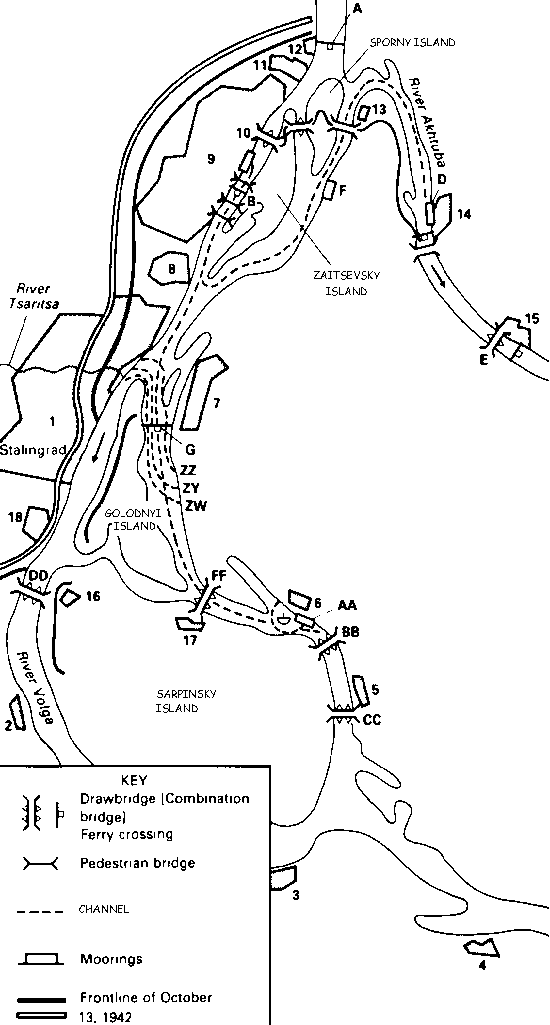
| CITIES | |||
| 1 Stalingrad | 2 Beketovka | 3 Krasnoarmeisk | 4 Svellyi Iar |
| 5 Shuch'e | 6 Tumak | 7 Krasnaia Sloboda | 8 Mamaev Kurgan |
| 9 Red October factory | 10 Barrikady | 11 Spartakova | 12 Rynok |
| 13 Skudri | 14 Verkhnaia Akhiuba | 15 Srednaia Akhiuba | 16 Boblyi |
| 17 Kul'tbaza | 18 Kuporosnoe |
CAPTIONS
A
Two ferryboats on barges and railroad crossing (until August 24, 1942).
The combined length of
the bridge is 1,408 meters (610 meters on pilings and master piers,
798 meters on floating
supports of lhe DMP type). Constructed August 15 to 20, 1942; utilized
until August 1942.
B
Army crossing of 3 ferryboats of the N2P type, 3 type SP-19 ferryboats,
3 (towing launches)
BMK type cutters, 1 launch, 6 barges, 6 tugs, 3 steamboats, a boat
crossing, 3 footbridges on
floats (as of August 23, 1942).
D
Two N2P type ferryboats (each 16 tons), 1 ferryboat on barge (30 tons),
and 1 floating bridge
(8 tons). Left-bank moorage of the Army crossing. Length of the
voyage is 12 km.
E
A floating bridge on floats (8 tons), a wooden combination bridge with
a drawbridge section
(60 tons), 2 ferryboats (16 and 30 tons),
F
The left bank moorage of the Army crossing. Length of the voyage is
5 km.
G
Ferry crossing on pontoons of the type SP-19.
ZZ
Central crossing number one, 2 barges, 2 lugs, 1 steamer. August 22
to September 13, 1942.
ZY
Central crossing number two, 5 ferryboats of the type SP-19 and two
cutlers. August 25
to September 21, 1942.
ZW
Special crossing for the wounded. Two river trams, 2 cutters. August
25 to September 20.
AA
The left bank moorage of the Army crossing. Length of the voyage of
23 km.
BB
Length of the bridge is 348 meters. September 21 to October 7, 1942.
CC
Length of the bridge is 506 meters. September 21 to November 7, 1942.
DD
The length of the bridge is 1,194 meters (1,159 meters is floating
and 35 meters is trestle).
Constructed August 31 through September 4, 1942, and utilized until
September 8, 1942.
FF
Length of the bridge is 505 meters (467 meters is floating and 38 meters
of trestle for moorage).
September 10 to September 20, 1942.
Source:
The Battle for Stalingrad : The 1943 Soviet General Staff Study : Edited
by Louis Rotundo.