 |
Croatia
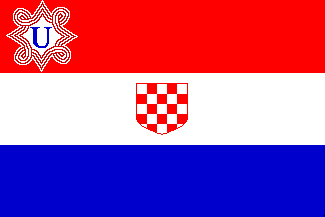
Flag of the Nezavisna Drzava Hrvatska* |
|
*Independent State of Croatia - Proclaimed
on April 10, 1941
369th Reinforced Infantry Regiment
(By Allen Milcic)
Brief history
After the German invasion of Russia, the "Poglavnik" (Leader) of the
Independant State
of Croatia, Ante Pavelic, called on Croatians to volunteer, and join
the German efforts to
destroy the Russian Communist state. Many Croats volunteered, as the
anti-communist feelings
of the Croats were quite high, as was the ancient annimosity of the
Croats toward the Russians
(the Russians being staunch supporters of the Croat enemies, the Serbs).
A Regiment was quickly formed, consisting of 3 battalions (2 of Croats
in Varazdin, and 1 of
Bosnian Croats in Sarajevo). These 3 battalions were sent to Austria
for training, and
organized into the 369th REINFORCED (CROAT) INFANTRY REGIMENT. Reinforced
because the Regiment had its own artillery, beyond the regular issue
infantry guns.
The majority of the 369th Regiment was Croatian, but contained some
German officers and
NCO's. Note also that the 369th Regiment was a part of the WEHRMACHT,
and NOT a
Croatian national army formation (the military of the Independant State
of Croatia did have
some units on the Eastern Front, however, not at Stalingrad. The most
notable "I.S.C." unit
on the Eastern Front would be the "Croatian Air Legion"; which fought
with distinction as
part of Army Group South).
In late August of 1941, the 369th was assigned to the 100th Light Division
(Wehrmacht), and
was sent east.
The Croats fought bravely, and eventually participated in the battle
of Stalingrad. The unit
was assigned to the northern sector of Stalingrad, and fought with
extreme courage in the
area of the "Red October" factory.
The entire Regiment was caught in the encirclement of the 6th Army in
November of 1942,
and trapped inside Stalingrad. The Croats continued to fight, and sustained
heavy losses. In
fact, by the time the 6th Army capitulated in February of 1943, the
369th Regiment had only
one, reduced battalion remaining. These survivors were herded into
Soviet captivity, together
with the other 6th Army POWs. Few survived Soviet captivity to return
to their homeland
after the end of the war.
However, the remnants of the 369th that had been evacuated by air from
Stalingrad (due to
wounds, sickness etc), formed the core of a new Croatian infantry Regiment,
that was also to
be named "369", in honor of the former Regiment. These Stalingrad veterans
were awarded a
special badge, called the "Croatian Legion Badge - 1941" (shaped as
a Linden leaf, with the
Croat chessboard, and the words "Hrvatska Legija - 1941" on it).
Note that the Germans referred to the Croat Regiment as the "Schachbrett"
or
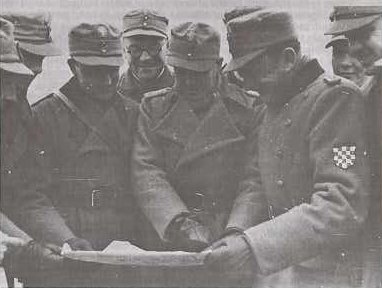
"Chessboard", due to the distinctive shoulder patch worn by the Croatian
soldiers.
 |
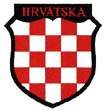
Shoulder patch worn
by the Croatian soldiers. |
Croatian Officer (Oberst Leutnant Mesic ?)
On his left arm you see the shoulder patch.
A list of battles in which the 369th Regiment fought in, is as follows:
- Poltawa, anti-Partisan actions, latter 1941 (very
effective);
- Advance on Kharkov, latter 1941 (very effective);
- Stalino Sector defence during Russian winter counter-offensive
of
1941-1942;
- Advance from Voronezh to Stalingrad, 1942;
- On May 31, 1942 the 369th captures 5000 Red Army
soldiers, and is
congratulated in an OKW communique;
- Kalatsch, forcing a passage across the Don River,
late July/early
August 1942;
- September 25, 1942 enters Stalingrad;
- Heavy fighting in many of the hardest sectors
of the Stalingrad
battlefield, specially around the Red October tractor factory;
- Annihilated by February, 1943, together with the
entire 6th Army.
The 369th Regiment was formed with 3 battalions, consisting of four
infantry companies each.
It further had a regimental staff company, a supply company, one machine-gun
company,
one anti-tank company (equipped with 37mm PAK 36), and 3 batteries
of 105mm leFH 18
howitzers. This made the 369th a "Reinforced" infantry regiment (in
German military organization).
The full designation of the regiment was: "Verstarken Kroatischen Infanterie
Regiment 369"
[369th Croatian Reinforced Infantry Regiment]. The 369th was part of
the 100th Jager (Light)
Division.
 |
|
The 369th Regiment was re-organized after the fall of Stalingrad
and the destruction of the
original 369th. In fact, this "new" 369th Regiment became part of an
all-Croat Wehrmacht
Division, named the "369th Infantry Division". This division also carried
the name "Vrazja
Divizija" ("Devil's Division"), after the 42nd (Croat) Infantry Division
of the Austro-Hungarian
Army during WW1. This division (including the new 369th Regiment) fought
in Croatia on
counter-insurgency operations against the communist Partisans. It surrendered
to the British
in April of 1945, in Austria.
A very BIG thank you to Allen Milcic, Canada,
from who I received this hard to find
information.
The Order of Battle Source :
George F. Nafziger's "German Order of Battle in WW2" book, Volume 7
(Russian,
Croatian and Italian Soldiers in the Wehrmacht)
If you would be interested in contacting Mr. Nafziger (who is a private
researcher of
military history), he can be contacted at: G.F. Nafziger, P.O. Box
1522, West Chester,
Ohio, 45069-1522, USA. He has an extensive published collection of
Orders of Battle
Click
here to see a "real" Croation soldier of the regiment |