
|

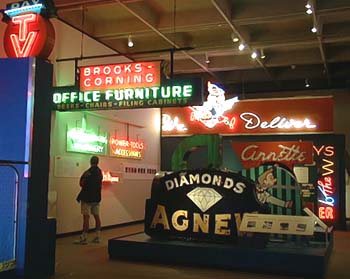
For the business owner, this meant peace-of-mind. Your sign was regularly maintained and painted and, of course, if that freak hailstorm hit, you were covered. For the sign company, leasing meant that the company assured itself a steady income, provided the hail storms were few and far between. And it was easier to convince your customers to upgrade to the latest trends. Elsewhere on the continent, signs were usually sold outright. This meant that sign maintenance depended on the well-being of the owner's business. As North American city cores were abandoned in the flight to the suburbs, the slowly decaying neon signs left behind helped to contribute to neon's bad reputation. In Vancouver when a business closed, the sign was usually quickly removed. That has made preservation of older signs in their original locations difficult. But it does mean that even in the poorest commercial areas of Vancouver, neon signs are kept in reasonably good repair. One example of this is the "Brooks Corning" sign (pictured above). This sign is from the Brooks Corning shop, located at 655 Hornby Street, Vancouver. The sign was made by Neon Products, circa late 1940's. Early electric signs used light bulbs to illuminate their message. Many signs were constructed with leaded glass panels held in a metal box. Other signs were simple shapes in sheetmetal with the letters picked out in light bulbs. Other signs were more complicated in size and shape and rivaled anything later designers created. The "Agnew Diamonds" sign (pictured above) is an interesting transition between two styles. It has a decorative stamped metal design and light bulbs outlining the sign's edges. At the center is a leaded glass insert in the shape of a diamond that would have been lit from the inside. The age of the "Agnew Diamond" sign is evident not only through its design, but also from the many visible paint layers. The Agnew sign, the original location of which is unknown, was also constructed by Neon Products, circa 1930. More from the "Vancouver Lights" |
Home | News | Events | Exhibits | FAQ | Talk | Membership | Links