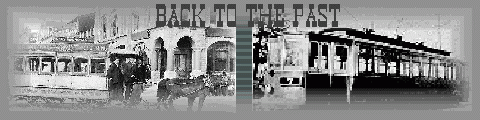
The Evolution of the Trolley . . . .
While we might say that riding an omnibus sure beats walking, it generally wasn't a comfortable ride. Running on the dirt streets of the city the ride was seldom smooth. Inclement weather made things even worse as the passengers were often boarding and exiting into mud and/or puddles.
The operation of the omnibus improved the publics ability to get around in the cities but it was soon to be replaced by a far better means of transportation, the Horse Railways.
Initially the cars very much resembled the omnibus, with the driver pearched atop the carriage. Around the time of the civil war the design of the carriages was changing. The driver was removed from the top and found his new position on the platform of the car. The passenger could now board from the side of the car rather than the rear. This also now allowed the use of double ended cars, eliminating the need of turning the cars at the end of the line. The horse (or horses) was simply unhitched and led to the other end of the car. The braking lever was replaced by a wind up cranking mechanism on the platform.
It has been reported that by the late 1880's there were over 500 horse car railway lines running in some 300 cities around the U.S. Over 100,000 animals were used in these operations. Horses weren't the only animals in use. Mules became a popular means of power as well, especially in the south, as it was said that they withstood the heat better and required less in the area of food and care. While the horse might have run from $150 to $200 each when bought by the railway, probably half that cost could be recovered by the sale of the horse once it outlived it's usefullness to the railway. This was not true of the mules however. While their initial cost wasn't near as high as that of a good horse, there was little market for the old mules.
Over the years there were several interesting ideas that were tried and probably worth mentioning. As we still see today in railroading, grades are always a problem. Durring the horse car era there were a few cars designed so that after once conquering the hill, the horse was allowed to board the car and ride back down the hill. Starting the cars always takes more power than it takes to keep it running. With this in mind an idea was tried that had a winding spring arrangement that used the momentum of the rolling car; stopping would wind the spring, the driver then releasing the spring when the horse tried to start the car. Another idea involved using what was called a "sprag". It was simply a sturdy piece, hinged at the car with the other end dragging the ground. Once stopped, on the hill, the car could be held from rolling back by the Sprag digging itself into the ground. It was common practice to add horses for the trip up the hill much the way locomotives today are added to a train to get over the steeper grades.
While it certainly varied from route to route, the average horse was expected to work only 4 or 5 hours a day, or put another way, pulled his load over 12 to 15 miles per day. The horse had to be stabled for the rest of the day as well as having to be fed, usually three times a day. In a day a horse comsummed about 30 pounds of feed and hay. Generally it required one hostler for each 15 to 20 animals, as well as company vets etc. The horse working so few hours a day meant that the railroads needed far more horses than they did cars. As example, the Metropolitan Railroad in Boston used 3,600 horse to operate it's 700 cars. With that many horses the manure becomes a problem, not just on the streets but even more so at the stables. The manure could be sold off for tidy sums but before being sold it was accumulated in large piles, at the stables, which gave off some pretty terrible odors, causing numerous complaints from the neighbors. Manure was always a problem.
Horse railways were expensive to operated and even in the better days generally returned only 8 or 9 precent. This was due mainly to small cars and slow speeds with operating costs around 25 cents per mile, per car. Except in the larger cities, most horse railways remained small, operating only on one or two routes, often with other companies offering competing service only a few blocks away.
Said to have come from Europe originally, the "Great Epizootic", an equine influenza, first turned up in Canada, in mid October 1872 and very quickly spread throught the Eastern United States reaching as far as Louisiana by the end of November. Thousands of horses died and many more were to sick to be called upon to work. 18,000 horses in New York alone were to sick to work while at the same time horses in Philedaphia were dying at the rate of 175 to 200 a day. More than 2,250 dying in that one city alone during a three week period. The epidemic spread so far and so fast that it baffeled the veterinarians, as well it could not be explained as being from contact of one horse to another. Horse car operations were brought to a halt in many areas and in some areas oxen were tried. In New York large numbers of the unemployed were tried as power to pull the horse cars.
This epidemic of course was not just confined to railways and during the height of the epidemic came the "Great Boston Fire". One reason given for the fact that the fire spread out of control for so long was that there were few horses to haul the fire wagons to where they were needed. The fire consumed 67 acres of the downtown Boston area with an estimated 75 million dollars in damage.
Winter use of the horse railways was another interesting topic. Heat in the cars was generally not available. Usually 8 or 10 inches of hay, as insulation, was all that was used to make the ride more comfortable. Coal stove heaters were occasionally used but these would, every once in a while, set the car on fire. Another problem occurred that upset many people, until now, snow was not plowed but rather walked or sledded on. With the other carriages using the roadway now having skis, or sleds or sleighs they encountered problems when they came upon a plowed railway. Some cities passed ordinances forbidding the railway companies from plowing the tracks. Many railways were forced to keep sleighs in the carbarns so they could provide, at least, limited service.
While the horse railway was effective and did the job, a better means of powering the cars was clearly necessary.
Actually, while the cable car was really what I would call the next step in the evolution of the trolley, there were many other attempts to use other methods as well. From wind-up spring drives to compressed air, ammonia gas and even mechanical legs. Steam locomotives were also a choice, but had the disadvantages of the soot, noise and smoke, and were not well received in the city, as well they caused problems with the horses and carriages that were still using the streets. Steam locomotives were somewhat more costly than the horses. Steam dummies had some success as did the little 4 wheeled locomotives with vertical boilers and using coke or anthracite to lessen the soot and smoke. These little locomotives were generally covered with a body resembling a car so as to appear to be less atrusive. A fireless locomotive was also tried. A vehicle that could be described as a steam locomotive without a firebox. The boiler was charged with enough steam to allow the engine to work long enough to get to the end of it's route. Generally less than 15 miles. Ammonia gas was also tried, with some limited success, in what was also referred to as a fireless car, but in this case it was not a separate locomotive but was contained within the car. Internal combustion was also tried using naphtha as a fuel. Some battery operated cars were being tried but the capacity of the battery and the usefullness of the electric motor was not yet at a point of being practical.
There were several special purpose incline counterbalance arrangements that were having some success but that's a whole topic in itself.
Though many others may have been involved, Andrew Hallidie, a manufacturer of wire rope, is given credit as being the person responsible for the idea of the cable drawn cars. Hallidie, and his wire rope, had already had much success in the use of cable drawn ore cars for use in mines. Hallidie set out to build the first cable car railway on Clay St. in San Francisco. He put all the money he had into it as well as convincing some friends to put some of their money into it and still had to borrow money. All of the underground utilities had to be relocated which amounted to more work and expense than was anticipated but on at five o'clock in the morning of August 1, 1873 the first trial run was made on his 2,800 ft railway. On this line he had to deal with grades of almost 20%. As a side note, the story goes that Hallidie, his three partners, along with several city officials were on hand that first morning and once the fog cleared and the fellow who had been assigned to operate the car on it's first run, got a better look at the very steep grade decided not to take the chance and resigned on the spot. Hallidie himself took control of the car, tightened the grip, and started down the hill. All went well and repeated runs were made up and down the hill during the morning and later that afternoon the first "official" run was made and the public was allowed to ride the new car, though there were a few minor problems. Despite so many feeling that the cable car would never work, it became an immediate success.
The cable car worked on a system that used a continous cable that ran underground in a conduit, the cable being supported by an elaborate system of sheaves, idlers, and cable guides. A slot between the rails allowed a grip mechanism to reach down to the cable and when the grip was tightened it grabbed the cable and the car was off and running. The power to run the cable came from a central location. Running at 6 or 8 miles an hour, depending on the system, this was a welcome improvement over the 4 or 5 miles per hour of the horse cars. Cable systems weren't without their own problems through. If the cable became damaged or frayed the entire system had to be shut down while a new piece of cable was spliced in. Likewise replacement of the various sheaves, guides, and idlers would require a shut down. Maintenance was always a headache, especially in the cities where the climate saw ice and snow. Often if a grip encounted a frayed or damaged area of the cable it could not let go of the cable, meaning the car couldn't be stopped until word could be passed to the power station to shut down the entire system. While these types of problems were not to serious on the smaller lines that only had one or two cars and ran short distance, it was a very serious problem on the longer line of some cities.
The cable car railways became popular very fast and by the early 1880's there were lines running in many cities across the United States. The systems grew in size and soon saw steam engines as large as 750 horse power powering them. Denver's system was said to have used a cable seven miles long. Cables themselves grew in size to diameters of one and a quarter inch to two inches. As the systems grew longer another problem arose. Cables stretch, and as they stretch the tension devices compensate but they can only take up so much. Now the system had to be shut down again while the cable was shortened.
Hallidie's first grip was a winding mechanism but as time went on the grip became operated by a long lever in the middle of the car. The term driver, used in the horse car days to describe the operator was replaced with the term "gripman". The gripman's operation of the levers within the car had much to do with the comfort of the passengers. If the grip was made to fast, the car leapt ahead with a hefty jerk, jarring the passengers. On the other hand if the grip was made to slowly there was excessive wear to the grip mechanism and the cable.
As time passed, the speeds of the cars increased as well. Typical speeds were up to 9 miles per hour on city systems and as high as 12 miles per hour on the systems that operated outside the city limits. Certainly not fast by todays standards but a very big improvement over the horse cars. The cable cars often were run using a "trailer" car, allowing the carrying of more passengers.
Despite the high costs of construction, the cable car industry continued to grow into the early 1890's and by then there were almost 500 miles of trackage and over 5,000 cars operating throughout the U.S. The larger systems operated in Chicago, San Fransico, St. Louis (55 miles), Denver (44 miles), as well as Washington, New York, Seattle, Providence, Oakland, Baltimore and many others. Chicago's system, opened in 1882, grew to be one of the largest and best systems.
During most of this time experiments and improvements were being made to a "new" means of transportation... the electric trolley. By the mid 1890's the electric cars reached a point where they were reliable and the cable systems began to change over to electric trolleys.
Early experiments saw some strange methods used to get power to the cars. Live rails, much like in a model railroad, were tried but it was soon found that the voltage was either to low to efficiently operate the motors or to high causing electrical shock to those who came in touch with them, especially on rainy days. Third rails were tried but here again the exposed rail was a hazard on the city streets. The first cars to use a wire overhead, used a "troller" running along the overhead wire and connected to the car with a slack cable. This also turned out not practical because when the trolley stopped the momentum of the troller kept it going until the slack was taken up. Having run out of slack, the troller would jerk to a stop, often falling off the wire. Another problen seen by the early lines was with the use of the rails as the return path for the current passing through the motors. The idea of a good electrical connection at rail joints wasn't a great concern at first, causing problems not only to the cars but also to the surrounding areas. Early telephone systems would see great interferance from the trolleys.
As time passed these problems were resolved, the use of a trolley pole, with it's under running wheel, came into being and the boom of the trolley car was underway. By 1887 the electric trolley was running in ten locations, over about 60 miles of track, with varing success, though there still wasn't a "standard" idea as how to build the cars. Some used motors mounted on the car, under the car, and driving the wheels in a varity of ways. Belt drives, chain drives, gear drives were all in use and dependability was still a problem.
In 1884 Frank Sprague, who had been working for Edison, started his own Sprague Electric Railway & Motor Company. His development of the electric motor was quite successful and he soon turned his full time attention to the electric railway. After a minor defeat while showing his new car to Jay Gould, in which the main fuse blew and Gould happen to be standing next to it when it let go, Sprague was able to land a contract with Richmand, Virginia to provide a complete electric street railway system. The contract called for twelve miles of track, a steam-electric plant of 375 hp and forty cars with 80 motors. This was nearly as many motors as were being used throughout the country at the time. The line was to be capable of running as many as thirty cars at one time and on grades up to eight percent. For this he was to be paid $110,000 "if satisfactory".
The track work was contracted out and was poorly done. There was some doubt that the two, seven horsepower motors with single reduction gears could handle the tasks on the steeper grades so a change was made to double reduction gears. This should take care of any question of torque but there was still the fear of losing traction on the grades. In the dark of the night in November of 1887 Sprague set out to see if the car would climb the grades. Though he had success in getting up the hill the motor did short out and the car had to be hauled back using mules. More gearing was added to ease the load on the motors. Problems were also apparent with the type of trolley pole he was using but after many attempts this also was resolved.
February of 1888 saw the opening of the line, though only ten of the cars were on hand. While the cars did pretty well electrically, at first, there were mechanical problems with the gears, though most was due to improper lubrication. The motors proved to be not dependable and were constantly shorting out, resulting in the need to ship them back to New York for rebuilding. The motor brushes, being made of brass, were wearing out at a tremendous rate, often needing replacement during a trip. Improvements were made and the trouble lessened as time went on and soon all forty cars were in Richmand.
In the mean time, the original operating syndicate in Richmond had gone bankrupt and was taken over. When it was all over Sprague estimated that it cost him $75,000 more than he was paid. But the great success of the railway paved the way for future work. Owners of horse car lines from all over the country came to see Sprague's electric railway. Most noteable among them was Henry M. Whitney, president of the West End Railroad in Boston. While the general manager of the West End Railway favored a cable system, Whitney was impressed with the electric cars. Longstreet, West End's general manager felt that the trolley couldn't work in a congested city because the trolleys were apt to bunch up and when this happened it would overload the system. To demonstrate the system and more importantly to satisfy Longstreet, Sprague set out to line up twenty two of the trolleys, one behind the other, and shortly after midnight, with his guests watching he gave the signal to start. Each car pulling away as soon as it had safe headway from the car in front of it. Certainly a strain on the system, but all cars were soon out of sight. Sprague went on to explain that, while this area of the system was designed to handle only four well spaced cars, it was capable of handling this type of congestion. Sprague ended up getting the Boston contract.
Until now the electric trolley hadn't threatened the horse car lines and cable lines in the big cities but that was all about to change.
In late 1889 the Sprague Electric Railway & Motor Company was taken over by Edison General Electric Company. The Edison General Electric Company chose not only not to use the name Sprague on any of its new systems but also to remove it from some of the existing systems and soon after Frank Sprague chose to leave the company.
Sprague had been involved in pioneering developments in several other areas, among them was the high speed elevator control system and the multiple-unit control system. While the subject so far has been trolleys, it should be noted that there were also in use, some small steam engines pulling passenger cars on elevated railroads. The idea of the elevated was to keep the steam engines and their soot and smoke above the steets and the people while moving large numbers of commuters. Sprague's "MU" system on electric cars would now not only allow each car to have it's own electric motors, but let them be controled by a single operator. Now under electric power these systems not only didn't have to be run above the streets any longer, but could now even be run underground. Again, this is a subject in itself but I'll get back to the trolleys.
The growth of the trolley was amazing and by 1900 there were over 30,000 cars running over more than 15,000 miles of track. The early cars were often the horse cars converted to electric cars but as time went on the size of the cars grew as did the varities of cars. These I'll cover a bit later.
While the electric trolley was successful and did it's job well, moving within the city and most often on the city streets, there was a need for faster heavier lines to move the people between the cities and towns. The Interurban lines filled this need. These Interurban lines often had very plush cars and were quite comfortable riding. Because of their greater speeds, the interurban, once outside the city or town, generally ran on private rights of way and not on the public streets. Once in the country side the interurban often reached speeds of 50 and 60 mph in the early years and even faster as improvements were made. The earliest lines, in the mid 1890's, were not always a success but after the turn of the century their reliability had greatly improved. While the interurban catered more to the passenger, they did carry express freight and mail and were beginning to be of concern to the steam railroads as far competition goes. The interurbans generally had lower rates and fares than the railroads and by 1917 the interurbans operated on over 18,000 miles of track. The trolley had also grown to where it had almost 45,000 miles of track and had almost reached it's peak.
The bicycle, the motor car, the bus and the "jitney" were all beginning to cut into the streetcar operations. The future is in question.
Certainly the most common of the car designs was the "closed car" and as the time passed this type car was seen in many variations. A favorite in areas of milder climate, and in the summer months in other areas, was the "open car". The "breezers", as they were often called, were especially enjoyable on those hot summer nights before air conditioning. Cars using a combination of the two were know as the "semi-open" and the "California Car". These were more popular in areas where the climate didn't change drastically between winter and summer but were rather popular because you could go inside on inclement days and ride in the open portion on the good days. In the earlier days of the trolley the cars were generally riding on a single truck but as the cars grew larger and larger the double trucked cars appeared. A company with a large fleet of cars soon found that keeping two fleets of cars, open cars for the summer and closed cars for the winter, was quite expensive. Several new designs solved this problem. One, was a "convertable" car where the side panels of the cars could be removed for use as an open car or reinstalled for use as a closed car or where the side panels could be slid out of the way into pockets in the roof and the floor. Another was the "semi-convertable" car where the upper portion of the side panels could be slid out of the way, storing a portion of the panel above or below, while leaving the lower portion in place. Another big advantage, to the companies, of these types of cars was that boarding and leaving the car could be controlled a lot better than on the open cars, reducing liabilities from falls and fare evaision, that was always a problem. Eventually the open cars faded from existance. There were a few other car types that were tried but were not widely used, the double deck car and the articulated car. While double deck cars were popular in other parts of the world they never became so in the U.S. For a time Boston was using an articulated car that was rebuilt from two single truck car, adding a small entrance section between them. Dubbed "two rooms and a bath", these cars were sucessful enough that they went on to do the same thing using larger double trucked cars. The list grows even longer if you want to consider the many special purpose cars such as "U.S.mail cars", "hearses", "sightseeing cars", "parlor cars", "combination cars" for hauling passengers and express frieght and more. Trailer cars were also popular with many street railways.
As mentioned before, the closed cars and the semi-convertables became the most common type of car. Prior to the turn of the century, most cars were constructed of wood but the new larger double trucked cars were beginning to appear made from steel. Boarding times and collecting fares was becoming a problem and resulted in several new car designs. The center entrance car very much improved boarding times, typically boarding at a lower, center entrance allowing the car to get underway while you paid your fare and stepped up into the seating area of the car. The P.A.Y.E. (Pay As You Enter) Car, the Nearside Car and the Peter Witt Car were other attempts at improving efficiency.
In most cases these cars all required the use of a two man crew, the motorman and the conductor. Just prior to the First World War, as competition from automobiles, busses, jitneys and the like ate away at the profits of operating the railway efforts were made to cut costs. Most significant of these was the introduction of the Birney "Saftey Car", a light weight, single truck car that could be operated by one man, serving as both motorman and conductor. These cars became quite popular with the companies and by 1920 were being made in a double trucked versions as well. While the Birney's helped save the car lines, they had already reached their peak and were heading towards a decline.
The new PCCs did help bring some of the business back to the trolley companies and when the Second World War was being fought the traffic was again increased but in the end the cars and the busses were winning out. The trolley companies either abandonded their lines or switched to busses. Only in a few on the larger cities did the trolley (PCC) survive and even today there are still a few around, still in revenue service.
Not all of the car companies or operators opted for the PCC cars but instead tried their own, although similar designs. Most notable among them was the Brill Company's "Brilliner"
As the hay days of the trolley were ending, fortunatly there were enough people with the insight to preserve this piece of history and today we have many museums where we can still see and ride some of these fine old cars.
Much has been written about the trolleys of the past and while these notes of mine do nothing more than hit some of the highlights I hope that they may have sparked an intertest. While there wasn't more than a passing reference to them here, similar interesting history can be found dealing with the subway and rapid transit lines, the Interurban lines and more.
There are several good books available dealing with the Evolution of the Trolley. My two favorites are "Trolley Car Treasury" by Frank Rowsame, Jr. and "The Time of the Trolley" by William D. Middleton. Other good books, dealing more with mass transit in general are "Cash, Tokens and Transferes" by Brian Cudahy and "Fares Please" by Miller and many more written to cover specfic areas, such as "Street Cars of Boston", a six part series by O.R. Cummings.