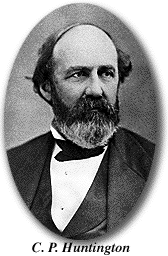
Leland Stanford, Collis P. Huntington, Charles Crocker and Mark Hopkins were
the "Big Four" that conceived this enterprise and brought it to a successful
ending after years of daily struggle that would have exhausted the patience
and spirit of ordinary men. Huntington looked after the financing of the
company. Crocker, with his tremendous energy, forced the construction of
rails over the snow-
A transcontinental railroad had been dreamed of as early as 1836. From time
to time it was suggested by visionaries and discussed by the orators and
newspapers of the '40s and '50s. In 1853 Congress expended $150,000 in
hunting a feasible route. Surveys were made from time to time. The
California Legislature took a hand in the issue in 1855-6, fearing that
Congress might relax its energies, and urged a speedy construction of a
railroad, but the jealousy of politicians delayed the initiative. Meanwhile
short line railroads were developing in the Middle West. Some of these
united, and systems began to develop.
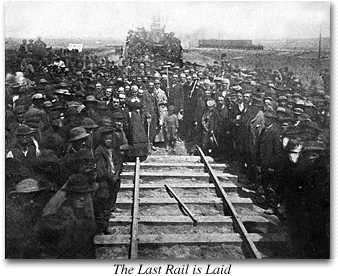
 The connection of the Central Pacific and the Union Pacific bridged the 2000
miles to the Missouri River, and the four to six months time taken by the
overland pioneers was reduced to six days. At once the Pacific States were
transformed, and Western life gradually caught up with the life and
aspirations of the East.
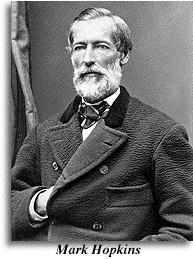 Leland Stanford is generally given credit for the initiative in starting the
enterprise. In passing the store of Collis P. Huntington in Sacramento, one
day, he noticed one of the huge freight wagons being loaded for the arduous
haul over the Sierra into Nevada. Traffic was developing rapidly, and he
realized that a better carrier and faster service was demanded. He and
Huntington talked the matter over. Mark Hopkins and Charles Crocker were
drawn into the discussion; they all agreed that the time had come for a
railroad connection with the East. Theodore Judah, for whom Judah Street is
named, had surveyed a route over the Sierra and had interested Stanford in
its practicability. He was sent for, and backed with money to go over
several surveyed routes known and select the best one. Meanwhile, the
corporation organized with Leland Stanford as president, C.P. Huntington as
vice-
 This is Central Pacific locomotive
No. 1, the first engine to be placed in construction service on the western
end of the transcontinental railroad. The maiden trip was made at
Sacramento, November 11, 1863, after having arrived from the East on a
clipper ship via Cape Horn. This locomotive was named in honor of Leland
Stanford, then California's governor, and one of the "Big Four" builders of
the Central Pacific.
 Library
