
People & engines 1929 --- Three 4-4-0s with Roundhouse
People & engines 1929 --- Three 4-4-0s with Roundhouse
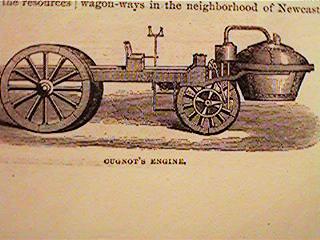
Sponsored by France's War Minister, The Duke of Choiseul, Nicholas Cugnot's cannon -hauling steam tractorclattered over the streets of Paris in 1769. Steam was directed into the vertical cylinders of Cugnot's engine by a "four-way valve"-an icsillating disk with two curved channels, each of which served alternatly as an intake and an exhaust passage. Klik For More History
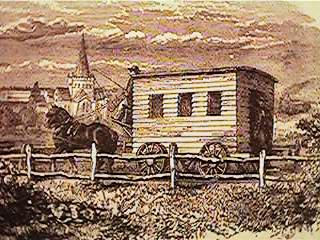
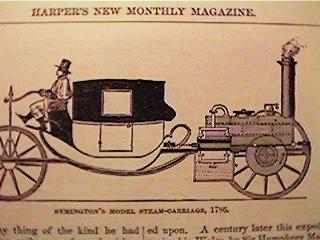
The body of the carriage, A, is about the size and capacity of those of an ordinary *gig-wagon, with a convenient seat, B, for two riders, and under the seat is a box that will contain two or three bushels of coal. Behind the seat is the boiler, C, which consists principally of two rows of copper tubes, placed in a vertical position: and the two rows being parallel to each other, and ten inches apart, the fire is contained in the space between them, and is restrained from coming in contact with the tubes above the surface of the water within them: the smoke escapes by the funnel. For full explanation on how it works & to see another model, klik on photo. *gig-wagon-a 2 wheeled horse drawn carriage.
4/22/01 5:11:28 AM
 Robert Stephensons "Rocket" He introduced the fundamental improvement of the multi tube boiler, and her resulting superior steam-raising and fuel economy. For the last stipulated loaded journeys the Rocket which hitherto been restrained to an average speed of 14 mph, was given her head and reached 29mph. Circa 1830
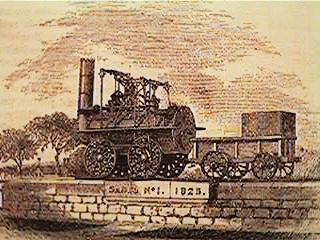 Imported by Delaware & Hudson in 1829, the Stourbridge Lion, was the first locomotive operated on a commercial railroad in America Whether or not the 7-ton engine carried an embossed head of the king of beasts on its boiler front remains a subject of debate. The embellishment did not appear, on this replica, displayed at the Chicago' World Columbian Exposition 64 years later.
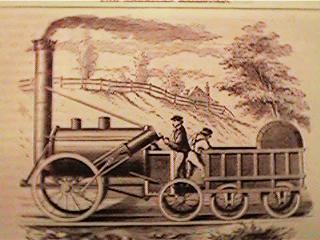 George Stephen's Geared Rocket with a multi tube boiler 1827 Average Speed 14 to 29 miles per hour with a full head of steam.
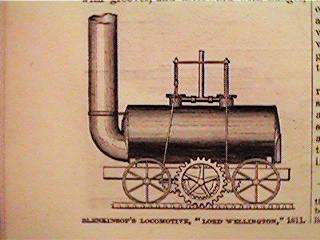 A Leeds colliery manager, John Blenkinsop, patented the worlds earliest cog railway system in 1811. One year later Mathiew Murray, completed a locomotive whose steam-powered spur gear engaged a tooth-flanked running rail applied to the company's track.
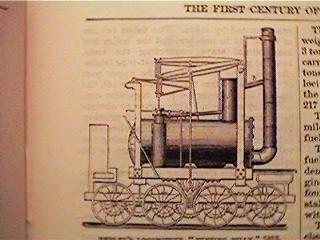 William Hedley's Puffing Billy built for the Wylam Railways in 1813, as shown here, was as almost immediatly altered to run on eight wheels, with a light weight two wheeled tender; the driver stood at the front on the left hand platform, the fireman on the right
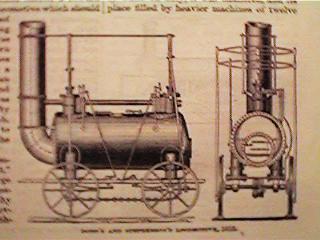 George Stephenson's second locomotive for Killingworth Colliery in the UK built 1815 and named "Wellington". It was illustrated handsomely by Nicholas Wood in his treatise on the locomotive in the 1820s, and your illustrations seems to be based on his..
It has a chain which couples the wheels together and thus coordinates and shares the power of the two cylinders one of which drives each axle. Otherwise the locomotive may stop in a postion where neither cylinder can deliver power.
It also has steam springs. Each wheel bearing is at the end of a piston contained in a "leg" off the boiler, and held by steam pressure. Thus there is some "give" in the suspension and the engine is kinder to the brittle cast-iron track used in those days. The above info, thanx to Derick Cullen
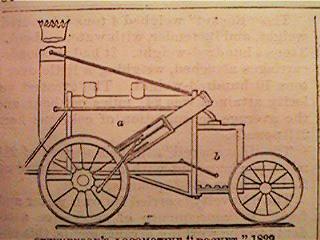 A drawing of George Stephenson's Rocket
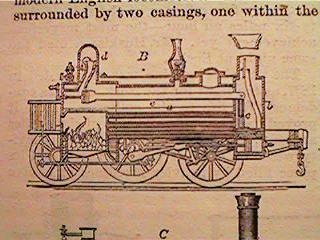 Sorry!! Unable to find the origin, of this one as well. I will keep searching
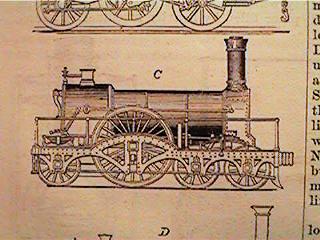 The Lord of the Islesone of Daniel Gooch's Iron Duke class eight-foot singles, built with only minor modifications from 1847 to 1888, these engines were the most famous of all the Great Western's brod- guage locomotives.
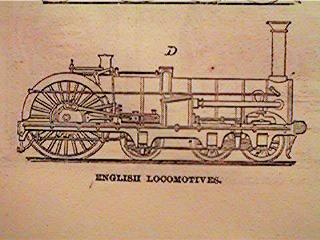 -Defying classification by Whyte's system, the Utica & Scenectady's Lightning was built by the Schenectady Locomotiive Engin Manufactory from the drawings of Edward S.Norris in 1849. Discouraged sales led the designer and his brother, Septimus Norris, to relinquish control of the firm, which went on to become the principle plant of the American Locomotive Company (Photo Loco. simular to the American one.)
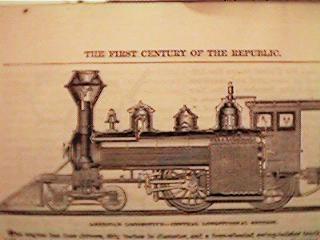 Cincinnati, which for many years built more steam boats annually than Boston, New York, and Baltimore combined, boasted four locomotive manufactories between 1845 and 1867. The largest- Niles & Co. and Moore & Richardson (originally Anthony Harkness & Son)- jointly produced some 200 engines. The unattractive relationship between the cylindes & guiding truck of the latter's Nathaniel Wright had a purpose - to place more weight on the drivers.
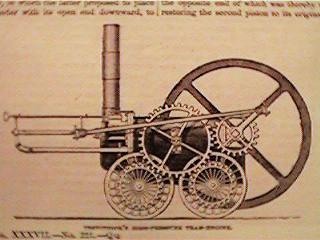 Richard Trevithicks's second railway locomotive, built at Gateshead, England, in 1805 and similar to his first, which had hauled the world's first steam train in Penydarrin the year before. His locotives were not to successful, as they were to heavy for the tracks. There wasonly 1 cylinder situated inaccessibly in the boiler barrel.

This page was generated by HTMLed And Hy Novak