Engineers began constructing wooden railways in the mines of central Europe during
the early 16th century. The first wooden railway in England was built at Wollaton in
1604. The original idea was to use the horse-drawn wooden railway to transport coal
from Wollaton "Colliery" (A Coal Mine) to the population of Nottingham. Soon afterwards similar
railways were built in Shropshire and Northumberland.
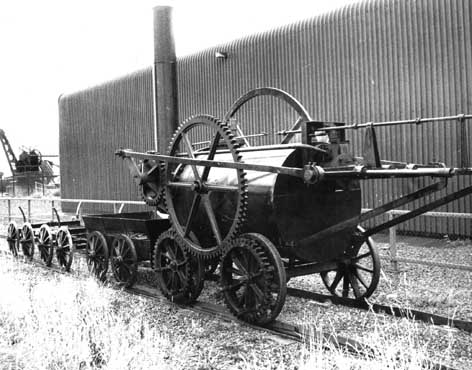
Trevithick's-(photo)- Penydarren locomotive only made three journeys. Each time the
seven-ton steam engine broke the cast iron rails. Samuel Homfray came to the
conclusion that Trevithick's invention was unlikely to reduce his transport costs and so
he decided to abandon the project.
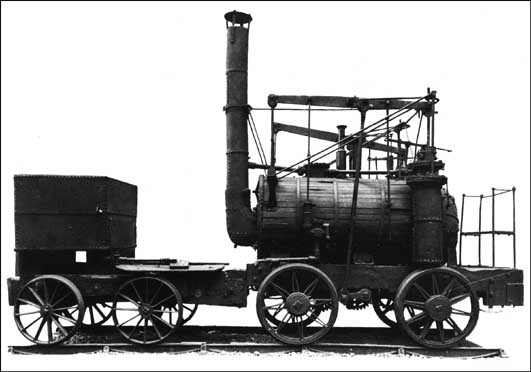
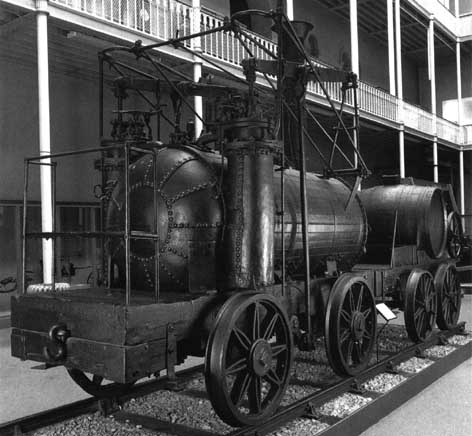
In 1812 William Hedley, was commissioned by Christopher Blackett, the owner of
Wylam Colliery, to produce a steam locomotive. Hedley was helped in his task by two
talented craftsman, Jonathan Foster, an enginewright, and Timothy Hackworth, a
blacksmith. By 1814 Hedley produced a locomotive that had two vertical cylinders
outside the boiler. Piston rods extended upwards to pivotted beams, which were in turn
connected by rods to a crankshaft beneath the frames, from which gears drove and
also coupled the wheels. Originally carried on four wheels, the 8 ton locomotives were
two heavy for the plate rails, and so to spread the weight on the templates, they were
redesigned with eight wheels. Two of these locomotives were still working at Wylam
Colliery in 1860. This included Puffing Billy and Wylam Dilly.
"The Sans Pareil" stood second in the list of the competing engines and should have
been next described; but we have not been able to procure a drawing of it in time for
this week's publication. We shall do it justice next week.]
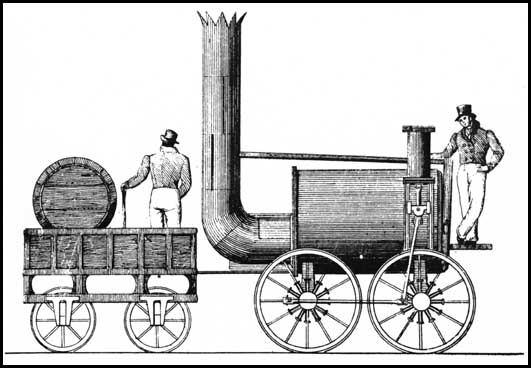
The front page of our present Number exhibits an external elevation of this engine and
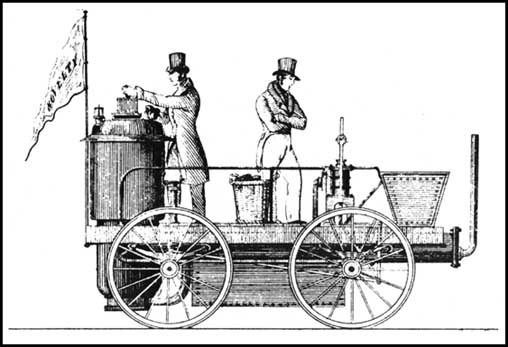
its tender; but on a scale one-half less than our engraving of "The Novelty." The
furnace A is two feet wide by three feet high, the boiler B is six feet long and three feet
in diameter. The furnace like that of "The Novelty" has an external casing between
which and the fireplace there is a space of three inches filled with water and
communicating with the boiler. The heated air from the furnace is circulated through the
boiler by means of twenty-five copper pipes of three inches each in diameter, which
have their termination in the tall chimney C. FG are safety-valves; HH the steam
eduction pipe. D one of the steam cylinders which have an angular inclination towards
the wheels, and embrace like two arms the boiler between them. E one of the
connecting-rods which give motion to the wheels; a, the slide of the piston of the
cylinder seen in the engraving; and o, one of two escape-pipes. M is the part of the
tender appropriated to the carriage of fuel; N the water-cask.
The performances of this engine indicate a very abundant and well sustained production
of steam; but the extent of surface which it has been found necessary to expose to the
heat, in order to obtain that effect, the great size of all the parts, and the quantity of
fuel required � are faults which even a still more copious generation of steam would
scarcely compensate. It is not by means of its heavy weight alone that such an engine
would operate injuriously on the rails. The chimney from its great height � a height
necessary to obtain that draught which in "The Novelty" - is produced hy means of the
air-forcing apparatus � gives a swaying motion to the engine from side to side; and the
rails have thus a lateral as well as a longitudinal force applied to jerk them out of their
places.
We observed in our first notice of this engine, (No. 322, p. 115) that it exhibited but a
very partial fulfilment of the condition that it should "effectually consume its own
smoke." As far as regards its performances on the first day of the competition, this
statement was perfectly correct. It is only fair however to state, that in its more recent
exhibitions there was scarcely any emission of smoke perceptible. We have heard that
on the first day there was an accidental intermixture of coal with the coke; a
circumstance which, if true, would sufficiently account for the appearance of smoke on
that occasion. Trivia on Richard Trevithick
This page was generated by HTMLed