The Book Title is
This is just a sample of this book !
It can be purchased from local merchants
Brobst, the miller and merchant, was striving and negotiating to have a bridge built across the river at Catawissa, he was also working on a scheme to open a canal from the Susquehanna River at Catawissa, up the Catawissa Creek, cross over the headwaters of the Catawissa Creek to the headwaters of the Little Schuylkill River, and then down the Little Schuylkill and into the Schuyl kill River to Philadelphia.
There was a matter of digging a canal three miles between the headwaters of the two streams, part of the way through a mountain. If his dream had materialized, he envisioned a canal from Philadelphia to Lake Erie. Brobst's map, dated June 1825, is still in existence showing the courses he would take to build this canal. His idea was that all the streams could be navigable by a series of dams. What caused him to desert the idea we do not know, but we know that by 1828, by use of his map for the canal, he himself being a member of the Legislature 'he was able to get the Legislature, (in 1828), to pass an act authorizing the Pennsylvania Canal Commission to employ a competent engineer to make surveys and examinations between a point on the Schuylkill canal near Pottsville, and a point on the Susquehanna River between the towns of Catawissa and Sunbury, as to the feasibility of building a railroad between these points." - County History 1915 p.44.
We quote from a railroad man's magazine "THE BIRTH OF THE PHILADELPHIA AND READING RAIL- ROAD .
" Christian Brobst spent much of his time on the banks of the Susquehanna River watching the rafts, arks. broad-horns and other rude craft float by. Being spirited he wanted his own town to derive some benefits from the river traffic. After studying for some time, it occurred to him that the solution of the problem was a railroad that would divert the up-coun- try trade through Catawissa to the Schuylkill, and thence to Philadelphia, instead of permitting it to continue down the Susquehanna and the Chesapeake to Baltimore. Brobst was decidedly in advance of his time for it was in 1822 only a year after the Stockton and Darlington of England had been chartered, after fierce opposition in Parliament, that he began to ponder the problem which seemed to be solved by railroad. Brobst was too shrewd to reveal his idea about railroads to his neighbors. By remaining silent, he succeeded in being regarded as a man of much sense, and in due time was elected to the legislature. For three years Brobst looked at the rafts and did much figuring. One day he went down to the village tinshop, where he ordered a tin tube about three feet long and an inch and a half in diameter. At each end was a hole in the upper side. In these he fixed glass bottles, using putty to hold them in Place. He went home, half-filled the bottles with water and calling his boys, Sam and Christian he struck out into the woods. Once out of sight of the town the astonished boys leered that their father actually proposed with their assistance to make preliminary survey for a railroad from Catawissa to Tamaqua, using the queer tube and bottles as a level.
Brobst could not procure the necessary instruments for surveying, but he had acquired sufficient ideas to serve his purpose. After the line had been run Brobst gathered up papers on which he had spent so many hours in computation and set out for Philadelphia. He went to the office of Stephen Girard, that eccentric capitalist of the early days. Here he exhibited the papers, and presented so - convincing an array of statistics and arguments establishing the possibility and prospects of his railroad scheme that one day during the summer of 1825. Girard accompanied by some other Philadelphia capitalists and Monroe Robinson, the brilliant young engineer, Proceeded to Catawissa on horseback. Brobst conducted them over the route of his proposed railroad. The party was favorably impressed with the route, with Brobst, and with his idea. Things moved slowly, for there was a most extraordinary prejudice, particularly in Pennsylvania, against railroads. It was not until March 31, 1831, that the Legislature granted a charter under which Christian Brobst, Joseph Paxton, William McKelfy, Ebenezer David and others were authorized to solicit subscriptions for building the little Schuylkill and Susquehanna Railroad. The road was ultimately built along Brobst's location. Engineers afterward marveled at the accuracy of the line run by the amateur with his home made level.This was the origin of the small railroads which later became the component parts of the great Philadelphia and Reading system. For many years after it was built it carried more traffic than any in the world. Today it ranks among the foremost in the world Brobst unfortunately, did not live to realize his dream."
The first train went from Port Clinton through Catawissa to Milton in the fall of 1854. Mr. Brobst died in January of 1849. "Another dream of his was the introduction of steamboats on the Susquehanna, a stream quite inad-equate for such use. Largely through Brobst's efforts the steamboat Codorus was built at York Haven, and in April 1826, proceeded as far as Wilkes-Barre.
This was regarded as proof of the practicability of the plan. A month later a second steamboat, the Susquehanna went up the river to Harrisburg, where a party composed of members of the legislate headed by Brobst, boarded it. On May 3, the Susquehanna arrived at Nescopeck Rapids, the most dangerous and difficult point yet encountered. The boat was stopped while an extra head of steam was raised by stuffing the furnace with "fat pine." As steam gauges had not yet been invented, the engine probably blew up soon afterwards, killing or injuring nearly all on board. Brobst was so badly hurt that he had to give up all active pursuits and eventually he died of his injuries . Thus came to an end the career of a remarkable. Columbia County man. His wife Barbara preceded him in death. She died the day before Christmas, 1847 He died January 14, 1849. They are both buried it, the Union Cemetery in Catawissa. After effort was made in vain to have the state agree to build the railroad from Catawissa across the mountains to Pottsville, an effort was made by citizens of Catawissa to interest men of money from Philadelphia to finance the project. On March 21, 1831, A charter was granted by the legislature to "appoint commissioners to open books for stock subscriptions' - 1915 History p.45. Christian Brobst and JosephPaxton were the Catawissa persons mentioned in connection with this effort. The organization was known as the Little Schuylkill and Susquehanna Railroad Company. Work was begun and continued through the years 1835 to 1838. A fifteen ton locomotive named the Catawissa was ordered to be built in England but it was not immediately used because the track was not laid at the time. The Schuykill Canal was frozen when the "Catawissa" arrived from England in 1833. The engine was taken apart and hauled by ox cart to Tamaqua. The Catawissa and anotherengine called the "Comet" were the first engines in the nation to transport coal. They were used on the Little Schuylkill Railroad to transport coal between Tamaqua and Port Clinton. We are indebted to two booklets on railroading for the materials in the preceding paragraph.
Early Transportation in Schuylkill County and This is the Reading 1950.
In 1838 the bank in Philadelphia,called the Bank of America, which had financed the project failed and the work was halted. Work was resumed in 1853 under the leadership of a new corporation called the Catawissa, Williamsport & Erie Railroad Company, chartered in 1850. Changes were made in the original construction and the project was completed from Port Clinton to Rupert in l854. By the fall of 1854 the road was completed to Milton where it joined the P. & E. Railroad.
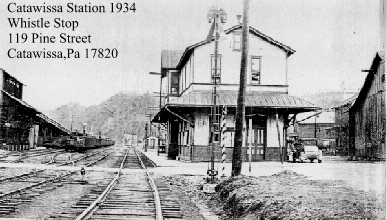
The first locomotive to be used on this line through Catawissa was called the "Massachusetts," built in the Commonwealth of Massachusetts by Hinkley & Duryea and delivered at Columbia, Pennsylvania, where it was loaded on a canal boat and brought to Catawissa, where a special track was laid to bring it ashore. It was put into use to lay the tracks within and out of Catawissa. The rails first used in the project were made at Danville and weighed 56 pounds to the yard. The "Massachusetts", later known as "Number 2" weighed twenty-five tons and was a wood-burner. Samuel Carpenter was the engineer and Frank Wright was the fireman, both from Columbia, Pennsylvania. Joseph Shuman, of Beaver Valley was hired as night watchman and engine wiper. The first train came into Catawissa on Sunday July 16, 1854 with William Cable as Conductor and John Johnson as engineer. The following day July 17 the train made its first regular run Catawissa to Port Clinton.
It is reported that there were thousands of people on hand in Catawissa from the town and from neighboring communities to see the train pull into town. In these days when the line was first open up as far as Catawissa, the locomotive was turned on a Y that extended from the old station to the river, and back to Robert's Run or what is now known as Corn Run.
The railroad repair shops were built in Catawissa in 1864. Repair work had been done, previous to that date in Tamaqua. The Catawissa, Williamsport, and Erie Railroad Company fell on hard times and was finally sold out in 1860 to a group calling themselves the Catawissa Railroad. In 1871, the Catawissa Railroad was extended from Milton to Williamsport with local resident William G. Yetter as assistant engineer. By 1882, Mr. Yetter, as resident engineer laid out the rail lines from Williamsport to Newberry Junction. In 1872, the Catawissa Railroad turned over its claims to the line to the Philadelphia and Reading Railroad Company.
A second railroad was builtthrough this part of Columbia County, known first as the Lackawanna and Bloomsburg Road, making it possible for residents of the Wilkes-Barre area to go to Philadelphia without going first to New York City. The road was completed to Rupert in 1857, connecting at first there with the Catawissa Railroad. The first train came to Bloomsburg January 1, 1858. Two years later the line continued to Northumberland. In 1881 it came under the control of the famous Lackawanna Railroad.
The 3rd railroad of interest to us at Catawissa was the Danville, Hazleton & Wilkes-Barre Railroad established in 1870 largely through the efforts of Simon P. Kase, who had built the second iron mill in Danville in 1837. In 1844 he built the first mill for the manufacture of merchant iron and in 1846 he built a rolling mill in Danville. In 1878 the name was changed to Sunbury, Hazleton & Wilkes-Barre R.R.This is the line that was built along the north bank of the Catawissa Creek through Main and Beaver Townships, connecting Catawissa with Hazleton and the hard coal region. This line was torn out about the year 1947.
The 4th railroad linethis one built through Catawissa was the North and West Branch Railroad was the brain child of the Rev. D.J. Waller, pastor of the Presbyterian Church in Bloomsburg. In fact, he wrote the charter for the road and the Honorable C.R. Buckalew had it passed by the Legislature in 1871. By 1881 it was built from Catawissa to Wilkes-Barre.
Gratefully we quote the NEWS ITEM concerning the events at the time the road was opened between Catawissa and Wilkes-Barre. "Twenty five years ago":
A special train passed over the North and West Branch Railroad on Tuesday November 14, 1882. The first passenger train ever run over the road. It carried the office furniture, stoves, etc. for the station, and the railroad officials and a few guests." - NEWS ITEM November 14, 1907."Twenty five years ago: The North and West | Branch Railroad was formally opened on Thursday | November 23, 1882. A special train from Sunbury to Wilkes-Barre took honored guests. A banquet was | held at the Wyoming Valley Hotel. Catawissans present were: Hon. M.G. Hughes, Hon. F.L. Shuman and wife, Dr. I.W. Willits and wife, Solomon Shuman and daughter. F.F.Merceron ,L.P. Osmun, J.H. Rinard, John Ritter, and G.E. Myers. - NEWS ITEM November 21, 1907
It came into the control of the Pennsylvania Railroad System in 1886. At the time of this writing it is operated by the Penn-Central Railroad. The rail line was badly damaged by the disastrous flood of June 1972 and has not been fully restored to use since that time.
Danville, Hazleton & Wilkes-Barre Railroad. Established in 1870

