Training was well underway before recruitment of the Accrington Pals battalion was completed on 24th September 1914. As early as the 18th, recruits had assembled at the Ambulance Drill Hall before marching to Ellison's Tenement where they practised drills and manoeuvres.1 In these early days, the drills evidently provided some amusement for the watching public; a letter to the editor of the Accrington Observer & Times complained:
"Raw recruits want drilling, and even the elementary evolutions cannot be learned all at once. It has been very trying, therefore, for those who have assembled for drill on Ellison's Tenement to have heard the giggles of idle women and frivolous girls, mixed with the sneers of the supercilious men at the slightest misapprehension and mistake of a man or two."2
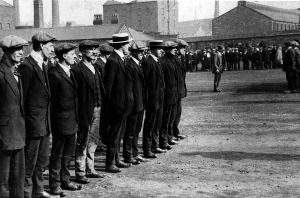
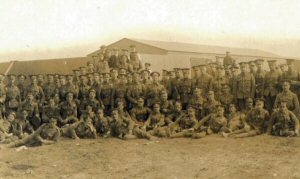
Above: Accrington Pals at Ellison's Tenement in Accrington. Photograph taken by Sam Harrison in 1914.
Click to enlarge |
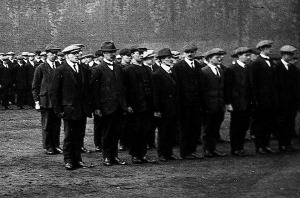
Above: On parade at Ellison's Tenement in Accrington. In the background, the second shed of the Accrington Corporation Tramways Department is under construction. Photograph taken by Sam Harrison in 1914.
Click to enlarge |
Until the full battalion moved to Caernarvon in February 1915, the four companies trained separately in their home towns of Accrington, Burnley and Chorley. The recruits were paid 21 shillings (£1.05) each week, part of which was a billeting allowance while the men continued to live in their own homes. Until blue uniforms were delivered towards the end of November, the recruits trained in civilian clothes. The first batch of rifles, outdated Lee-Metfords, arrived early in October but these were to be used only for drill purposes.
On most days the Accrington companies were to be found practising drill on Ellison's Tenement or taking part in marches through the town and district. On the Saturday following the end of recruitment, crowds of spectators turned out to watch as the Accrington Old Band led the battalion on a march through the town's streets.3
The Accrington Gazette of Saturday 2nd January 1915 gave a detailed account of the Pals' activities through the week:
Following the Christmas break, the battalion resumed duties at the usual hour on Monday morning, and have been busy during the week in entrenching exercises4 and company drill.
On Monday night Captain Broadley gave a lecture at the Drill Hall, taking as his subject "Advanced and flank guards", his remarks being illustrated by means of a large cartoon. On Tuesday Lieut. Rawcliffe gave a very interesting lecture on the history of the British Army, which, naturally, was much appreciated by the men. On Wednesday there was bathing, as usual, and on Thursday company and entrenching drills. Yesterday (New Year's Day) duties were suspended. This (Saturday) morning drills will be resumed, and in the afternoon there will be a route march. To-morrow (Sunday) the members of the battalion attend St. James' Church, whilst the Roman Catholics in the battalion will attend Altham Chapel.5
By the New Year, the recruits had at least received a supply of miniature rifles and ammunition for shooting practice. Although recruitment of a reserve company of 250 men was well underway at the start of the new year, it was slow to complete, perhaps because of the news that broke in mid-January of Accrington's Mayor, Capt. Harwood, being asked by the War Office to provide a local brigade for the Royal Field Artillery.6, 7
By February 1915, the decision had been made to bring the companies together, not at Accrington, but at Caernarvon. After a farewell service at St. John's Church, Accrington on 21st February, the Pals were given "a real good send-off" when they left for North Wales two days later. The men were billeted with the townspeople of Caernarvon and continued to enjoy many of the comforts of home-living. A step-up in professionalism took place on 1st March when Lt.-Col. Arthur Rickman, a Regular Army officer of the Northumberland Fusiliers, took over command of the battalion from Col. Richard Sharples. Training was stepped-up, and the temporary blue uniforms were replaced by khaki.
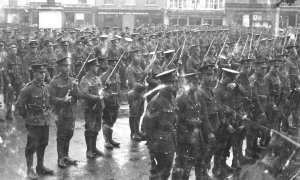
Above: On parade at Caernarvon. Photograph courtesy of John Garwood.
Click to enlarge |
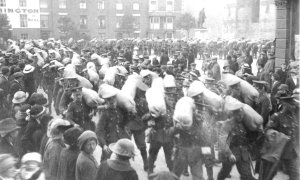
Above: Leaving Caernarvon on 12th May 1915 for Penkridge Bank Camp. Photograph courtesy of John Garwood.
Click to enlarge |
Many a romance had blossomed at Caernarvon, and it was with much regret that the battalion left for the far less comfortable surroundings of Penkridge Bank Camp, Cannock Chase on 12th May. It was at Penkridge that the battalion joined the 12th, 13th and 14th Battalions of the York & Lancaster Regiment8 to form 94th Infantry Brigade.
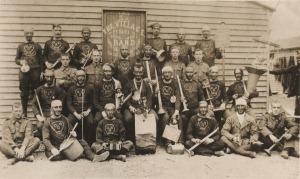
Penkridge also saw the formation of the 'Village Band', their uncoventional instruments having been provided by Accrington's 'Lang Bridge's Band'. 17996 Pte. James Birch wrote:
"On Monday, June 21st, some of our boys carried the instruments three miles from the station to the camp. The first night these merry 'Pals' marched up in fours, playing 'Bluebells of Scotland'. Soon all the men came out from their huts quite surprised, and also from the other lines, in fact, the officers all turned out with a smile on their faces, and contributed to the collection. On Wednesday the last batch left camp for their four days' leave home, and the Band turned out, formed up on the square, playing 'Bluebells of Scotland', 'Home, Sweet Home' and many other ditties, which sent the boys home with a cheerful smile upon their sunburnt faces."9
Above: Accrington Pals at Penkridge Bank Camp, Cannock Chase. Photograph courtesy of Paul Harrison.
Click to enlarge |
Above: The 'Village Band' formed by men of X (District) Company. Photograph courtesy of John Garwood.
Click to enlarge |
At the end of July, the battalion left Penkridge to make a recruiting march through its home towns in East Lancashire before moving into huts at Ripon Camp where training focused on rifle shooting. The home leave that was granted from Ripon would be the last for a long time for all but a lucky few, and the last of all for many.
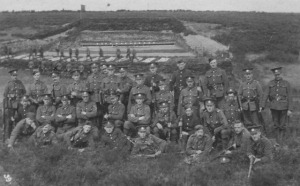
Above: X (District) Company group above a rifle range at Ripon in August or September 1915. 15925 Pte. William Henry Parkinson is third from left in the back row. Photograph by kind courtesy of Gilbert Parkinson.
Click to enlarge |
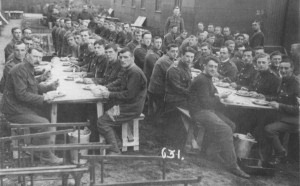
Above: X (District) Company eating dinner at Ripon South Camp. 18048 Pte. Stanley Bewsher is seated second from the front, in the third row from the left. Photograph courtesy of John Garwood.
Click to enlarge |
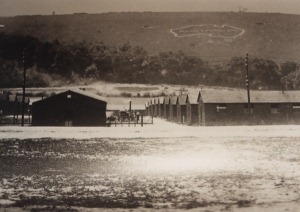
In September, the battalion moved again, this time to Hurdcott Camp10 near Salisbury where Major E. L. Reiss replaced Major George Slinger as 2nd in command. Apart from a few days spent on the rifle range at Larkhill, the battalion remained at Hurdcott waiting for orders to move overseas. Advanced parties of the battalion were sent to Le Havre on 30th November, only to be recalled the following day. On 2nd December, 31st Division - now comprising 92nd, 93rd and 94th Infantry Brigades - was ordered to prepare to embark not for France but for Egypt.
Above: Hurdcott Camp, and the map of Australia carved into the hillside in 1916. Photograph by kind courtesy of Phil Guest.
Click to enlarge |
Above: Then and now - the same scene in 1999.
Click to enlarge |
Francis Macalpine, who served with the battalion throughout the war, later wrote:
"The change which had taken place in each member of the battalion between August, 1914, and December, 1915, was perhaps scarcely realized at the time; but considering that the men had been drawn from the mine, factory or office, and the officers from business, college or profession, the discipline and the regard for regimental tradition were remarkable."11
Notes
- Accrington Observer & Times, Saturday 19th September 1914, page 5.
- Accrington Observer & Times, Saturday 26th September 1914, page 8.
- Accrington Observer & Times, Tuesday 29th September 1914, page 1.
- The Pals practised digging trenches on the Coppice - overlooking the town of Accrington - and Moleside. Click here to view a 360-degree panorama from the Coppice.
- Accrington Gazette, Saturday 2nd January 1915, page 8.
- Accrington Gazette, Saturday 16th January 1915, page 4.
- Recruitment for the Accrington & Burnley Howitzer Brigade (later 158th Bde., Royal Field Artillery) began on 6th February 1915.
- The Sheffield City Battalion, and the 1st and 2nd Barnsley Pals.
- Accrington Observer & Times, Saturday 3rd July 1915, page 10.
- More information on Hurdcott Camp can be found in the 'World Wars' section of the Fovant History Interest Group website.
- "The History of the East Lancashire Regiment in the Great War" edited by Major General Sir N. Nicholson. The chapters on the 11th Battalion were contributed by Francis Macalpine.
© Andrew C Jackson 2004
Email:
Compiled from "The History of the East Lancashire Regiment in the Great War" edited by Major General Sir N. Nicholson, quoted sources, and with the kind help of John Garwood, Phil Guest, Peter Johnson and Gilbert Parkinson.