William Penn Highway
William Penn Highway
If Bud Shuster can get a highway, can't the founder of Pennsylvania get one as well? The difference between the two is that William Penn legitimately got this highway that traverses the center of the state named after him by other people.
The highway pretty much follows the route it used to take. Near Pittsburgh, it followed Old Steubenville Pike and current PA 60 to enter the city. In Pittsburgh, it followed Carson Street to the Point Bridge, across the Point Bridge to the Boulevard of the Allies, to Forbes Avenue, to Beeler Street, to Wilkins Avenue, to Dallas Avenue to Penn Avenue and onto Ardmore Boulevard. From Mundys Corners to Ebensburg, through Loretto, Cresson, to Altoona, then through Williamsburg. Routed from New Bloomfield to Mecks Corners and Ducannon and east from Harrisburg to Reading on the current US 422 alignment. From Reading it followed the current US 222 alignment to Allentown. In Harrisburg, the route followed River Road, Front Street, Chestnut Street, Mulberry Street, and Derry Street. In Reading, the route followed Penn Street and 9th Street. In Allentown, the route followed Hamilton Street, in Bethlehem it followed Broad Street, Linden Street, and Eastern Avenue, in Easton it followed Butler Street, Walnut Avenue, and Northampton Avenue.
In 1927, the highway followed an alignment from Mill Creek to Reedsville and was moved the current alignment in 1929. Also in that year, the highway was still dirt from West Virginia to Florence, under construction from Florence to near Imperial. The highway was still dirt from outside Newport to Amity Hall. In 1929, the highway was under construction from West Virginia to the Allegheny County line, and was unimproved from Frankstown to Canoe Creek. The route was also rerouted to bypass Williamsburg.
In 1930, the section from Strodes Mills to Lewistown was under construction and was completed the following year.
Planning for altering the designation between Harrisburg and Allentown began in 1930. On November 8, 1930, Fred L. Shankweiler, president of the backing organization for the William Penn Highway, wrote to the American Association of State Highway Officials' Executive Secretary, W. C. Markham: "We also hope that you will use your influence to see to it that the Wm. Penn Highway, as it now runs from Harrisburg to Allentown, be not changed. In other words, we seriously hope that you will not concur with the recommendations of some highway officials that the present Route 43 be designated as the Wm. Penn Highway. Inasmuch as the prevailing public now knows the Wm. Penn Highway and also for the benefit of the towns located along the present Wm. Penn Highway, it is very important that this remain as it is as present."
Markham replied on November 10 that the highway designation would not be discussed during the annual meeting in Pittsburgh. He referred Shankweiler to the Pennsylvania Department of Highways because AASHO did not concern itself with naming highways."
Chief Engineer Samuel Eckels informed Markham on June 3, 1931, of several desired changes in the US highway system. One involving US 22: "I am calling your particular attention to Route 22 between Harrisburg and Allentown, familiarly known in the State of Pennsylvania as the William Penn Highway. We have constructed a new route between Allentown and Harrisburg which is probably the highest speed road in our entire State and is used by practically all through traffic over the William Penn Highway between Harrisburg and Allentown." On June 8, 1931, AASHO's Executive Committee approved the changes in Pennsylvania and they were printed in the 1932 route log. The Department of Highways moved the "William Penn Highway" name to the new route of US 22.
PA 43 which was replaced with the US 22 designation would resurface as the Schuylkill Expressway in the 1950s and then the Mon-Fayette Expressway in the 1990s.
In 1931, the highway was improved from Frankstown to Canoe Creek, and the designation was moved to 5th Street in Reading.
In 1934, the highway was under construction from Mundys Corners to four miles east of town. The designation was moved in many locations in 1934. In Harrisburg, the designation was moved to 4th Street, Walnut Street, and State Street. In Allentown, the designation moved to Tilghman Street and Union Boulevard. In Bethlehem, the designation was moved to West Union Boulevard, Main Street, and Elizabeth Avenue. In Easton, the designation was moved to 13th Street from Walnut Street. Also in 1934, the highway was rerouted from Ebensburg to Cresson. In 1935, the designation was moved yet again in Harrisburg to follow Maclay Street and Cameron Street to State Street. The new alignment opened near Mundys Corners. In 1939, widening work began on the highway from Cliff Mine to Pittsburgh, Pittsburgh to Penn Hills, Lewistown to Mifflintown, Speeceville to east of town, PA 443 to Harrisburg, and Walbert to Allentown.
The 1940s began with widening work continuing along the route. In 1940, the highway was widened from Summit to east of town, west of Yellow Spring, and Harrisburg to Progress. In 1941, widening continued with work happening from one mile east of US 119 north to 1 mile west of PA 259, Cresson to Summit, one mile east of Duncansville to Hollidaysburg, one mile east of Mill Creek to Mt. Union, one mile east of Harrisburg to Frankstown, Progress to Paxtonia, PA 72 to east of Jonestown, and in Hamburg. Construction halted during the war, but picked up in 1945 with widening taking place west of Bavington, Penn Hills to Newlonsburg, west of Mill Creek to the town, Speeceville to Dauphin, Paxtonia to Jonestown, Fredericksburg near PA 343, and east of PA 100 to Walbert. The designation moved to North Street (westbound) and Walnut Street (eastbound) to State Street in Harrisburg. Another move in designation happened in Easton, when US 22 and Alternate US 22 switched routes. US 22 moved to Pearl Street and Bushkill Street. In 1948, the highway was completely widened from Harrisburg to Fredericksburg. In 1949, more widening took place from west of Five Points to east of New Alexandria, Huntingdon to Mill Creek, Clarks Ferry to Speeceville, and Harrisburg to the Berks County line. That same year, construction began on two new alignments of US 22: Newlonsburg to east of Delmont and south of Huntingdon.
The 1950s continued to see widening work on the highway. In 1950, the section from the Clarks Ferry Bridge to Amity Hall was widened. Also in that year, two new alignments opened to traffic: south of Delmont and south of Huntingdon. Construction on a new alignments began in 1950 north of Bethel to Schubert. In 1951, construction commenced on the long-awaited Penn-Lincoln Parkway in Pittsburgh while the new alignment from Bethel to Schubert opened.
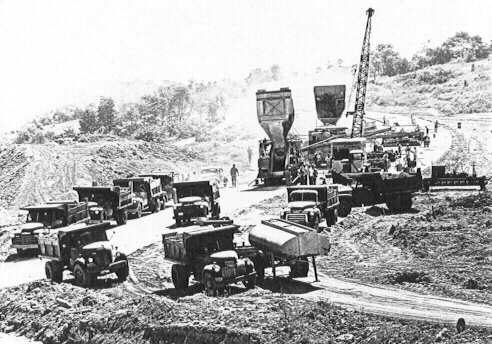
Penn-Lincoln Parkway under construction at the Campbell's Run
Interchange in
1951. (Clyde Hare)
In 1952, the highway moved to the current alignment from New Alexandria to Blairsville and construction began from Blairsville to US 119 north. Widening continued in 1952, with the sections from Dauphin to PA 443, west of Lenhartsville to town, a section west of Krumsville, Upper Bern, Krumsville, and Fogelville, and at the Berks/Lehigh County line. That same year, construction began on the Lehigh Valley Thruway. In 1954, the Penn-Lincoln Parkway opened to traffic, and for the complete history see the Interstate 279 or Interstate 376 pages. Other new sections of the highway to open were near Blairsville, and the Lehigh Valley Thruway from west of Allentown to PA 987. The expressway was still under construction to the New Jersey state line. Construction began on a new alignment from Schubert to Shartlesville. In 1955, the Lehigh Valley Thruway opened to traffic completely to the New Jersey state line. Another new alignment to open was from Schubert to Shartlesville that same year. In 1956, the highway was widened from Ebensburg to Munster. That same year, the designation was moved to Forester Street and 7th Street in Harrisburg. In 1957, construction commenced on a new alignment from Shartlesville to Hamburg. In 1958, US 22 was divided at the US 22/PA 66 interchange, a section west of New Alexandria, and west of Duncansville. The highway was divided from the end of the Penn-Lincoln Parkway in Churchill, to Murrysville, Blairsville to east of the US 119 north interchange, Cresson to the Blair County line, a section to the east of the county line, sections from Alexandria to Ardenheim, Speeceville to Amity Hall, and in Dauphin. That same year, construction began on the Lewistown Bypass while the designation for westbound travel was moved in Harrisburg to 2nd Street and Division Street. In 1959, construction began on a new alignment north of Mundys Corners and south of Ebensburg. That same year, the Lewistown Bypass opened to traffic. A new alignment opened from New Smithville to PA 100.
The 1960s saw the highway begin to be upgraded to accommodate more and more traffic. In 1961, with congestion increasing in the Monroeville area and with the prospect of routing I-70 through Pittsburgh, the Pennsylvania Department of Highways began construction on the Penn-Lincoln Parkway Extension from Business US 22 to the Pennsylvania Turnpike. That same year, work began on another new alignment from Mundys Corners to east of Ebensburg. The following year, the Penn-Lincoln Parkway Extension opened to traffic and provided a bypass around the busy Monroeville "Miracle Mile" shopping area. Work began on another alignment in 1962 from Clyde to PA 403. In 1963, construction began on the section of the Penn-Lincoln Parkway from US 30 west to PA 60. In 1964, that section opened to traffic while work then shifted to the section from the Washington County line to the US 30 west interchange. Construction also began on another section of expressway in central Pennsylvania from south of Newport to Amity Hall. Also that year, the new alignment from Clyde to PA 403 opened including an interchange with PA 56. In 1965, the sections of expressway from the Washington County line to the US 30 west interchange and from Newport to Amity Hall open to traffic, while work began on the next section from Newport to Newport westbound exit. The next year, the expressway was under construction from the Juniata County line to Newport. In 1967, construction was extended from Thompsontown to the Perry County line and it opened to traffic from Millerstown to the exit after Newport. In 1969, construction began on the expressway from PA 18 to the Allegheny County line, while at the same time the section from Thompsontown to Newport.
The first year of the 1970s saw construction extended from PA 18 to the West Virginia state line. In 1971, the expressway opened from the West Virginia state line to the Allegheny County line. This now provided Weirton, WV a limited-access, high-speed highway connection to Pittsburgh. In the central part of the state, construction commenced on the section from Dauphin to Harrisburg. In 1972, construction started on the section of expressway west and north of Cuba Mills and from Mexico to the Thompsontown interchange east of town. In 1973, construction extended from Cuba Mills to Mexico. In 1975, the expressway opened from Cuba Mills to Thompsontown. In 1979, the expressway opened from PA 443 to Cameron Street in Harrisburg. With that opening, the designation was rerouted onto Arsenal Boulevard and Herr Street to replace the Alternate US 22 designation.
The 1980s were a slow period in the history of US 22. In 1982, construction began on the expressway from Ebensburg to I-99/US 220 and opened to traffic in 1984 from Ebensburg to PA 764. One year later, the remaining section from PA 764 to I-99/US 220 opened.
The 1990s for US 22 were one of rebuilding. A monumental project to widen US 22 through Westmoreland County, as was done to US 30 through the southern part of the county, began in 1993. Traffic has steadily grown on the corridor over the years, and with the poor condition of the highway such as only three lanes in locations, something had to be done to bring it up to standards. Construction commenced to widen and divide the highway from PA 66 to Five Points. One year later, that work was complete and then construction on the section from Five Points to US 119 began. That section was completed in 1995. On the other side of the state, construction began to upgrade the Lehigh Valley Thruway in 1998 and finished in 2000. Construction began on transforming the US 22 interchange with PA Turnpike 66 from a cloverleaf into a SPDI (Single Point Diamond Interchange) on April 5, 1999. On October 9, 1999, the beams were lifted into place for the new bridge that carries US 22 over PA 66. The interchange partially opened on August 31, 2000 then completely opened on September 14, 2000. The entire project cost $23 million. "It's a diamond interchange, but it's not a normal diamond because it has two connecting legs and two lights on each side. This has one light on each side, and moving traffic is a lot more efficient. I went through it a couple of times this morning, it's a very slick operation," said Mike Dufalla, PENNDOT District 12 engineer said on the day it opened.

The completed SPDI facing eastbound. (PENNDOT)
In 1997, construction began on the Dauphin Bypass, a segment of expressway from PA 325 to PA 443. The Bypass opened to traffic in 1999 and the latter section opened in 2000.
The first decade of the 21st Century saw work continuing with more widening and dividing continuing in Westmoreland County. The next section to be widened and divided from US 119 to PA 981 in New Alexandria. The $20.5 million project began in 2001 and finished in 2003. Project website: http://www.renew22.com/.
In April 2000, construction began on the Northern Lewistown Bypass near Oliver. The 12 new miles of US 522 will include a new interchange with Electric Avenue and US 322 near Lewistown. The cost of this project is estimated at $130 million, and is to be completed in late 2004. Project website: http://www.penndot2.com/mifflin/index.html or http://www.pb4d.com/projects/highways/route220/route220.htm.
On January 4, 2001, construction began on the Water Street Bypass in Huntingdon. The highway will be improved, such as a new bridge over Shaffer's Run to replace the one that has been there since the 1930s, and improvements to the US 22/PA 453 intersection. Construction was completed in 2002.
In August 2001, construction began to replace the existing interchange at US 119, east of Blairsville. This is being done in conjunction with a widening project of US 119 north of US 22. The project's estimated end is in Summer 2003. Project website: http://www.119south.com/.
Further down the highway, the state is looking to widen and realign the highway from US 119 north to Armagh. Carl Young, who owns Young's Garage said, "They've been talking about that highway since 1970." He added that two of his three garages would have to go to make way for the wider US 22. Another business owner, Len Lichtenfels of Len's Auto at the corner of US 22 and Bowser Road said, "I'm not one to fight it. I might bite my tongue off later, though." He would lose the most with his house sitting right behind his business. "The house, that's going to be the kicker," he said. "That's where the fight is."
Another dangerous section of US 22 is the expressway through the Lewistown Narrows, which is currently the most dangerous stretch of highway in Pennsylvania. The highway connects two sections of expressway by a two-lane highway. Construction is projected to begin in the spring of 2002, and be completed in late 2004. Project websites: http://www.penndot2.com/route22_322/index.html or http://www.eadsgroup.com/narrows/.
A sinkhole developed on the section of expressway known as the Penn-Lincoln Parkway West in North Fayette near the Tonidale exit on March 7, 2002. The two-foot-deep, 60-foot long dip occurred in the left lane of the highway, but affected the right lane as well. PENNDOT blamed mine subsidence for the creation of the sinkhole. Crews worked around the clock to fill the hole with grout, as was done in construction projects in eastern Pennsylvania. All lanes were reopened on March 13.
Links:
Exit Guide
US 22 Auxiliary Routes
US 22 Pictures
US 22 Expressway
Interstate 279
Interstate 376
Interstate 78
E-ZPass - Delaware River Join Toll Bridge Commission
Easton-Phillipsburg Toll Bridge
- Delaware River Joint Toll Bridge Commission
Route
22 Lewiston, Pennsylvania - Parsons Brinckerhoff
US 22/US
522
Northern Lewiston Bypass Project
US 22 Long Range Planning
(Lehigh County)
US 22 Widening (Westmoreland
County)
US 22 - The William Penn Highway - Federal Highway Administration
Field
Notes-Squirrel Hill Tunnel and Penn Lincoln Parkway East - Bruce Cridlebaugh
Fort
Pitt Bridge - Bruce Cridlebaugh
Fort
Pitt Tunnel - Bruce Cridlebaugh
Penn-Lincoln
Parkway East Structure Tour - Bruce Cridlebaugh
Squirrel
Hill Tunnel - Bruce Cridlebaugh
'Tard
of the Month: May 1998-US 22/30 Reconstruction
Terminus of US 22 - Dale Sanderson
US
22
Junction List - Tim Reichard
US
22 Pictures - Andy Field/Alex Nitzman
US 22/US
322 Pictures - Andy Field/Alex Nitzman
 INFORMATION |
|
| Western Entrance: |
West Virginia state line near Paris. |
| Eastern Entrance: |
New Jersey state line at the Easton-Phillipsburg Toll Bridge in Easton. |
| Length: | 319 miles |
| National Highway System: |
Entire length |
| Names: | William Penn Highway Penn-Lincoln Parkway: US 30 to I-76 Twenty-Eighth Division Highway: Lewistown to I-81 78th Division Highway: Exit 8 to Exit 51 of I-78 Lehigh Valley Thruway: I-78 to the New Jersey state line |
| SR Designations: |
SR 0022 SR 0279: I-79 to Exit 6A SR 0376: I-279 to I-76 SR 0078: Exit 8 to Exit 51 |
| Counties: | Washington, Allegheny, Westmoreland, Indiana, Cambria, Blair, Huntington, Mifflin, Juniata, Perry, Dauphin, Lebanon, Berks, Lehigh, and Northampton |
| Expressway: | PA 978 to I-79 I-79 to I-76 Ebensburg to PA 764 West of Cub Mills to PA 325 Dauphin to Harrisburg Exit 8 to Exit 51 on I-78 Allentown to Easton |
| Multiplexed Routes: |
US 30: PA 978 to Exit 8A of I-376 I-279: I-79 to Exit 6A US 19: Exit 5A to Exit 5C of I-279 Truck US 19: Exit 5C to Exit 6A of I-279 I-376: I-279 to I-76 US 119: New Alexandria to Blairsville PA 655: Mill Creek to Mapleton PA 764: Cross Creek to Duncansville Business US 220: Duncansville US 522: Mount Union to Lewistown US 322: Lewistown to Harrisburg I-78: Exit 8 to Exit 51 PA 343: Fredericksburg |
| Former Designations: |
PA 3 (1925 - 1926) PA 43 (1928 - 1932): Harrisburg to Allentown |
 Pittsburgh Belt System: |
Oakdale interchange to PA 60 |
  Path of Progress: |
SR 2014 to SR 4001 in Cambria County SR 4008 in Blair County to US 522 in Mount Union |
 Traffic Conditions: |
Fort
Pitt Tunnel - PA 60 (Westbound) PA 60 - Fort Pitt Tunnel (Eastbound) Fort Pitt Tunnel - Carnegie (Westbound) Carnegie - Fort Pitt Tunnel (Eastbound) Monroeville - downtown (Westbound) Downtown - Monroeville (Eastbound) Churchill - downtown (Westbound) |
 Traffic Cameras: |
Red Bull (Eastbound) Settlers Cabin (Eastbound) Bishops Corner (Eastbound) Campbells Run (Eastbound) I-279 Interchange (Westbound) I-79 Interchange (Southbound) Rosslyn Farms (Northbound) Carnegie Interchange (Northbound) Greentree Interchange (Northbound) Greentree Hill-Top (Southbound) Greentree Hill-Middle (Northbound) Banksville Interchange (Southbound) Fort Pitt Tunnel Garage (Southbound) Commonwealth Place (Westbound) Ft. Pitt Boulevard (Westbound) Grant Street (Eastbound) County Jail (Eastbound) Birmingham Bridge/Bates Street (Eastbound) Bates Street (Westbound) Swinburne Street (Eastbound) Saline Street (Westbound) Beechwood Boulevard (Eastbound) Commercial Street (Westbound) Swissvale (Eastbound) Edgewood (Westbound) Brinton Road (Westbound) Forest Hills (Westbound) Wilkinsburg (Eastbound) Greensburg Pike (Westbound) Chruchill (Eastbound) Penn Hills (Eastbound) |
| Area Codes: | 724/878: West Virginia state line to the Allegheny County line;
Allegheny County line to the Cambria County line 412/878: Washington County line to the Westmoreland County line 814: Indiana County line to the Perry County line 717: Juniata County line to the Berks County line 610/484/835: Lebanon County line to the New Jersey state line |