
Vietnam Veterans Memorial Highway
Vietnam Veterans Memorial
Highway
The major north-south highway along the East Coast, Interstate 95 was originally planned by the City of Philadelphia as a link between the Port of Philadelphia, downtown, and points northeast. In 1937, engineers from the city's planning commission proposed an elevated highway from Delaware Avenue to Center City. The plan was rejected due to the findings that the support columns would interfere with port operations. In 1945, Department of Highways engineers reviewed the plans, and two years later both the Bureau of Public Roads and the Philadelphia City Planning Commission approved the path of the expressway. Original price tag for the construction was $180 and would conclude in 1960.
Early in the planning stages, the project was studied as a potential toll highway to pay for construction. The highway was to be built as the Philadelphia Loop Extension and become a part of the Pennsylvania Turnpike Commission's plan for a statewide system of limited access toll highways. However, in 1956 when the Interstate Act was passed, the project was handed back to the then Department of Highways.
Originally, Pennsylvania wanted to route I-95 along the US 13 corridor, leaving the current one at Exit 40. New Jersey did not like this routing on the basis that it would overtax the four-lane Trenton Toll Bridge and Trenton Freeway. The states studied three alternatives for a crossing: Scudder Falls west of Trenton, the existing Trenton Toll Bridge, and Biles Island to the east of Trenton. The two states approved the Scudder Falls crossing in 1960 and the Bureau of Public Roads approved the new alignment of I-95 in 1964. This is why a direct connection between the Pennsylvania Turnpike and the Interstate was not constructed.
The first section to open was the 1,740 foot-long Scudder Falls Bridge between Pennsylvania and New Jersey. Constructed in the late 1950s, the bridge would not open to traffic until June 22, 1961 due to incomplete approaches on both sides of the bridge. The bridge is not tolled itself, but instead relies on the funds from the other bridges under the Delaware River Joint Toll Bridge Commission jurisdiction for support.
Construction began in 1962 on two sections: from Exit 2 to US 13 near the current Exit 7 and from Exit 35 to Exit 40. These first two sections of Interstate 95 opened in 1965.
Controversy began to brew in 1961 as the Interstate's future route was being planned into Center City. The 1955 report from the engineering firm of Madigan-Hyland called for a six-lane elevated highway through this area, but later changed to an eight-lane design in 1959. The project would encompass urban renewal with the demolition of empty warehouses for the Interstate and the Penn's Landing development. In 1963, upon seeing a model of the elevated expressway through the proposed Penn's Landing development, architect Frank Weise got a hold of Edmund Bacon, the chief planner at the city planning commission, and warned him that the expressway would sever the link between the city and the river. Weise created a team to find alternate designs and submitted their findings to the Department of Highways. Highway officials tapped the design firm Ammann and Whitney to design an eight-lane depressed expressway, two years after Weise and his team began developing alternate designs. To ensure this section wouldn't become an eyesore, the City Council sought and ultimately obtained Interstate highway funds to implement the Ammann and Whitney design, which was today's Penn's Landing.
In 1965, construction commenced on the section from just south of Exit 32 to Exit 35 and opened the following year to traffic. In 1967, construction began on the section from the Delaware state line to Exit 2 and from Exit 23 to Exit 32. In 1968, construction concluded on the section from Exit 25 to Exit 32. That same year, work on the Interstate moved to the suburbs, as construction commenced on the section from Exit 46 to the Scudder Falls Bridge in Bucks County. In 1969, the section from the Delaware state line to Exit 2 opened, while construction began around Exit 9, between Fort Mifflin and Exit 17, and from Exit 40 to Exit 44.

Clearing for the I-95 alignment in 1968. (Philadelphia Inquirer)
In 1970, the section from Exit 46 to the Scudder Falls Bridge opened to traffic as did the section from Exit 23 to Exit 25. In 1973, the section from Exit 40 to Exit 44 opened to traffic and construction was extended from near Exit 7 to near Exit 9. The following year, the section around Exit 9 opened to traffic, which extended from Exit 8 to Exit 10 and included the ramps to and from PA 291. In 1974, construction also continued on the section near the Naval Shipyard from Exit 15 to Exit 20. In 1975, the section from Exit 7 to Exit 8 opened to traffic and construction began on the sections not already underway between Exit 10 and Exit 23 which included the double-deck Girard Point Bridge. This meant that I-95 was either open to traffic or under construction through the Commonwealth. In 1976, a two mile section between Enterprise Avenue and Broad Street opened. In 1977, the section between Broad Street and the Schuylkill Expressway/Walt Whitman Bridge interchange opened.
The 1980s began with the 10 mile section from Exit 13 to Exit 23, which passed right through downtown Philadelphia and under Penn's Landing where the USS Olympia is docked. The remaining four-mile section between Exit 10 and Exit 13 would seem like a cake-walk to finish; however, engineering, environmental, and fiscal problems would befall this part. The engineering and environmental problems were with the city's water supply, which is separated from the sludge discharge by the sewage treatment plant by a layer of clay. Engineers were faced with a dilemma of having to pierce the clay with support pilings, and not contaminate the city's water supply. It was remedied with workers inserting a cylinder partway into the clay, and removing the sludge from inside. With the inside of the cylinder cleaned out and sealed, it was safe to insert the pilings into the clay. The financial problems were due to the Pennsylvania legislature voting down implementation of an emission program in 1981. In reaction, the Federal government suspended highway funds for projects within the Commonwealth which did not impact I-95 construction immediately, but would have affected continuation of the construction. Pennsylvania began emission testing in 1983 and thus regained highway funds for projects.

View of Interstate 95 from Penn's Landing. (Alex Nitzman)
The section finally opened, and thus completed Interstate 95 in Pennsylvania on December 15, 1985. This section includes collector-distributor highways on the outside of I-95 to serve Philadelphia International Airport and ramps leading to Island Avenue. The entire Interstate cost more than $500 million to build, with $191 million of that being spent on that final section alone.
In the late-1980s, PENNDOT opened previously constructed ramps for the Crosstown Expressway at Exit 20. Originally, they were planned to connect I-95 to I-695 and were built even after it was removed from state plans in 1974. Residents feared that the ramps would lead to a revival of the expressway plans, but in 1982, PENNDOT reached a compromise with community leaders which cleared the way for connections to surface streets.
In 1996, a fire broke out under the elevated section between Westmoreland Street and Tioga Street and caused three spans of the 26-span, 1,707-foot-long Westmoreland Viaduct to buckle. The cause of the fire was discarded tires in an illegal dump underneath the viaduct. Temporary spans were constructed to carry the Interstate traffic, and within weeks, the damaged section was replaced with costs running into the millions.
Fire also played a role in the history of the highway only a mere two years later. On May 23, 1998, the driver of a tanker truck loaded with 8,700 gallons of gasoline, while swerving to avoid a passing car, jumped the Jersey barrier and exploded after striking a pickup truck in the southbound lanes. The drivers of both vehicles died at the scene. Nine steel support girders, each six feet in length, eight inches tall, and between 65 and 80 feet long of the bridge crossing the Chester Creek were damaged. During five weeks, PENNDOT spent $3.5 million to rebuild the bridge and open it in time for the Independence Day weekend.

Chester Bridge accident (Pittsburgh Tribune-Review)
For the Northeast, the summer of 1999 was not a pleasant one. It was so hot on July 5, the southbound lanes near the Street Road Exit buckled. Then if that wasn't bad enough, a 10 inch-high heave was discovered by PENNDOT workers on the northbound lanes at the same exit on July 6.
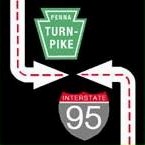 There is now a plan to connect
I-95 to I-276. This plan would "finish" Interstate 95 from Philadelphia to New
York City. The plan would also mean that I-276 would end at another
Interstate, instead of disappearing at the PA/NJ border. The current
highway after I-276 would receive the Interstate 295 designation. Until the late 1960s,
I-95 and US 13 were designated on the same highway. This would have provided
a direct connection to the Turnpike, but because of environmental reasons
the highway could not be built north from the Turnpike. That is how the current
alignment in that area came into existence.
This is just part of the work that would be done in this area. Also included in this project is construction of a mainline toll barrier just east of the Neshaminy Service Plaza, which is just east of Exit 351. With the new toll barrier in place, the remainder of the highway from there to the bridge would become a coin-drop system. This would allow the new interchange to be a high speed interchange with no toll plaza. Widening of I-276 from Exit 351 to the Delaware River Bridge. Construction of a second Delaware River Bridge, paralleling the existing bridge, which would increase the capacity to three lanes in each direction. With these three projects, a completion date of 2016 has been given for the all of the work to be completed. However, as mentioned above, the interchange would be completed much sooner.
The Draft Environmental Impact Study has recommended the following for the new toll plaza, interchange, and bridge:
|
|
|
|
|
|
On January 6, 2004, the US Department of Transportation approved the environmental impact study. "Late 2007" is the "optimistic forecast" for groundbreaking for the first part, a new toll plaza, said PTC spokeswoman Christina Hampton after the announcement was made. Project website: http://www.paturnpike.com/i95/
PENNDOT rebuilt a section of I-95 between Spruce Street and I-676 through the Penn's Landing tunnel. The $9.7 million project included work performed on the southbound in 1999 and concluded with the work northbound lanes in June 2000. The project entailed removing 13 inches of the old concrete pavement and replacing it with a new concrete surface. Also included was the removal of old wall tiles from inside the tunnel, painting the walls with anti-graffiti coating, and diamond grinding the new concrete to give motorists a smooth riding surface.
Entering the 21st Century, work to improve Interstate 95 continued with an ambitious program totaling $500 million over the next few years. The project will include the rebuilding of bridges, installing Intelligent Transportation System (ITS) equipment, and upgrading several interchanges. Project website: http://www.95revive.com/.
|
|
|
|
New access ramps to Philadelphia International Airport are also a part of the 95revive plan. The $72 million project includes: construction of new ramps from northbound and southbound I-95 to the new Departures Terminal and the removal of the current ramp from southbound I-95 to the current Departures Terminal, construction of a new ramp from northbound I-95 to the current Arrivals Terminal, construction of nine, Mechanically Stabilized Earth (MSE) retaining walls, relocation of the Bartram Avenue ramp to southbound I-95 and repaving of Bartram Avenue between Island Avenue and PA 291, relocation of the northbound I-95 collector-distributor highway at the airport, creation of replacement wetlands, and placement of new signs and sign structures in the airport property.
|
|
 Beams being place for the deck of the new ramp. (PENNDOT) |
On May 3, 2001, PENNDOT announced that on May 17 it would start a two-year, $42 million dollar project to rebuild bridges on Interstate 95 at the Allegheny Avenue and Bridge Street interchanges. The first structure to be rehabilitated was the Westmoreland Viaduct in May 2001. The project consisted of rebuilding the 26-span structure by replacing piers, beams, and sections of the bridge deck. Summer 2001, work will move to the bridge at Allegheny Avenue, where crews will replace expansion joints, repair bridge walls, replace concrete approach slabs, and repair beams. Also, the Richmond Street Viaduct, from Lehigh Avenue to Ann Street, will have old paint removed from the support beams and a new coat of paint placed on the beams. In spring 2002, work will shift to the bridge over Levick Street, where work will be done to replace the beams and deck.
Starting in 2002, PENNDOT plans an estimated $80 million project to repair six bridges between Cottman Avenue and Academy Road. Included in that will be the rebuilding of 1.2 miles of the highway between Pennypack Creek and Academy Road. The entire project is being financed with 80% federal and 20% state funds. For alternatives to I-95 during the construction: SmarTraveler
Also in 2002, the Delaware River Joint Toll Bridge Commission completed the Southerly Crossings Corridor Study, which recommended improvements at the bridge and along the Interstate to relieve current congestion and future congestion and to improve safety. The study showed that the bridge carries 55,000 vehicles every day and operates at the worst level of service, LOS F, during peak rush hours. By 2030, traffic is projected to increase an additional 35% to around 74,000 vehicles a day. Also, within a half mile of the bridge there are two poorly configured interchanges: Taylorsville Road in Pennsylvania and NJ 29 in New Jersey. The ramps within these interchanges are not configured properly to safely handle traffic. In January 2003, the DRJTBC signed a Memorandum of Agreement with PENNDOT and NJDOT to continue with environmental studies and preliminary design for improvements to the bridge and surrounding area. Project website: http://www.scudderfallsbridge.com/.
Links:
Exit Guide
Interstate 95 Pictures
I-95 Coalition
I-95 Exit Information Guide OnLine
95revive - PENNDOT
Scudder Falls Bridge - Delaware River Joint Toll Bridge Commission
Delaware Expressway
- Steve Anderson
I-95 Gap Signage: The I-95 Eastern Route -
Ray Martin
Interstate 95 - Andy Field/Alex Nitzman
Interstate 95
- Scott Kozel
Interstate 95 - David Steinberg
Interstate
95 Pictures - Andy Field/ Alex Nitzman
Scudder Falls Bridge - Steve Anderson
 INFORMATION |
|
| Southern Entrance: |
Delaware state line near Marcus Hook. |
| Northern Entrance: |
New Jersey state line at the Scudder Falls Bridge near Yardley. |
| Length: | 51 miles |
| National Highway System: |
Entire length |
| Names: | Vietnam Veterans Memorial
Highway Delaware Expressway |
| SR Designation: |
SR 0095 |
| Counties: | Delaware, Philadelphia, and Bucks |
| Multiplexed Route: |
US 322: Exit 2A to Exit 4 |
| Former Designations: |
None |
| Speed Limit: | 55 |
| Emergency: | 911 |
 Highway Conditions: |
Interstate 95 Conditions |
 Traffic Conditions: |
I-495/Naamans Road - Philadelphia International Airport Philadelphia International Airport - PA 63 PA 63 - I-295 #211/215-567-5678 |
| Area Codes: | 610/484/835: Delaware border
to the Philadelphia County line 215/267/445: Philadelphia County line to the New Jersey state line |


