
Raymond P. Shafer Highway
Raymond P. Shafer
Highway
This Interstate is the main north-south artery for Western Pennsylvania. It is a major transportation route from Pittsburgh to Erie and north.
Initially, this project was under the guidance of the Pennsylvania Turnpike Commission. In the early 1950s, before the Interstate Act was passed, the state proposed a system of limited access toll highways that followed the routes of the current Interstates. Interstate 79 would be comprised of two sections: the Northwestern Extension that would run from Pittsburgh to Erie and the Southwestern Extension that would run from Pittsburgh to the West Virginia border.
The Interstate Act was passed on June 30, 1956 and construction began in 1958 on the section from Kearsarge to the I-90 alignment. In 1961, construction began on the Washington bypass and a section from then I-70S to the US 19/US 40 interchange. In 1962, the later sectioned opened to traffic and the bypass of Zelienople was started. In 1963, the Zelienople bypass and the Washington bypass opened to traffic. At this time, three sections were started: a section from Harmony to Portersville, one from near Valcourt to north of Blacktown, and another from Morganza to the Allegheny/Washington county border.
In 1964, the Department of Highways decided not to route I-70 through Pittsburgh and therefore would not be cosigned. The Department of Highways was following the rules that the main highway goes through a city, while a even numbered loop goes around the city. So, I-279 was proposed to bypass the city. At this time, the section from Harmony to Portersville opened to traffic, while a section between PA 21 and PA 221 got underway.
In 1965, I-79 was complete from Exit 85 to Exit 113 and construction began on sections south of Pittsburgh and Washington. In 1966, construction was underway from Exit 14 to 30, Exit 41 to Exit 54, Exit 113 to west of Stonesboro, south of Meadville, and from Meadville to Erie. In 1967, I-79 was completed between Exit 7 and 14, and from Exit 41 to Exit 54. In 1968, the highway was completed from Exit 14 to Exit 30, from Harmony to US 62, and from I-90 to Erie. At this time, construction began from Exit 55 to 60A, from the PA Turnpike to Exit 85, from PA 65 to PA 865, and from US 62 to I-90. In 1969, a section from Exit 154 to Exit 166 opened to traffic, while construction was extended from PA 60 to PA 51.
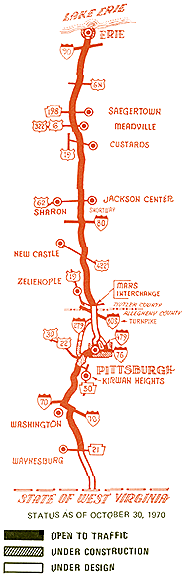
I-79's progress by
October 20, 1970.
(Allegheny College)
In 1970, I-79 opened between Exit 78 and 85, from US 62 to Exit 141, and from Exit 166 to I-90. In 1971, the section between Exit 141 and 147 opened and construction began from Exit 14 south to a point southwest of Fordyce. At this time, the newly formed Department of Transportation switched the designation of I-79 and I-279. The DOT had now marked I-76 to continue through Pittsburgh and end at I-79 and Interstate 279 would be a spur into the city from the north. The same year, construction was extended from PA 865 to the Wexford area. In 1972, the remaining sections from Exit 78 to I-90 and from PA 60 to PA 51 opened to traffic. Construction was extended to the West Virginia border, from Exit 14, to connect with their section that was already underway. In 1973, I-79 was opened from Exit 55 to PA 51 and construction continue on the section from PA 51 to PA 228. This section included the massive interchange where I-79, I-279, US 22, and US 30 come together, which opened in November 1973 after four years of delays caused by a long construction workers strike and by changes in state priorities in the aftermath of tropical storm Agnes. At $14 million, it was the most expensive interchange project ever built in the state at the time. In 1975, a small section from the West Virginia state line to Exit 1 opened. In 1976, the remaining section opened to traffic.
The first exit numbers to appear on the 1975 PENNDOT map showed I-79 with mileage based exit numbers, which in 2001 reappeared, from the Parkway West interchange north to Erie and sequential exit numbers from the West Virginia Line to Bridgeville. The last time mileage based exit numbers were shown on I-79 was on the 1977 map.

Program from the dedication on October 30,
1970. (Allegheny College)
However, that was not the end of construction on I-79. In 1982, construction began to extend the end of the Interstate to PA 5 which opened in 1984, and eliminated a temporary connection to Pittsburgh Avenue to the west that opened in 1975. Even though the designation ends at PA 5, the highway continues as an at-grade facility to the lakefront known as the Bayfront Parkway which opened on October 22, 1990 to spur development around the Flagship Niagara.
It was reported in 1999 that there are cracks developing on the bridge that spans the Ohio to Neville Island from the north shore. The I-79 Bridge, as it is referred to, is the longest bridge in Western Pennsylvania. In 1979, a riverboat pilot noticed cracks on the underside of the then newly opened bridge. This caused PENNDOT to close it until repairs could be made. PENNDOT reported that these new cracks did not pose a threat to the span.
In the spring of 2000, work began on connecting I-76 to I-79 directly. The project, called the Cranberry Connector Project, will consist of building a high speed interchange between the two Interstates with access to and from US 19. There will be no toll plaza at the interchange, instead a mainline toll plaza was built at milemarker 31 where the Butler Service Plaza used to stand. The ticket system ends at the Warrendale Toll Plaza with the Gateway Toll Plaza a coin-drop facility. The project was completed on June 1, 2003 when the Warrendale Toll Plaza opened.
This project hit a little snag on May 17, 2000. When workers began lowering the 50 ton concrete beams into place for the seven-lane PA 228 overpass, they realized something: the beams were six inches too long and wouldn't fit. As a result, PENNDOT had to put them into storage and buy 25 new ones built to the exact specifications, at a cost of $1.6 million. The Department of Transportation paid about $50,000 to have the beams, which were built in Erie, shipped south on I-79, trucked back north to a state maintenance storage yard off US 422 in Portersville. With this error, the price tag of this segment of the project has gone from $9.7 million to $11.6 million.
The first ramps that were constructed as a part of the project opened on October 4, 2001. These are ramps leading from PA 228 to southbound I-79, and from northbound I-79 to PA 228.
Groundbreaking took place on February 22, 2002 for the final leg of the project, which was the direct connection from I-79 to I-76/Pennsylvania Turnpike. Secretary of Transportation, Bradley L. Mallory, along with state and local officials, attended the ceremony to kick off the $44.3 million project. This segment of the work consisted of building an off-ramp from I-79 North to PA 228 and an on-ramp to I-79 South from PA 228. Traffic signals were installed at the end of both ramps at PA 228. These ramps opened on October 5, 2003. Temporary ramps between the connector and US 19 opened on November 12, 2003, with permanent ones to follow. Project website: http://www.cranberryconnector.com/.

Groundbreaking for the final section of the Cranberry
Connector.
(Pennsylvania Department of Transportation)
Another connection that has been lacking will be taken care of finally. On December 9, 2002, the Southwestern Pennsylvania Commission approved shifting $6.7 million in state and federal funds to the project so construction can get under way in 2005. Pennsylvania Department of Transportation Engineer Ray Hack said the project will take two years and cost at least $50 million. Currently to head west on US 22 and US 30, one must exit and travel PA 60, which has become congested with development. "Everybody knows the ramps are long overdue," Hack said. "People who have to use Route 60 to and from the airport face nothing but traffic lights between I-79 and the parkway." In addition, PENNDOT will widen more than one mile of the Parkway West to three lanes in each direction between the I-79/I-279 interchange and Parkway View Industrial Park. Hack went on to say, "Someday, the Parkway West will be three lanes in each direction between Pittsburgh and the airport."

Location of new ramps.
Another interchange that has had problems, but will be corrected, is the I-70/I-79 interchange east of Washington. PENNDOT is planning a $30 million project to rebuild the interchange and eliminate the hairpin curve where I-79 north merges into I-70 west. That location has been the scene of many accidents, many of which involving tractor-trailers traveling too fast and spilling their loads as they tried to negotiate the turn. Five-year-old Tonya Watson, of Portland, Oregon, died nearly 20 years ago when the truck her father was driving overturned on the curve, and suffocated when the padding in the sleeping bunk of the cab pressed against her throat. After that accident, the tall Jersey barrier was installed an additional signs and rumble strips were added to warn of the sharp curve. The speed limit was also lowered to 25 MPH.
Michael Dufalla, PENNDOT District 12 engineer, said, "That's been a problem to me since they built it." He also noted that the interchange was built to 1950s' standards. "Rarely did people go 60 or 65 miles per hour then," he said. "Automobiles have progressed faster than we can rehab the roads." The project will improve access in all directions and the ramp designed to handle higher speeds. To rebuild the interchange, additional land will be purchased. The project is expected to begin in 2006, but will take several years to finish.
The January 2004 weather was not kind to a four mile section from Kirwan Heights to I-279. As happened on that expressway, potholes began opening up on I-79 due to the cold weather and age of the highway. The conditions were so bad early in the week of February 1 that state police shut down two lanes for four hours. PENNDOT laid down temporary patches, but will start a $84 million project to rebuild this section starting in August 2004.
Links:
Exit Guide
Interstate 79 Pictures
Bayfront
Parkway Pictures - Doug Kerr
Interstate 79 - Andy Field/Alex Nitzman
Interstate
79 - David Steinberg
I-79
Exit 147 - David Brunot
Interstate 79
Pictures - Andy Field/Alex Nitzman
Interstate
79 Pictures (Allegheny County) - Doug Kerr
Interstate
79 Pictures (City of Erie) - Doug Kerr
Interstate
79 Pictures (Crawford County) - Doug Kerr
Interstate
79 Pictures (Washington County) - Doug Kerr
Raymond
P. Shafer, Allegheny's Governor of Pennsylvania - Allegheny College
Raymond
P. Shafer: Highways - Allegheny College
 INFORMATION |
|
| Southern Terminus: |
West Virginia state line south of Morrisville. |
| Northern Terminus: |
PA 5 at Exit 183B in Erie. |
| Length: | 183 miles |
| National Highway System: |
Entire length |
| Names: | Raymond P. Shafer Highway Pittsburgh-Erie Expressway |
| SR Designations: |
SR 0079 SR 0070: Exit 34 to Exit 38 |
| Counties: | Greene, Washington, Allegheny, Butler, Lawrence, Mercer, Crawford, and Erie |
| Multiplexed Route: |
I-70: Exit 34 to Exit 38 in Washington |
| Former Designations: |
I-70 (1957 - 1964):
Exit 38 to Exit 59A I-179 (1958 - 1959): Exit 178 to Exit 180 I-279 (1958 - 1971): Exit 59A to Exit 72 |
| Speed Limits: | See exit guide |
| Emergency: | 911 |
 Highway Conditions: |
Interstate 79 Conditions |
 Traffic Conditions: |
Parkway
West - Exit 54 (Southbound) Exit 54 - Parkway West (Northbound) |
| Travel Radio: | 1630 |
| Area Codes: | 724/878: West Virginia
state line to Exit 54 and Exit 72 to Exit 166 412/878: Exit 54 to Exit 72 814: Exit 166 to Erie |