
Pennsylvania Turnpike
Pennsylvania Turnpike
This is one of four Interstate which comprise the Pennsylvania Turnpike system. After the Western Extension opened in 1951, the next logical expansion was to New Jersey. A 33-mile section from the Valley Forge exit to Bristol and a proposed crossing of the Delaware River there would be necessary. With a bridge, travelers could access the New Jersey Turnpike, thus making it possible to travel from New York City to the Ohio line. In May and June of 1951, Governor John S. Fine signed a bill to construct the Delaware River Extension and a joint toll bridge with the New Jersey Turnpike.
Everything seemed fine; however, there was a problem. The 1948 indenture under which the Philadelphia and Western Extensions were financed allowed additional expansions. The problem was work could not start on a new extension until the previous project was open to traffic for two years, which would mean waiting until 1954 to begin financing. Governor Fine signed a bill in August of 1951 creating a new financing instrument, the Indenture of September 1, 1952. It was a supplement to the 1948 indenture and was intended to facilitate all future expansion.
To finance the Delaware River Extension, the PTC issued $65 million worth of bonds in September of 1952. The configuration at the Valley Forge interchange had to be converted from a terminus to an "off-line" interchange. It was built to connect to a future highway that would connect the Turnpike to Philadelphia: the Schuylkill Expressway. Construction started in 1952 with the ground breaking on November 20.
The 1,224 foot long bridge over the Schuylkill River was the longest structure on the extension. On August 23, 1954, the Delaware River Extension opened to the Norristown and Willow Grove interchanges. The remaining interchanges opened as follows: Fort Washington on September 20, Philadelphia on October 27, Delaware Valley on November 17.
While the celebration of the opening was taking place, the Pennsylvania Turnpike Commission was not only looking to building the Delaware Bridge but also a spur to Scranton. In 1954, the commission combined the financing of both projects into one $233 million bond.
Ground was broken for the bridge on June 22, 1954. It was constructed and jointly financed by the New Jersey Turnpike Authority and the Pennsylvania Turnpike Commission. It cost $27,200,000 and opened on May 23, 1956 at 11:30 AM when Governors George M. Leader of Pennsylvania and Robert B. Meyner of New Jersey met in the middle of the span to cut the ribbon. The bridge is 135 feet above the Delaware River because of the ship traffic that utilizes the river. The significance of the bridge is that it would soon be possible to travel between Maine and the Indiana-Ohio border (and soon to Chicago with the completion of the Indiana East-West Toll Road) without encountering a traffic light, cross street, or grade crossing.
Originally designated as Interstate 280, the number changed in 1963 when Interstate 76 replaced Interstate 80S. With the change, so went the I-280 designation in exchange for the current Interstate 276 designation.
This highway has the distinction of being where the first Act 61 project began. Act 61 is in plain English the Turnpike Organization, Expansion, and Toll Road Conversion Act which was passed in September 1985 by the state legislature. On March 10, 1986, work began to widen the highway from the Northeast Extension to the Philadelphia Interchange from four lanes to six to accommodate the increased traffic. The $120 million project was finished on November 23, 1987. Improvements to the Fort Washington, Willow Grove, and Philadelphia Interchanges preceded the widening.
In late 1989, ground was broken on the Mid-County Interchange in Plymouth Township, Montgomery County. This project included the largest contract awarded by the Pennsylvania Turnpike Commission. The interchange is the largest in the system and the first additional interchange on the mainline to be constructed since completion of the Scranton Interchange on the Northeast Extension in 1957. The interchange has the largest toll plaza with 17 lanes for entering and exiting traffic and eight ramps comprising 4.4 miles. The Mid-County and Norristown interchanges are connected via a fiber optic cable. This permits data sharing between the toll barriers and the main office in Harrisburg.
A $55 million general construction contract was awarded to the Hull Corporation of Syracuse, New York in late 1989. This included construction of the toll plaza, utility building, roadway, structures, signing, and lighting.
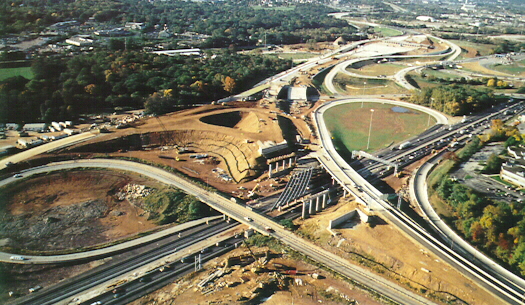
Mid-County Interchange under construction. The old Northeast Extension
interchange bridge is in the foreground. (Pennsylvania Turnpike Commission)
In 1990, the PTC awarded contracts totaling $131,000 to the Hull Corporation for heating, ventilation, and air conditioning. Thomas M. Durkin and Sons' contracted to handle wetland replacement totaling $316,097.
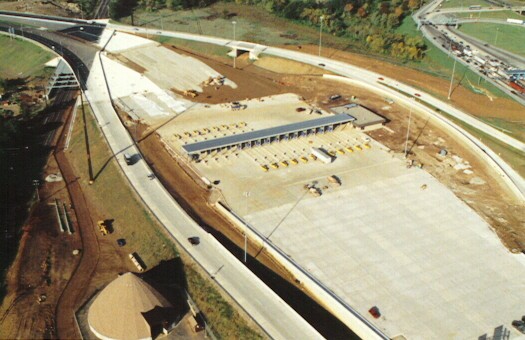
The new 17 lane toll plaza. The ramps on the edges of the picture
are for
the Germantown Pike interchange. (Pennsylvania Turnpike Commission)
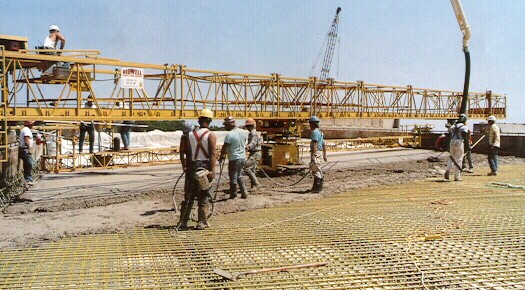
Workers pouring concrete for the deck of the
new southbound bridge.
(Pennsylvania Turnpike Commission)
Since the construction took place in a highly developed area of suburban Philadelphia where there are many active roadways, maintaining a smooth traffic flow posed a challenge. To prevent problems, the project was divided into phases and stages. The purposes of this was to maintain at least four lanes of traffic on the mainline Turnpike and to provide access to the Northeast Extension while the ramps are under construction. Solution cavities posed an even greater problem to the construction. These are formed when groundwater has worn away earth between limestone rocks, thus creating an underground cavern. To guarantee that the bridge supports at the south end of the culvert for the Plymouth Creek sat on firm ground, an addition $400,000 was needed. This paid for extra excavation and concrete work. A concrete grout mixture was pumped underneath and around the bottom of the bridge pilings required an additional $350,000. On December 15 1992, the first interchange on the Turnpike to have "fly over" ramps opened to traffic.
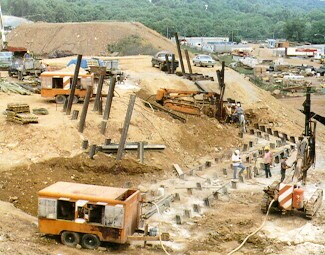
Grout being pumped into underground voids.
(Pennsylvania Turnpike Commission)
In other news, on July 9,1998 a massive pothole opened up on the Delaware Bridge. It took days to fix, and and traffic had to be diverted off the bridge.
In January 1999, the PTC began a feasibility study on widening the highway from the Valley Forge interchange to the Norristown interchange. The entire project, including widening work on the Northeast Extension, will cost approximately $200 million. Work was already underway to widen the existing bridge over the Schuylkill River which began in spring 1997 and wrapped up in June 1999. Widening the highway to six lanes will begin in 2003.
 There
is now a plan to connect I-95 to I-276. This plan would "finish"
Interstate 95 from Philadelphia to New York City. The plan would also mean
that I-276 would end at another Interstate, instead of disappearing at the PA/NJ
border. The current highway after I-276 would receive the Interstate 295
designation. Until the late 1960s, I-95 and US 13 were designated on the same
highway. This would have provided a direct connection to the Turnpike, but
because of environmental reasons the highway could not be built north from the
Turnpike.
This is just part of the work that would be done in this area. Also included in this project is construction of a mainline toll barrier just east of the Neshaminy Service Plaza, which is just east of Exit 351. With the new toll barrier in place, the remainder of the highway from there to the bridge would become a coin-drop system. This would allow the new interchange to be a high speed interchange with no toll plaza. Widening of I-276 from Exit 351 to the Delaware River Bridge. Construction of a second Delaware River Bridge, paralleling the existing bridge, which would increase the capacity to three lanes in each direction. With these three projects, a completion date of 2016 has been given for the all of the work to be completed. However, as mentioned above, the interchange would be completed much sooner.
The Draft Environmental Impact Study has recommended the following for the new toll plaza, interchange, and bridge:
|
|
|
|
|
|
On January 6, 2004, the US Department of Transportation approved the environmental impact study. "Late 2007" is the "optimistic forecast" for groundbreaking for the first part, a new toll plaza, said PTC spokeswoman Christina Hampton after the announcement was made. Project website: http://www.paturnpike.com/i95/
E-ZPass, an electronic toll collection system, was unveiled on December 2, 2000 on the entire stretch of I-276. This system is, or will be, used for toll collection on every toll highway and bridge in the Northeast. It was only available to personal automobiles for the initial unveiling and expanded to include commercial vehicles on December 14, 2002.
With the implementation of the E-ZPass system, the PTC was able to open its first two slip ramps at Virginia Drive at the Fort Washington Office Center Park. The interchange is the first unmanned exit, and first to be numbered using mileage-based exit numbers, on the mainline Turnpike, utilizing only the E-ZPass system to charge tolls for vehicles entering or exiting the westbound Turnpike. Construction of the ramps began in early 2000. Additional slip ramps are being planned along the Turnpike near large businesses or corporate parks, to allow drivers to enter or exit the highway closer to their workplace.
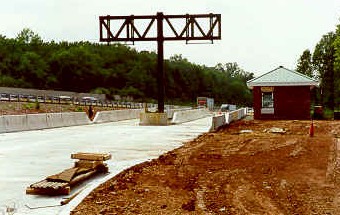
The new Virginia Drive/E-ZPass only exit.
(Pennsylvania Turnpike Commission)
Links:
Exit Guide
Interstate 276 Pictures
Interstate 280
Pennsylvania
Turnpike
E-ZPass
- Pennsylvania Turnpike Commission
Pennsylvania Turnpike Commission
Pennsylvania Turnpike
Toll/Mileage Calculator
Delaware
River-Turnpike Toll Bridge - Steve Anderson
Pennsylvania Turnpike-Delaware River Extension - Steve
Anderson
Interstate
276 - Steve Alpert
Interstate 276 - Andy Field/Alex Nitzman
Interstate 276 - Scott
Oglesby
Interstate
276 Pictures - Andy Field/Alex Nitzman
 INFORMATION |
|
| Western Terminus: |
I-76 at Exit 326 in King of Prussia. |
| Eastern Terminus: |
New Jersey state line at the Delaware Memorial Bridge. |
| Length: | 33 miles |
| National Highway System: |
Entire length |
| Names: | Pennsylvania Turnpike East-West Expressway |
| SR Designation: |
SR 7276 |
| Counties: | Montgomery and Bucks |
| Multiplexed Routes: |
None |
| Former Designations: |
I-80S (1957 - 1958) I-280 (1958 - 1963) |
| Speed Limit: | 55 |
| Emergency: | *11 and call boxes every mile |
 Highway Conditions: |
http://www.paturnpike.com/rttc/ 1-800-331-3414/717-939-9871 |
 Traffic Conditions: |
Valley
Forge - Fort Washington Fort Washington - NJ Turnpike #211/215-567-5678 |
| Travel Radio: | 1640 |
| Area Codes: | 215/267/445 |


