|
Were Radio Sponsors (Part II) "Stoy is 100% soy….. it's not a mix!" Announcer SWEET RIVER Whether a product was nationally known or known only in a small area, they shared an equal and common ground as sponsors of radio programs during the golden age. In Part I of this series, products like Cal-Aspirin, Rio Grande Cracked Gasoline, and others were in the spotlight. In Part II, we will take another look at those unsung products that shared the airwaves with the nationally known brands during the golden age. Our first unsung product was made and distributed by (believe it or not) Procter & Gamble. American Family Soap and American Family Flakes were soap products that were made and sold for the people in the Midwest. In its heyday, it was billed as the "The most popular soap in Chicago." The reason why it was so popular was because its soap content worked well with the hard water in the Midwest. Fluffy white suds were ready to take on any laundry chore. Using American Family would also prove beneficial to all its users who took advantage of the coupons on each American Family wrapper and box. These coupons could be redeemed at any American Family outlet store for useful household items. On the radio, American Family had one of the most fitting commercial phrases for the time it was heard. In 1934, American Family was the sponsor of THE SONG OF THE CITY, a Chicago-based serial program that aired over the stations of NBC's Red Network. During the commercial, announcer George Watson would say, "It's cheaper….. far cheaper to buy a new soap than to buy new clothes."  Of course, Watson's statement would prove true at any time, but since he said it in 1934, it had a greater meaning with the United States trying to recover from The Great Depression of that time. 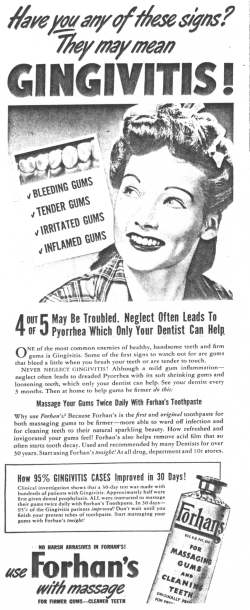 With the recent TV commercials for Listerine Antiseptic, we have become familiar with "Gingivitis"--- the infamous inflammation in the human mouth that left untreated could eventually lead to the wearing of false teeth. During radio's golden age, the listeners would know of a product that was specially made to take on and overcome Gingivitis. Forhan's Tooth Paste was unique from the other brands because it was specially made for both massaging gums and cleaning the teeth to their own natural sparkling beauty. With a twice daily brushing, Forhan's reduced the threat of Gingivitis for 95% of its users in 30 days. The human yap would feel refreshed and invigorated, and the smile was attractive to look at. On a Mutual newscast with Frank Singiser, announcer Marshall Dane informed the listeners to start using Forhan's without delay. Even if the listeners still had some of another brand of toothpaste, Dane asked them to go to their favorite drug, department, and 10¢ store and buy a tube of "Famous Forhan's Tooth Paste" A.S.A.P.! His advice meant the listeners could have a natural, healthy smile for a lifetime!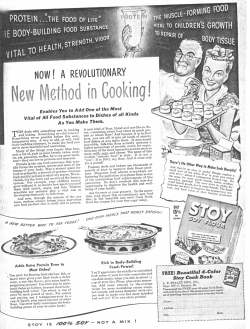 World War II would provide a true test for the housewives of "The Home Front." With food rationing in effect, it was a challenge to provide a meal that the family will love, yet stay within the confines of rationing. Fortunately, there were unrationed products that helped out. One such product was the sponsor on the Blue Network serial SWEET RIVER. The product in question was Stoy Soy Flour, a product made by A.E. Staley Mfg. Co. The contents inside a typical Stoy box consisted of 100% soy flour---- it was not a mix. It was used like regular flour in baking and cooking. There would be a distinct advantage in using Stoy over regular flour—an advantage that was vital for the people of the home front. Foods baked or cooked with Stoy had extra protein, which in turn provided every man, woman, and child who ate these foods with body building food substance vital to health, strength, and vigor. Stoy was the best of all worlds for the housewives. It did so much to provide good food and good health for only 15¢. In another article, I stated it was a tremendous challenge for the housewives of the home front to maintain good health for their families with food rationing in effect. Luckily, a solution to this potential problem could be found by tuning in to the serial programs sponsored by American Home Products (the Anacin people) during the war years. From The Anacin Company division of American Home Products comes Benefax Multi Vitamins. This was a product where every member of the family can take part in preserving their own good health. Just 1 Benefax Multi Vitamin every day supplements war-rationed diets completely. Unlike other brands, Benefax was prescription-type vitamins, the kind doctors recommended to their patients. It was actually good health for less than 3¢ a day. There were 3 types of Benefax Vitamins to choose from. Benefax Multi Vitamins in the orange box, Benefax B-Complex Vitamins in the red box, and Benefax A & D Vitamins in the yellow box. With good health essential during the war years, it was more important than ever for the people to ask their druggist for Benefax. We conclude this article with a regional product from my neck of the woods. This product was a part of life in the New England states for many years. Just like some products were closely associated with the programs they sponsored, there was also the close association between the sponsor and the radio coverage of regional baseball games. The listeners of the Boston Red Sox baseball games on radio would remember the sponsors, the Atlantic Refining Company, and the product featured here, Narragansett Lager Beer. In its heyday, Narragansett was New England's beer. It would achieve more popularity in the 6-state region than the national brands. When the Red Sox broadcast began, the announcer would greet the listeners with a cheery "Hi, neighbor"--- which was part of the famous "Hi, neighbor, have a 'Gansett!" phrase the beer was famous for in its advertising. Between innings of a Red Sox game, the announcer would encourage the adult listeners to enjoy the game with a glass of Narragansett. Narragansett's close association with the Red Sox broadcasts lasted for over 2 decades. When the beer's sponsorship ended, other regional and national products would sponsor the baseball games. Unfortunately, there isn't that close relationship of sponsor and broadcast like there was in the past. As for Narragansett Lager Beer, it would continue to be made and sold in New England, but "New England's Beer" was taken over by a national brewing company (Falstaff Brewing Company). Unfortunately, the national beer brands were beginning to assert themselves for the beer drinkers in the New England area. This popularity would take its toll on Narragansett. Before anyone knew it, Narragansett was completely gone from the shelves in grocery stores and markets in the New England states. Radio's golden age had a lot of radio sponsors during its time. Although some sponsors weren't as well known as others, they did share an equal ground--- they played a part in bringing the radio programs into the homes of the listeners to enjoy. |

