|
Not-So-Famous Products Were Radio Sponsors
And don't forget your change. --- Closing of Avalon Cigarette commercial
Lincoln, Me. (DG)---
Since network radio began, many products either had their names on the programs they sponsored, or when direct selling became a reality, were featured in commercials. Many of these products are famous in the United States--- and in some cases, worldwide. We already know of Ivory Soap's floating ability, champion athletes eating Wheaties, and Johnny's call for Philip Morris. Since you already know about these products, we're NOT going to talk about them or any other famous product in this article. This is the first of a series of articles that will give those obscure products some recognition.
Let's begin with a product that was a mystery to me until a couple of months ago (as of February 3, 2001 when this article was being prepared). The product in question is Cal-Aspirin. When I was doing my own personal research on old time radio, I came across Cal-Aspirin as a sponsor of 3 different daytime serials during the 1930's and early 1940's. I did have a clue it was made by Sterling Drug, the people who made Bayer Aspirin--- which explained why I had a hard time finding it in the magazines I have. Not that they really care (and rightfully, they shouldn't), Sterling Drug is the most difficult company for a researcher (like me) to find its products in magazines that were printed during radio's golden age. While some brands were featured in magazine advertising, others were not. Unfortunately for me, Cal-Aspirin was an example of the latter. It wasn't until I surfed the Internet, when I found a picture of a Cal-Aspirin box--- and I would get an idea what kind of a product it was.
If you examine the name closely, Cal-Aspirin was what the name implied. It was a pain reliever that featured an unusual combination of calcium and aspirin. The tablets appear to be small in size, because they were packaged in a narrow tubular container. According to what it said on the box, it was 20¢ for 12 tablets. Whether or not the calcium helped to relieve pain I couldn't say, but the calcium could certainly help strengthen the bones inside the regulation human body.
As I stated earlier, Cal-Aspirin was either the sponsor or co-sponsor of (at least) 3 network daytime serial programs. During the 1935-1936 season, it was the sponsor of PAINTED DREAMS on Mutual and co-sponsored NBC(Blue's) AMANDA OF HONEYMOON HILL during its first 2 seasons (1940-1942) with Haley's M-O. While the 2 soaps had various successes, Cal-Aspirin would achieve fame as being the very first sponsor of YOUNG WIDDER BROWN, which would become one of radio's most popular serials. Its fame would be brief, because it sponsored the program for only its initial season before turning the sponsoring duties over to Bayer Aspirin.
During the 1930's and 1940's, there were a lot of cigarette brands for a smoker to choose from. Of course, the people, smokers and non-smokers alike, knew of Lucky Strike, Camel, Old Gold, Chesterfield, and Philip Morris for the simple reason they were major sponsors of radio programs during the height of radio's golden age. The lesser known cigarette brands would have a major uphill battle to compete against the 5 major brands. Despite the odds, Avalon Cigarettes would give it a try.
Avalon was a brand made by Brown & Williamson. Like the major cigarette brands, Avalon also used fine quality tobacco, while giving its smokers a mild smoke and a rich tobacco taste. The only difference between Avalon and the major brands was a noticeable one. It costs a few cents less. The radio commercials focused on the saving of money when a smoker bought Avalon. It closed with a cashier ringing a cash register and telling her customer, And don't forget your change.
On radio, I come across 2 radio programs sponsored by Avalon Cigarettes. The first was SHOW BOAT, which returned to the air on NBC's Red Network after a short absence. The second program was appropriately called AVALON TIME, also on NBC(Red). This variety program would be famous for being the first radio program to star Red Skelton.
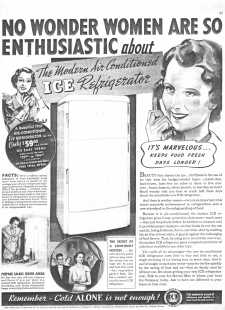
Even during the 1930's, Ice and the Ice Box were in a competitive battle with the new electric refrigerators that were becoming popular. What gave them a fighting chance was this competition originally took place during The Great Depression--- and it did cost a sizable amount of money (by 1930's standards) to buy an electric refrigerator. The commercial would imply that food kept in an Ice Box stayed fresh days longer because of the consistency of keeping the right amount of moisture and cold. Its famous line on the air was Cold ALONE is not enough.
If you're wondering, Ice (under the name of the National Ice Headquarters) sponsored PARTIES AT PICKFAIR, a program that featured celebrities, talk, and music at the home of actress Mary Pickford. This program was heard on the Columbia Network from 1935-1936. Ice also sponsored NBC(Red's) HOMEMAKERS' EXCHANGE from 1937-1938. It was a daytime program of cooking and household hints hosted by Eleanor Howe.
The following sponsor wasn't well known because it was only sold in a 2 state region (California and Arizona to be exact). Before unleaded gasoline became a reality, petroleum companies had interesting and colorful nicknames for the gasoline they sold. A motorist would know about (Texaco) Fire Chief, (Atlantic) Imperial, (Mobilgas) Special, (Chevron) Supreme, Good Gulf, and (Esso) Extra, to name just a few. Believe it or not, there was a gasoline that was Cracked. Now let's examine this for a moment. Cracks have the reputation of being rather unpleasant. For example, a person with butterfingers was inclined to drop something on a piece of valuable china. The end result was a crack for their trouble. As a rule, cracked china, no matter how valuable they were before being cracked, would end up in the trash. With this thought, could Cracked Gasoline be beneficial for the typical motorist? On paper, it sounds like a person was a little cracked to buy and use this gasoline, but in real life, he/she would definitely have all his/her marbles intact. The gasoline, Rio Grande Cracked, was the performance fuel that more police and fire vehicles in California and Arizona used than any other brand. The announcer would state if professional vehicles got quality performance with Cracked Gasoline, imagine what it would do with everyday cars and trucks that weren't used as vigorously and constantly.
We conclude this article with
Since Bab-O was a nationally known brand of cleanser, Glim would help its fellow Babbitt brother co-sponsor DAVID HARUM (CBS and later NBC), LORA LAWTON (NBC), and NONA FROM NOWHERE (CBS) from 1949-1950.
I have a large list of little known radio sponsors, but I think it's wise to put an end to this particular article. In Part II of this series, we'll take a look at more of the little known products that shared the airwaves with the established brands.
|