|
Home Front Doing Its Part For Allied Victory
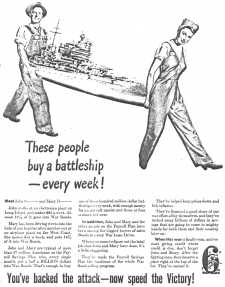
Back the attack, buy War Bonds till it hurts¦.. and then some.
--- Announcement for buying War Bonds
Lincoln, Me. (DG)---
In Part I of this series, we saw how the radio sponsors got the message across on how the people of the Home Front could do their part in helping the Allied forces. This article will look at the public service announcements that also informed the listeners what to do--- and more importantly, what NOT to do.
With radio as a valuable means of communication, the War Advertising Council was created to inform the radio listeners what was expected of them during the challenging time they lived in. Some of the Council's campaigns weren't very easy, but it was something that had to be done.
One of the Council's very first campaigns concerned
The rationing of food and gasoline played a big role for the people of the home front. It wasn't exactly popular, but when some people complained, there was a common saying back then that went like this, There's a war on! For those people who wanted more than his/her share, there was another alternative to rationing--- unfortunately, it was also a shade on the illegal side. This alternative was the infamous Black Market. The War Advertising Council immediately focused on this problem with a series of commercials discouraging people from buying anything through the Black Market.
The naughty people associated with the Black Market would also become involved in another campaign the War Advertising Council conducted. This campaign was to Keep Prices Down. Once again, it didn't exactly spread smiles across the kissers of the people, but it was necessary to keep inflation in check. The announcer of the commercial asked the American consumer to do 7 things to keep prices down. They were:
1.) Buy only what you need. 2.) Pay no more than ceiling prices (stay away from the Black Market) 3.) Support higher taxes 4.) Pay off old debts 5.) Don't ask for more money 6.) Save for the future 7.) Buy more War Bonds
With the exception of #7, the above wasn't very appealing--- but then again, inflation wasn't very appealing, either!
One of the War Advertising Council's most important campaigns was the American Red Cross. Its War Funds were drives for the American people to donate money. The money the Red Cross received went for training nurses who went to war to help the doctors save lives. The money also went for training the people of the home front to learn first aid, home nursing courses, canteens, motor corps, and nurse's aide. This training was vital, because of the possible dangers of an enemy invasion.
The Red Cross also asked the people for a different, but extremely vital donation during each War Fund--- blood. Collecting pints of blood for plasma meant the difference between life and death to a wounded American soldier. Like with War Bonds, the commercials made it extremely hard for the people not to donate a pint of blood, because they knew that pint meant life itself.
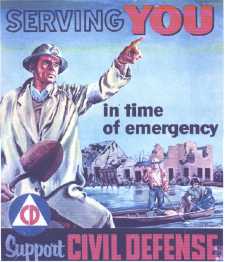
These are just a few of the many campaigns the War Advertising Council informed the people about through radio during World War II. When the war ended, the Council and its campaigns didn't. Instead of contributing to the war effort, the campaigns were designed to help people in the United States and the post-war world. Instead of buying War Bonds, the announcer asked the people to buy Victory Bonds. The money would be used to bring the victorious troops home. From there, Victory Bonds were known as Defense Bonds, Security Bonds, and the name we're familiar with today, Savings Bonds. The Red Cross continued to ask the people for money and blood for domestic and worldwide emergencies. The Civilian Defense became the Civil Defense. Instead of watching enemy planes, the CD had trained personnel in towns & cities across the United States. Their task was to help people in case of natural disasters.
There was also a noticeable change with the War Advertising Council itself. Since the war was over, its name was shortened to the Advertising Council. It would continue its good work to this very day with different campaigns not only within the confines of the United States, but worldwide.
The Allied troops were victorious in World War II. It was also a victory every American man, woman, and child could share, because they knew exactly what they had to do--- and did it. It also helped that the U.S. had 2 powerful means of communication that got the word out quickly--- radio and the War Advertising Council.
Author's note: This article is dedicated to the memory of my father, Clyde D. Goodwin, Jr. He proudly served in World War II and was involved as a member (and later as director) of the Lincoln, Maine Civil Defense.
Author's note #2: This article was originally written and completed on February 27, 2001. With the tragic events that occurred on September 11, 2001, I would also like to dedicate this article to all the men and women who took part in the search and rescue at the World Trade Center and the Pentagon, and to the memories of those people who lost their lives while trying to save others.
|