|
Everyone Takes Part "Get some Golden Fluffo .. real soon." -- Red Barber Lincoln, Me. (DG)- When network radio began, the networks didn't have the luxury of having people who specialized in only specific speaking jobs and nothing else. In other words, if a person spoke in front of a microphone, he/she was expected to either present the news, host a program, or the subject of this article--- doing radio commercials (when direct selling on the air was allowed). This article will focus on some famous people who were better known for other roles on the radio than presenting radio commercials. Gabriel Heatter was one of the most popular news commentators of radio's golden age. On his newscasts, Heatter wasn't bashful in changing the subject from a major news event to selling Kreml Hair Tonic. Heatter didn't just sell products on his newscast. He was also the commercial spokesman for Peter Paul candy bars. Unlike the Kreml commercials, Heatter used a different advertising tactic. Instead of the casual, easy going manner I mentioned earlier, Heatter put the power of resistance to an extreme test. He made Mounds and Almond Joy sound so irresistible, the radio listeners were easily persuaded to go to their favorite store and buy a Mounds and/or Almond Joy candy bar at that moment. Sportscaster Red Barber made a name for himself as the legendary voice of the Brooklyn Dodgers and later the New York Yankees. When he wasn't doing play-by-play, Barber was selling Old Gold Cigarettes on different programs for CBS during the 1940's. Using his country boy technique that made him famous to baseball fans, Barber informed the listeners of the pleasant taste and cool smoking Old Gold provided. He also talked about "Apple Honey," Old Gold's natural ingredient to preserve the freshness of the tobacco leaves before they were manufactured. As an announcer, Barber was remembered best as the commercial spokesman for Old Gold Cigarettes--- but his ability to sell on the air didn't stop there. Barber was also the commercial spokesman for an unlikely product--- Golden Fluffo Shortening. If you are not familiar with Fluffo, it was the modern shortening of the 1950's created by Procter and Gamble� 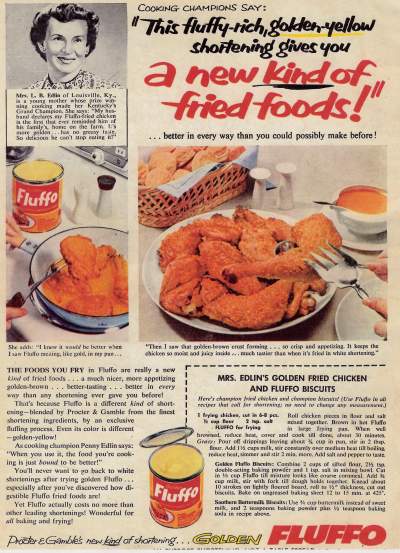
Getting back to the commercial, its format had Barber interviewing housewives who won blue ribbons for their cooking and baking creations. Of course, the housewives used Fluffo in their creations. Like he did with Old Gold, Barber used his familiar country boy approach in his commercial presentation for Fluffo. Before he became the voice of the New York Yankees and goodwill ambassador for Major League Baseball, Mel Allen started his radio career as an announcer. During the late 1930's and early 1940's, Allen was selling Ivory Soap and Crisco on different daytime serials the 2 products sponsored. On a particular broadcast*, Allen also displayed his singing ability in an Ivory Soap musical commercial with Ralph Edwards--- HOW ABOUT THAT! (*-I think the commercial was presented on TRUTH OR CONSEQUENCES, but it's inconclusive). When he wasn't doing NBC Radio's play-by-play of the weekly college football game, Fort Pearson worked during the week as a radio announcer. On a historical note, Pearson was one of the first of a long list of announcers for THE GUIDING LIGHT. He was heard selling PandG Naphtha Soap, the program's first sponsor. In later years, Pearson sold Kix on BEAT THE BAND and Alka-Seltzer on QUEEN FOR A DAY. Pearson had a convincing style of speaking voice that when he said PandG Naphtha Soap washed clothes "really white," there was no doubt whatsoever. 
Edwin C. Hill was another distinguished radio journalist. His talents on the air expanded to program M.C.--- and commercial spokesman. During a 1939 newscast, Hill easily changed the subject from the somber news of that moment to an upbeat commercial for Amoco's Orange American Gas. Although Amoco Gas was better known of Amoco's two gasoline grades, Hill informed the listeners that Orange American Gas was also a quality gasoline to use. For those people who preferred regular gasoline, Hill assured them that Orange American Gas was a "pure, sweet product" that was 100% petroleum--- and 0% impurities and gunk that hampered an engine's performance. At the end of the commercial, Hill asked the listeners to stop at the Orange American Pump and give Orange American Gasoline a tryout. Presenting commercials on the air wasn't reserved for famous journalists, announcers, and sportscasters--- or even men for that matter! In addition to the various character roles she played in the 1930's, actress Bess Johnson was also one of the few female announcers of network radio of that era. On the WAYNE KING'S ORCHESTRA program, Ms. Johnson presented the commercials for Lady Esther Cosmetics in the role of Lady Esther. According to an article in the May 28,1938 issue of Radio Guide magazine, Ms. Johnson's portrayal of Lady Esther stirred up some controversy. Some people believed that all radio commercials should be done by men. To focus into this controversy, Radio Guide featured the article, "should radio use women announcers?" To answer the question the best way as possible, the article took an equal view of both sides with 12 people (six from each side) who either worked on radio or were radio listeners. In an interesting turn of events, of the six people who favored female announcers, four were men--- and of the six who didn't favor them, three were women. From a personal viewpoint, Ms. Johnson had an outstanding speaking voice, and she could present radio commercials as good as any announcer, male or female. Besides, can you picture Lady Esther on the air with a man's voice??!! Regardless what the people thought of her as Lady Esther, it didn't discourage Ms. Johnson from presenting radio commercials. When PALMOLIVE'S HILLTOP HOUSE made its debut on the Columbia Network, Ms. Johnson played the lead role (who happened to be named Bess Johnson), the manager of the Hilltop House Orphanage. Frank Gallop was the program's announcer, but it was Ms. Johnson who presented the commercials for Palmolive Soap. Ms. Johnson's announcing duties didn't hamper the popularity of PALMOLIVE'S HILLTOP HOUSE. During its time on the air, the program was among the most popular daytime serials of the late 1930's. This is only a short list of some big names in radio doing their part in selling the product to the radio listeners. It also demonstrated the "team effort" of the people to make network radio successful--- and considering the golden age lasted as long as it did, they succeeded. |


