RHODE ISLAND
Fort Anne |
Camp Arnold |
Barker's Hill Fort |
Barrington Fort |
Fort Barton |
Beaver Head Fort
Beaver Tail Fort |
Camp Beeckman |
Bliss Hill Fort |
Bonnet Battery |
Bonnet Point Fort |
Boston Neck Fort
Brenton's Battery |
Brenton's Point Barracks |
Brenton's Point Fort |
Bristol Ferry Fort |
Bristol Gun House
Bristol Mud Battery |
Fort Brown |
Bull Garrison |
Bullock's Point Fort |
Camp Burnside |
Burr's Hill Fort
Fort Butts |
Butts Hill Fort |
Canonchet's Fort |
Castle Hill Fort |
Fort Chastellux |
Coaster's Island Fort
Coddington's Cove Fort |
Coddington's Point Fort |
College Hill Fort |
Conanicut Battery |
Fort Conanicut
Fort Daniel |
Fort Denham |
Fort Dumpling Rock |
Dumpling Rock Battery |
Fort Dumplings |
Camp Dyer
East Greenwich Armory |
Eldred's Battery |
Ferry Lane Redoubts |
Fogland Ferry Fort |
Fox Hill Fort
Fort George |
Green End Fort |
Camp Hallett |
Fort Harrison |
Fort William Henry |
Hog Pen Point Fort
Honeyman's Hill Fort |
Fort Independence |
Kettle Point Batteries |
King Philip's Fort |
Lawton's Valley Fort
Fort Leverett |
Fort Liberty |
Fort Louis |
Fort Mansfield |
Mount Hope Fort |
Nayatt Point Fort
Fort Neck Lot |
Newman Garrison |
Newport Battery |
Fort Ninigret |
North Battery |
Noyes' Neck Fort
Oaks Inn Res |
Owl's Nest Fort |
Pawtucket Armory |
Pawtuxet Neck Fort |
Popasquash Point Fort
Prospect Hill Fort (1) |
Prospect Hill Fort (2) |
Providence Armory |
Pumham's Fort |
Quaker Hill Fort
Queen's Fort |
Quidnessett Fort |
Old Rehoboth Garrisons |
Robin Hill Fort |
Rose Island Fort
Sassafras Hill Fort |
Seekonk Garrison |
Smith's Castle |
Old State Arsenal |
Fort Sullivan
Tiverton Heights Fort |
Tonomy Hill Fort |
Towering Hill Fort |
Turkey Hill Fort |
Warwick Neck Fort
Fort Washington |
Watch Hill Fort |
Westerly Armory |
Wickford Fort |
Roger Williams' Post
Woonsocket Armory
Modern Narragansett Bay - page 2
Woonsocket Armory 
(unknown), Woonsocket
The RI National Guard Armory had a "dummy" training battery used for coast artillery practice. In 1922 it was officially named Battery Flynn.
Camp Arnold
(1861 - 1862), Pawtucket
A Civil War training camp located in Riding Park that replaced Camp Hallett in Cranston.
Pawtucket Armory
(unknown), Pawtucket
The RI National Guard Armory had a "dummy" training battery used for coast artillery practice. In 1922 it was officially named Battery Gatchell.
Prospect Hill Fort (2) 
(1777 - unknown), Providence
A large Patriot fort located near the present-day Roger Williams Memorial on Beacon Hill. Also known as College Hill Fort. It was 300-by-150 feet, with four bastions, moated, mounting 58 guns.
Fox Hill Fort
(1775 - unknown), Providence
Armed with ten guns. Located near Fox Point on Brooke Street between Wickenden and India Streets. No longer exists. Nearby were the two circular Patriot Ferry Lane Redoubts.
Fort Sullivan
(1778 - 1780's), Providence
A Patriot fort located at Chestnut and Friendship Streets, near present-day Johnson and Wales University.
Fort Independence
(1775 - 1810's), Providence
Originally Robin Hill Fort, located on Robin Hill, and was once connected by earthworks to Sassafras Hill Fort (1775 - 1810's) on Sassafras Point near the present-day Municipal Wharf. The fort has been restored and is now a park near Vermont and Michigan Aves.
Fort William Henry
(1812 - 1815), Providence
Located at Fields Point. It was once connected by earthworks to Fort Independence and Sassafras Hill Fort. No longer exists.
Old State Arsenal
(unknown dates), Providence
Located at 176 Benefit Street.
Camp Burnside
(1861), Providence
A Civil War training camp. Exact location undetermined.
Providence Armory
(unknown), Providence
The RI National Guard Armory on Cranston Street had two "dummy" training batteries used for coast artillery practice. In 1922 they were officially named Battery Crocker (10-inch DC) and Battery Babcock (12-inch mortar).
Newman Garrison 
(1674 - 1676), Rumford
A fortified parsonage, once located on the north side of Newman Ave. near Meeting House Pond. It was destroyed during King Philip's War. Rumford was considered part of Massachusetts until 1862.
Old Rehoboth Garrisons
(1674 - 1676), East Providence
Several garrison houses were once here, including Seekonk Garrison. All were destroyed during King Philip's War in 1676, except Seekonk. East Providence Township was once known as Rehoboth, and was part of Massachusetts until 1862.
Hog Pen Point Fort
(1775 - 1815 ?), East Providence
Located on Fort Hill at Bold Point, formerly known as Hog Pen Point. Some earthworks still remain.
Kettle Point Batteries
(1775), East Providence
Several earthwork Patriot batteries were once located here.
Bullock's Point Fort
(1776), Riverside
A large Patriot work at Bullock Point.
Camp Hallett
(1861), Cranston
A Civil War training camp used before Camp Arnold was built in Providence.
Pawtuxet Neck Fort
(1774 - 1780 ?, 1798 - 1800, 1812 - 1815), Pawtuxet Neck
A Patriot earthwork fort with a blockhouse, armed with two 12-pounder guns, later with two 6-pounders. Garrisoned by the Pawtuxet Rangers. Abandoned after the American Revolution. Reactivated during the French - American War. Rebuilt as a stone fort in 1812. Abandoned after the war. Many of the stones and timber were later used to build private homes in the area.
(website and info courtesy of Capt. Ken Gilbert, Pawtuxet Rangers, R.I. State Militia)
Warwick Neck Fort
(Rocky Point Park)
(1776 - 1780's), Warwick
A strong Patriot fort built at Rocky Point to prevent the British from landing to make a land advance against Providence.
Pumham's Fort 
(1644 - 1676), Warwick
A Narragansett Indian fort built by the colonial militia for mutual protection. The site is located near the eastern arm of Greenwich Bay on Paine and Fort Streets, overgrown.
Fort Daniel
(1770's), East Greenwich
A Patriot nine-gun fort built by the Kentish Guards to prevent the British fleet from entering Greenwich Cove. Exact location undetermined.
East Greenwich Armory
(unknown), East Greenwich
The RI National Guard Armory had a "dummy" training battery used for coast artillery practice. In 1922 it was officially named Battery Mosher.
Nayatt Point Fort
(1776 - 1780's), Nayatt
A Patriot fort or battery was here. Another Patriot fort was located nearby in Barrington, or this may be the same fort.
Burr's Hill Fort
(1778 - 1781), Warren
A Patriot work erected on Burr Hill after the British attacked the town in 1778.
King Philip's Fort
(1660's - 1675), Mount Hope, Bristol
The main village of the Pokanokets, and Metacom's (King Philip's) stronghold. The colonials drove out the Indians in 1675, and built a temporary fort, Mount Hope Fort, which lasted only about one month. (There is a Fort Hill on the north side of town.)
Popasquash Point Fort
(1776 - 1780's), Bristol
A Patriot six-gun battery was located here on the western side of Bristol Harbor.
Fort Leverett
(1675), North Tiverton (or Fall River, MA)
Built by the colonial militia near Pocasset Swamp. Exact location undetermined.
(see also MASSACHUSETTS page 3)
Fort Barton
(1776 - 1781), Tiverton
A Patriot redoubt that still exists near Highland Road. Originally named Tiverton Heights Fort. Staging area for the 1778 Battle of Rhode Island. An observation tower and several markers are located at the site.
Bristol Mud Battery
(1776), Bristol
A Patriot breastwork that protected the ferry. Located near Hope and Church Streets.
Bristol Gun House
(1808), Bristol
A Federal/state armory may have been built to store 10 cannon on traveling carriages for use in times of crisis. If built, location undetermined.
Bristol Ferry Fort
(1776), Bristol Ferry, Portsmouth
A Patriot work abandoned when the British took Newport.
Butts Hill Fort
(1777 - 1778), Portsmouth
Also known as Fort Butts, it was built by the British and later occupied by Patriots. The redoubt still exists on Butts Hill behind the American Legion Post on Sprague Street, along with nearby markers. Scene of the 1778 Battle of Rhode Island. The British recaptured the fort and the Patriots retreated back to Tiverton. Lack of cooperation from the French fleet was blamed on the American defeat.
Turkey Hill Fort
(1778), Portsmouth
A Patriot fort located on Turkey Hill.
Quaker Hill Fort
(1778), Portsmouth
A Patriot fort built during the 1778 advance. Located on Quaker Hill along Middle Road, south of Butts Hill and Turkey Hill.
Fogland Ferry Fort
(1776), Portsmouth
A British redoubt located near Sandy Point, opposite Fogland Point.
�� Revolutionary War Forts of Greater Newport
NOTE: Newport was occupied by the British from 1776 through 1779. The French occupied it from 1780 to 1781 while their fleet was anchored there.
According to a French map there were 39 forts and batteries located in the Newport and Middletown areas in 1780 - 1781.
�� Lawton's Valley Fort
(1776), Lawtons, Middletown
A British fort on the west-side of the island.
�� Honeyman's Hill Fort
(1778), Middletown
A Patriot fort built during the advance on Newport.
�� Barker's Hill Fort
(1776 or 1778), Middletown
A British redoubt on Barker Hill, near Vaucluse Ave.
�� Bliss Hill Fort
(1778), Middletown
A Patriot fort built during the advance on the British lines at Green End Fort nearby.
�� Green End Fort
(1776 - 1779), Middletown
The redoubt still exists, located at the northwest corner of Green End Pond on Miantonomi Ave. This fort was at the eastern end of British defensive lines around Newport. It was attacked by Patriots in 1778.
(info provided by Rolland Everitt)
�� Owl's Nest Fort
(1778), Gould Island
A British fort.
�� Coddington's Cove Fort
(1778), Newport
A British elliptical fort that still exists, located at Coddington and Maple Aves. near Coddington Cove. The British also built a heavy gun battery called Coddington's Point Fort nearby.
�� Tonomy Hill Fort
(1776 - 1780's), Newport
A Patriot redoubt located on Miantonomi Hill. It was used by the British in their defensive lines. A blockhouse or guard house was built here in 1794.
�� Coaster's Island Fort
(1779), Coasters Harbor Island
Patriot works erected after the British left town.
The Naval War College is now located here on the island.
�� Rose Island Fort  ?
(1778 - 1781), Rose Island
A British battery was on the island in 1778, and in 1780 - 81 the French built a 40-gun fort here after the British left Newport. Fort Hamilton (see page 2) was built on the island in 1798.
�� Fort Washington
(1702 - 1794), Goat Island
Originally known as Fort Anne (1702 - 1724) with 12 guns. Renamed Fort George in 1730, with up to 50 guns, Fort Liberty in 1776, with 25 guns, and Fort Washington in 1784, with 28 guns. The British captured the fort in 1776 and held it until 1779, reusing the name Fort George. The French used the fort in 1780 and 1781. The 28-gun fort later became Fort Wolcott in 1794/1798 (see page 2). Now a developed area.
�� North Battery
(1776), Newport
A semi-circular eight-gun redoubt located north of Fort Greene's (1) future site, opposite Fort Liberty (Wolcott). This Patriot work was never completed before the British took the city.
�� Towering Hill Fort or
(1776 - 1780's, 1799), Newport
Part of the defensive lines around the city, located one mile east of North Battery. A blockhouse was built here in 1799.
�� Newport Battery
(1776), Newport
An unnamed Patriot breastwork was once here at the site of the later-built Fort Greene (1) (see page 2). Located at Battery Park, across from Fort Wolcott, at Washington and Battery Streets. A city park since 1891.
�� Fort Denham
(1780 - unknown), Newport
Built by the French as Fort Chastellux, covering the batteries at Goat Island. After the war it was renamed Fort Harrison. It was rebuilt and renamed again in 1798. Located between Berkeley and King Streets, near King Park.
�� Castle Hill Fort
(1776), Castle Hill, Newport
This Patriot battery was not completed before the British captured the city. The Castle Hill Lighthouse is nearby.
�� Brenton's Point Fort ?
(1776 - 1781), Newport
This point was fortified as early as 1683 with two guns, known as Brenton's Battery. Refortified in the 1750's. The British built Brenton Point Barracks in 1776. It was destroyed when they left in 1779. The French rebuilt it in 1780 and used it until 1781. Fort Adams (see page 2) was built here beginning in 1793.
�� Prospect Hill Fort (1)
(1776 - 1781), Jamestown
A Patriot fort also used by the French in 1780 and 1781. Located here are several observation towers from World War II.
�� Eldred's One-Gun Battery
(1776), Jamestown
Located on the eastern side of Conanicut Island. It was captured by the British.
�� Beaver Head Fort
(1776), Jamestown
Along with Beaver Tail Fort at Beavertail Point, these Patriot forts were captured by the British. Also known as Conanicut Battery. The current remains at Beaver Head are of British construction, located just south of Fort Getty on Battery Lane. It has been restored.
�� Fort Conanicut
(1776 - 1824), Jamestown
Used by three different armies during the American Revolution. It was originally Patriot eight-gun Dumpling Rock Battery (1776) or Fort Brown, then British Fort Dumpling Rock (1776 - 1779). The French used the fort after the British left. Named Fort Conanicut from 1779 - 1800. A circular stone tower with casemates mounting eight guns was erected in 1798, named Dumplings Tower. It was also known as Fort Louis (1800) (unofficial), and Fort Dumplings (1800 - 1824). In 1818 it was a ten-gun fort. The fort was later replaced by Fort Wetherill (see page 2). Currently under restoration.
(see page 2 for modern defenses of Narragansett Bay)
Quidnessett Fort
(1776 - 1780's), North Quidnessett
A Patriot fort was here.
Camp Dyer
(1898), North Kingstown
A Spanish-American War state muster camp at Quonset Point. This site was already in use as the state's National Guard summer encampment. The site was later incorporated into the Quonset Point Naval Air Station established in 1941.
Camp Beeckman
(1917), North Kingstown
A National Guard mobilization center, probably at Quonset Point.
Smith's Castle
(1660's - 1676), Cocumscussoc
A garrison and trading post built just north of Roger Williams' original trading post. This was the base of operations for colonial troops against the Narragansett and Wampanoag during "The Great Swamp Fight" of 1675. It was destroyed in 1676, and rebuilt in 1678. The much altered house is now a museum, located on Richard Smith Drive. It was fully restored in 1996.
Roger Williams' Trading Post
(1636 - 1651), Wickford
Roger Williams' first trading post established in the colony. He sold out in 1651 to Richard Smith. The blockhouse was destroyed during King Philip's War in 1676. Located on the west-side of US 1 just south of Smith's Castle.
Wickford Fort
(1776 - 1780's), Wickford
A Patriot fort was located here.
Bonnet Point Fort
(1776 ?, 1777 - 1860's, intermittent), Bonnet Shores
Also known as Bonnet Battery, this elliptical work was used during the American Revolution by both Patriots and British. It may have also been known as Boston Neck Fort, a Patriot fort located here, or nearby (?) in 1776. Bonnet Battery was rebuilt during the War of 1812 and the Civil War. It still exists. A WWII observation tower is also still here.
Queen's Fort
(1675), Exeter
Indian survivors of "The Great Swamp Fight", which was near West Kingston, took refuge here. This was a stronghold of the Narragansett. The ruins of the semi-circular bastion consist of a low wall of rocks on a hilltop. The site was never discovered by the colonial militia during King Philip's War.
Canonchet's Fort
(Great Swamp Wildlife Preserve)
(1675), West Kingston
A Narraganset Indian fortified village in the Great Swamp. Somewhere between 100 and 340 Indians were massacred here. The monument for the fort and battle is located about two miles (north ?) from the actual site on Great Neck.
(NOTE: There is a Stony Fort Road on the northern side of Kingston.)
Bull Garrison
(1675), South Kingstown
A stone house once located on Tower Hill on the west-side of Middle Bridge Road, along Pettaquamscutt Cove. It was destroyed during King Philip's War, and was rebuilt in 1684. The site was excavated in 1918. Surrounded by private property.
Point Judith Fort
(1775 - unknown), Point Judith
A Patriot fort was here along with the first lighthouse. In 1818 it was a
six-gun fort. It was abandoned by the 1850's.
Fort Ninigret (park) 
(mid 17th-century), Charlestown
Used by the Niantic Indians, possibly as a defense against settlers or Pequot Indians. Also known as Fort Neck Lot. Originally this was a Dutch fort as evidenced by its military architecture. A park since 1883.
Westerly Armory
(unknown), Westerly
The RI National Guard Armory had a "dummy" training battery used for coast artillery practice. In 1922 it was officially named Battery Merrill (6-inch DC).
Noyes' Neck Fort
(1776 - 1780's), Weekapaug
A Patriot fort or battery was here.
Watch Hill Fort
(1776 - 1780's), Watch Hill
A Patriot fort or battery was here.
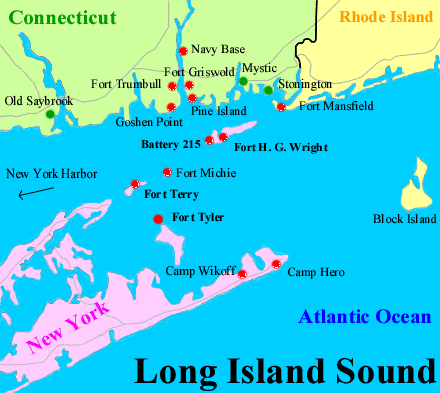
� COAST and HARBOR DEFENSES of EASTERN LONG ISLAND SOUND (partial)
View Long Island Sound Map
� Fort Mansfield
(1898 - 1917), Watch Hill
Located on Napatree Point. It was a subpost of Fort H.G. Wright on Fishers Island, NY. Batteries here are Battery Wooster (1901 - 1917), Battery Crawford (1901 - 1917), and Battery Connell (1901 - 1917), which is submerged in the surf due to a hurricane in 1938. It is visible at low tides. A fire-control tower no longer remains.
� Oaks Inn Military Reservation
(1940's), near Avondale
Site of a four-gun 155mm gun battery on Panama mounts, three mounts remain, one is still buried. Battery 114 was to be built here. The Officers' quarters still remain here.
� ALSO: Additional fire-control towers in Rhode Island associated with HD Long Island were located at Block Island (three remain), Green Hill (no longer remains), Charlestown (one remains), and at Weekapaug Point (no longer remains).
(websites courtesy of Chris Wiles)
NEED MORE INFO: Blockhouse Lane in Little Compton, near Brown Point; Fort Hill in Bristol.
Information on the forts and garrison houses during King Philip's War was gathered from "King Philip's War: The History and Legacy of America's Forgotton Conflict" by Eric Schultz and Michael Tougias, 1999 The Countryman Press.
Modern Narragansett Bay - page 2