Camp Arbuckle |
Fort Arbuckle (1) |
Fort Arbuckle (2) |
Fort Arbuckle (3) |
Fort Blunt |
Boggy Depot
Fort Cantonment |
Cavalry Remount Depot |
Camp Cheyenne Agency |
Chouteau's Fort (3) |
Chouteau's Post (1)
Chouteau's Post (2) |
Fort Coffee |
Fort Cobb |
Camp Commanche |
Fort Davis |
Fort Edwards |
Fort Gibson
Glenn's Post |
Camp Holmes |
Fort Holmes |
Camp Mason |
Fort McCulloch |
Neosho Post |
Camp Nichols
Fort Nichols |
Fort Oakland |
Camp Radziminski |
Red River Post |
Fort Reno |
Sewell's Stockade |
Fort Sill
Fort Spunky |
Camp Supply |
Fort Supply |
Fort Towson |
Fort Washita |
Fort Wayne |
Camp Wichita
Fort Wayne


(1839 - 1842, 1862), near Jay
Once located outside Maysville, Arkansas, near the state line. The Confederate Cherokee troops also used it. In 1848 the fort was at the center of the Cherokee split between John Ross and Stand Watie.
Chouteau's
Post (1)
(Memorial)
(1796 - unknown), Salina
The oldest permanent white settlement in the state.
Fort Davis
(1861 - 1862), Muskogee
Destroyed by the Union.
Fort Arbuckle (1)
(1834), Tulsa
This fort was abandoned.
Fort Spunky
(unknown dates), Catoosa
A fortified farmhouse that served as a stage station. Some ruins remain.
Fort Arbuckle (2)
(Keystone State Park)
(1834 - 1850?), near Mannford
This post was built where the dam now stands. It was established to keep
the peace between the Creek and Cherokee tribes.
Neosho Post
(1829 - 1833), Wagoner
A trading post set up by Sam Houston before he moved to Texas. It no
longer exists.
Glenn's Post
(unknown dates), Tullahasse
A stockaded trading post from the 1820's or 1830's.
Fort Gibson
(Historic Site
and Military Park)
(1824 - 1890, intermittent), Fort Gibson
The first federal fort in Indian Territory. The fort was enlarged in 1831.
It was abandoned in 1845 because of flooding, and construction of a new post
was begun on a nearby hill in 1847. But only one building was completed by
1857 and the fort was abandoned again.
The Confederates briefly used this fort early in the Civil War, but the
Union quickly reclaimed it. The Union also called it Fort Blunt
during that time and finished building it. The state park includes a 1936 replica of the 1824 log fort and stockade and original 1870 barracks. The
Garrett Historic Home is the Fort's Commanding Officer's Residence, built
in 1867. Admission fee. Another website at Geocities.
Fort Coffee
(1834 - 1838), Fort Coffee
Once located near Fort Smith, Arkansas. It was a temporary post located in
the Choctaw Nation on the Butterfield Overland Route.
Fort Holmes
(1834 - unknown), Holdenville
A subpost of Fort Gibson, and later a trading post on the California Trail. It was also known as Choteau's
Post (2) and was no longer used by the early 1850's. It no longer exists. A competing trading post, called Fort Edwards, was built directly across the river.
Fort
Towson
(Historic Site and Military Park)
(1824 - 1854, 1861 - 1865), Fort Towson
Only ruins remain of this frontier fort. It was built to protect the Choctaw Indians from the native tribes. This post was also used as the Choctaw Indian Agency for a time. It was used by the Confederates
during the Civil War. This was the site of the last Confederate surrender in June 23, 1865. A visitor center is here.
Boggy Depot
(State Park)
(1861 - 1865), Atoka
A Confederate commissary depot during the Civil War. It later served as a
stage coach station, Chickasaw headquarters, and temporary Choctaw capital.
The Confederate Memorial Museum is near here.
Fort McCulloch
(1862), Kenefic
This was the headquarters for the Confederates in Indian Territory. The site is on private
property.
Fort Washita
(Historic Site and Military Park)
(1842 - 1865, intermittent), Brown
Located northwest of Durant. It was a subpost of Fort Gibson to protect the Chickasaw and Choctaw tribes. It was no longer used by 1853, but it was used
by Confederates beginning in 1861. There are original ruins and
reconstructed structures, including the replica 1849 barracks.
Camp Arbuckle
(1850 - 1851), Byars
The post moved south to Davis.
Fort Arbuckle (3)
(1851 - 1870), Davis
A subpost of Fort Gibson, it was built to protect the Chickasaw Indians from the native tribes. The site is at the Arbuckle Historical Museum. The museum is the former Old Santa Fe
Depot and it has a scale model of the fort. Some of the structures may still exist on private property.
Camp Holmes
(1835 - 1838), Lexington
Located on Choteau's Creek. It was also called Camp Mason A fur trading post was also here around the same time period.
Fort Sill
(U.S. Military Reservation)
(1869 - 1911/present), Lawton
The Old Post and
Museum is open to visitors
(another website).
The fort was built by Buffalo Soldiers to watch over the Comanche and Kiowa
tribes. It was originally called Camp Wichita. The new post was built in 1911, surrounding the old post, with many of the original buildings still used. Also located here is
Apache chief Geronimo's gravesite, a 1930's Balloon Hangar, and the Field
Artillery Museum, which contains pieces from the 1890's to the present.
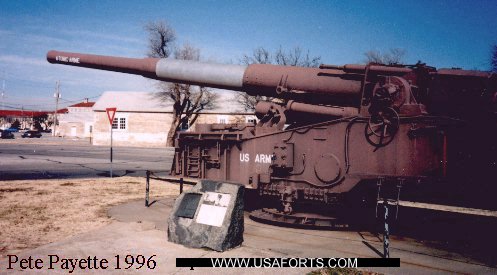
Also on display along the Cannon Walk is "Atomic Annie",
a 280mm gun that fired the world's first atomic artillery round in 1953.
The Field Artillery
Half Section is also here.
Red River Trading Post
(Museum of the Great
Plains)
(1830's - 1840's), Lawton
A replica log stockade and trader's cabin located next to the museum.
Admission fee.
Chouteau's Fort (3)
(1837 - 1838), Lawton
Once located three miles below Fort Sill, on the west bank of Cache Creek.
Camp Radziminski
(1858 - 1859), Mountain Park
This was a temporary Army camp.
Camp Commanche
(1834), Apache
Built by the Army to shelter ill soldiers who could not continue the 1834
expedition through Indian lands.
Fort Cobb
(State Park)
(1859 - 1862, 1868 - 1869), Fort Cobb
Originally built to keep the peace between tribes. It was burned down by
Caddo Indians in 1862. Half of the garrison left in 1861 for Fort Washita, the other half left
for Fort Leavenworth just before the arrival of Confederate troops. The Rebels abandoned
the post after the "Tonkawa Massacre" between the Caddo and Tonkawa tribes. After the war,
the Federals came back in 1868. The adobe and sandstone fort was abandoned after Fort Sill was
established. The town of Fort Cobb was founded in 1899 one mile west of the fort site.
Fort Reno
(1874 - 1948), El Reno
First a temporary camp called Camp near the Cheyenne Agency, it was named Fort Reno in 1875. It was built to protect the
Darlington Indian Agency and guard the Cheyenne-Arapaho Indian Reservation. It also
helped keep "Boomers" out of the territory. Soldiers from this fort are the ones who
fired the shots that started the Land Rushes of 1889 and 1892. In 1908, it became
the Cavalry Remount Depot (1 of 2 in the U.S.), a quartermaster depot in 1938,
and a German and Italian POW camp during World War II. In 1948, it was used as a
livestock research station by the U.S. Department of Agriculture. It is still used as
an agricultural experiment station. A visitor center was built in 1997, and there are
15 original buildings here.
Fort Cantonment
(1879 - 1882), Canton
Built in an attempt to stop Indian raids into Kansas. It no longer
exists.
Fort
Supply
(Historic Site and Military Park)
(1868 - 1894/95), Fort Supply
Of 92 buildings, only five historic structures remain. Originally called
Camp Supply until 1878. The fort guarded trails, supervised land
runs, and kept the peace between Indians and cattlemen. It was abandoned.
The stockade is a reconstruction and includes original ruins. The park is
on the campus of Western State Correctional Center and Hospital, built in 1903. The Oklahoma
Historical Society administers the park.
Sewell's Stockade
(1870's), Jefferson
A stage station and stockade for protection from the Osage tribe. The town of Jefferson was formerly called Pond Creek Station.
Fort Nichols
(Black Mesa State Park)
(1865 - unknown), near Kenton
Originally called Camp Nichols. It was established by Kit Carson.
Located along part of the Santa-Fe Trail. The stone foundations and parts
of the stone walls from the fort and the officers quarters outside the fort
still remain.
NEED MORE INFO: Fort Oakland near Tonkawa
Towns: Camp Houston; Old Town Trading Post just west
of Pawnee.
 Books about Forts in Oklahoma