(1776 - 1783), Catskill
A Patriot garrison was here for use in Schoharie Valley actions.
Fort Arnold |
Camp Black |
Camp Buckner |
Catskill Fort |
Fort Clinton (2) |
Fort Clinton (4)
Fort Constitution (a) |
Fort Constitution (b) |
Continental Village |
Camp Creedmore |
Deyo's Hill
Dobbs' Ferry Forts |
Dobbs' Ferry Blockhouse |
Fort (Daniel) Dubois |
Camp Dutchess |
Fort Esopus |
Camp Fishers Island
Fishkill Barracks |
Fort Franklin |
Fort Golgotha |
Camp Greenburgh |
Fort Hamilton (1) |
Camp Hero |
Hurley Blockhouse
Fort Independence (2) |
King's Ferry Forts |
Fort Lafayette (1) |
Fort Look Out |
Camp Stephen Luce |
Machin's Battery
Fort Meigs |
Fort Michie |
Miller's Hill Redoubt |
Fort Montgomery (1) |
Fort Neck |
Fort Nonsense |
Oyster Bay Camp
Fort Plum Point |
Camp Popolopen |
Fort Putnam (2) |
Putnam's Battery |
Red Hook Barracks |
Camp Rose |
Sag Harbor Fort
Fort St. George |
Camp R.N. Scott |
Camp Winfield Scott |
Fort Setauket |
Fort Slongo |
Camp Smith |
Southampton Fort
Fort Terry |
Camp Townsend |
Fort Tyler |
Fort Vaughan |
Fort Webb |
West Point |
Camp Wikoff
New Windsor Cantonment |
Fort H.G. Wright |
Fort Wyllys
Northern New York: page 1 |
New York City I: page 3
New York City II: page 4 |
Central New York: page 5
Western New York: page 6
NEW YORK'S FORTS AND MILITARY HISTORY
NEW YORK'S INDEPENDENCE TRAIL
Catskill Fort
(1776 - 1783), Catskill
A Patriot garrison was here for use in Schoharie Valley actions.
Red Hook Barracks
(1775 - 1782), Red Hook
Patriot barracks often used as a rest stop for New England troops moving into the mid-atlantic colonies. It also protected a gunpowder mill in Rhinebeck, the largest in New York at the time.
Fort Esopus 
(1658 - 1677), Kingston
A Dutch palisaded settlement with a moat and guardhouse. It was attacked by Indians in 1659. A Dutch trading post was first located here in 1615. Esopus was the original name for Kingston.
Hurley Blockhouse
(1660's - 1686), Hurley
A Dutch settlers' palisaded blockhouse.
Deyo's Hill Blockhouse 
(1757 - 1764), Pine Bush
A settlers' blockhouse. Site located on US 209 north of Kerhonkson.
Fort (Daniel) Dubois
(1705 - unknown), New Paltz
A fortified stone house in a palisaded French Huguenot settlement. It still exists on Huguenot Street.
Camp Dutchess 
(1862), Poughkeepsie
A temporary Civil War encampment, located one mile northeast of the courthouse.
Fishkill Barracks
(1776 - 1782), Fishkill
Also known as Fishkill Supply Depot, it was the largest Patriot supply depot during the war. Located here in addition to the supply depot were an administration headquarters for troops east of the Hudson River, a hospital, and a POW camp. Just to the south at Wiccopee Pass (Beacon) were three gun batteries for the duration of the war, once protecting the river barrier (1777) from Pollopel's Island to Fort Plum Point. A gun battery may have also been located on the island in 1777.
Fort Plum Point
(1777), New Windsor
A Patriot 14-gun battery also known as Machin's Battery, protecting the barrier in the Hudson River. The barrier proved useless as the British Navy easily maneuvered through it during their raid on Kingston.
New Windsor Cantonment (State Historic Site)
(1782 - 1783), Vails Gate
The last encampment of Patriot forces under General George Washington in the final days of the American Revolution. About 7000 officers and men lived here in 700 huts and seperate officers' quarters, laid out in regular streets. The largest structure was an assembly hall called "The Temple of Virtue", located of course on Temple Hill. The Order of the Purple Heart was created here, and was only awarded to a total of eight men. The Society of the Cincinnati was also formed here. The Newburgh Addresses, the greatest conspiracy against Washington's military leadership, took place here. The camp was dismantled when the peace treaty was signed. Only one officer's hut was saved as a private dwelling, and was restored to its location in 1934. Another hut was later found as part of a barn, and restoration efforts were undertaken. The park was created in 1965 with a scale reconstruction of the village. Also here is Knox's Headquarters State Historical Site, and nearby in Newburgh is Washington's Headquarters State Historical Site.
Fortress West Point
(USMA: West Point Tourism)
(1778 - 1802), West Point 
Constructed after the demise of Forts Montgomery (1), Clinton (2), and Independence (2) in 1777. Fort Arnold was constructed first in 1778, and was considered the principal fort. It was renamed Fort Clinton (4) in 1780. It guarded the chain across the river. It was restored in 1857, and is in good condition today. The other major fort here was Fort Putnam (2). It was partially rebuilt in 1780 and 1794, and was restored in 1910, and again in 1976. Other minor forts built in 1778 were Chain Battery, Lantern Battery, Water Battery, Knox Battery (no longer exists), Sherburne's Battery (no longer exists), Fort Webb (no trace remains), Fort Wyllys, and Fort Meigs. Built in 1779 were Redoubts #1, #2, #3, #4. Two miles southeast of Constitution Island on Fort Hill, near the town of Garrison are North and South Redoubts, built in 1779. The U.S. Military Academy at West Point was formerly called West Point Military Academy. Became Federal property in 1790. The first engineer cadet class started in 1802. Coastal training batteries were once located here. They were Battery Schofield (disappearing carriage), Seacoast Battery (barbette), and Battery Byrne (nee Mortar Battery until 1911) (mortars). Battery Byrne was buried under today's parade ground grandstand in 1931. Live-fire training was conducted at Fort Hancock, Sandy Hook, New Jersey. Another website
On Constitution Island across the river was built Fort Constitution (a) in 1775. It consisted of Roman's Battery and a blockhouse, Marine Battery, Hill Cliff Battery (1776), and Gravel Hill Battery (1776). The British destroyed the fort in 1777. In 1778, with the construction of the new fort across the river, the Marine Battery and Gravel Hill Batteries were rebuilt. The Gravel Hill Battery was renamed Greaton's Battery. Also built in 1778 were Redoubts #5, #6, and #7. The eastern end of the river chain was anchored here. The island became part of the USMA property in 1915.
Also part of the USMA was Camp Buckner (1821 - 1942), originally at the site of Fort Arnold/Clinton. It was moved to Lake Popolopen southwest of main campus and renamed Camp Popolopen. In 1945 the name was changed back to Camp Buckner. Camp Smith is located across the Hudson from Bear Mountain, and was originally named Camp Townsend from 1895 - 1913. Both camps are now modern training grounds for the USMA.
Fort Montgomery (1)
(1776 - 1777), Fort Montgomery *PHOTOS*
Its function was to guard the chain across the Hudson to prevent the British from sailing upriver. It failed to do that. Destroyed by the British in 1777 after a furious battle. The Patriots used the site as a camp after 1778, and also erected Putnam's Battery (1779 - 1783) here as a watchpost for West Point. Earthworks of the Grand Battery still exist, as well as a powder magazine. Several redoubts west of US 9, including Round Hill Redoubt, no longer exist.
Fort Clinton (2)
(Bear Mountain State Park)
(1776 - 1777), Fort Montgomery *PHOTOS*
Located just south of Fort Montgomery across Popolopen Creek. It was renamed by the British after its capture to Fort Vaughan. The Bear Mountain Historical Museum is located within the site of the fort. The West Redoubt still exists, located near the US 9 traffic circle.
Fort Independence (2)
(1776 - 1777), Peekskill
A small Patriot earthwork defense, with barracks. Originally named Fort Constitution (b). Its purpose was to defend Continental Village, a Patriot supply depot located three miles northeast. In 1777 the British attacked the garrison and destroyed it, along with Forts Clinton (2) and Montgomery (1). The site of the fort was on Tethard's Hill (Fort Hill Park) on Roa (Rahway) Hook, near the entrance to Camp Smith. Site now obliterated by a quarry. Located on a hill to the east of here was Fort Look Out, another Patriot defense that was also destroyed by the British. Located near here on Teller's Point on the Hudson was another Patriot battery.
Fort Lafayette (1)
(1779 - 1783), Verplanck
A Patriot fort protecting King's Ferry, located south of West Point on Verplanck Point, which is across the river from Stony Point. Another Patriot fort was also at the Stony Point Battlefield State Historical Site. This may have been called Fort Hamilton (1). Another website for Stony Point Battlefield. These forts were the southern outposts of the West Point defenses, and were often refered to as the King's Ferry Forts. They were captured by the British before they were completed, but the Patriots soon recaptured Stony Point. The British again retook Stony Point, and strengthened both defenses. The British later secretly abandoned both forts to concentrate on New York's defenses. The Patriots then held both forts until the end of the war. A lighthouse was erected at Stony Point in 1826. Another website (a) | Another website (b)
Camp Rose
(1917 - 1919), Croton Resevoir
A NY State Guard camp protecting New York City's water supply.
Miller's Hill Redoubt
(Miller's Hill Battlefield Park)
(1776), New Castle Township *PHOTO*
A Patriot redoubt built during the last phase of the Battle of White Plains. Monument and earthwork remains on site.
(info courtesy of Mike Casale)
Camp Greenburgh 
(1777), Hartsdale
Temporary headquarters for the French Army after arriving in New York. Site located along Ridge Road.
Dobbs' Ferry Forts
(1776 - 1783), Dobbs Ferry
Patriot works overlooking the ferry landing, commanding an excellent view of the Hudson River in both directions. The British captured the fort after the Patriots abandoned New York City. The fort was recaptured in 1777. Two redoubts were nearby, and the ruins of all three works were still visible in 1850.
Dobbs' Ferry Blockhouse
(1780 - 1783), Palisades
A large wooden and stone blockhouse about 500 feet north of the road to Sneden's Landing, just south of today's Tallman Mountain State Park. A battery of three guns was also built nearby.
See New York City I and New York City II
Camp Winfield Scott
(1861), Westbury
A Civil War training camp. Camp Black was established here or nearby in 1898. Camp Mills was established in 1917, renamed Mitchel Field 1918 - 1961.
Fort Nonsense
(1813), Poquott
A one-gun battery on Port Jefferson Harbor.
Oyster Bay Camp
(1778 - 1783), Oyster Bay
Headquarters for the Queen's Rangers during the occupation of New York. Raynam Hall was the commanding officer's quarters, and still exists. The fort was a square redoubt with a blockhouse on the hill overlooking the town, located at Orchard and Prospect Streets.
Fort Franklin
(Caumsette State Park)
(1778 - 1783), Lloyd Harbor
Located on Lloyd Neck between Oyster Bay and Huntington Harbor. The Lloyd Manor House was the officers' quarters, and still exists. The fort was square with a blockhouse in the center. Attacked by a Patriot force in 1779, with the entire garrison taken prisoner. Attacked again in 1781. Another website from LI History
Fort Golgotha
(1782 - 1783), Huntington
It was built in an old cemetery from the wood of a dismantled church, and the British troops' grim humor gave it its name. The tombstones were used for tables, fireplaces, and ovens. An earthwork wall surrounded the two-acre enclosure, with a barracks in the center.
Fort Slongo
(1778? - 1781), Fort Salonga
Located at Treadwell's Neck on private property. An earthwork fort with a ditch and a 7-foot high wall, garrisoned by 100 men. Captured by Patriots in 1781. The blockhouse and stores were destroyed, but most of the men escaped. The outline of the blockhouse can still be seen today.
The town's name has been corrupted over the years. Another website from LI History
Fort Setauket
(1777 - 1778), Setauket
A fortified church on Strong's Neck Road. Sustained two Patriot raids in 1777. Four swivel guns were mounted in the church's gallery windows, with the first floor used for stables. An earthwork wall surrounded the church, and was palisaded. The church was repaired after the war, but burned down. A new church was built in 1811. Another website from LI History
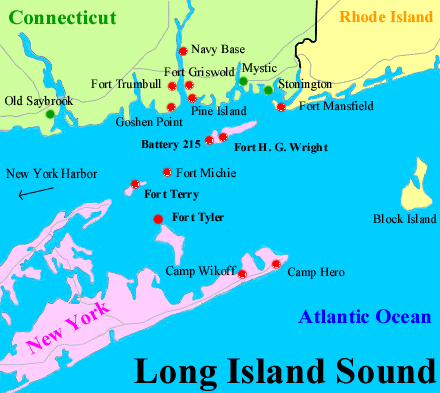
�� HARBOR DEFENSES of EASTERN LONG ISLAND SOUND (see also Fort Mansfield, RI)
World War II History
of Long Island | View Long Island Sound Map
�� Fort H.G. Wright
(1899 - 1946), Fishers Island
This was the headquarters for the Harbor Defenses of Long Island Sound. Originally located here was Camp Fishers Island from 1879 - 1888. It was also known as Camp Creedmore, Camp R. N. Scott, and Camp Stephen B. Luce. Batteries here are Battery Clinton (1902 - 1943) partially buried, Battery Butterfield (1901 - 1945) partially buried, Battery Barlow (1901 - 1943) partially buried, Battery Dutton (1901 - 1945) partially buried, Battery Hamilton (1905 - 1917), Battery Marcy (1906 - 1917), Battery 215 (1943 - 1946) at Race Point, Battery Dynamite (pre-WWI) at Race Point, Battery Hoffman (1906 - 1946), Battery Hoppock (1905 - 1946), Battery 111 (1944) on Mt. Prospect, Battery 214 (1940's) at Wilderness Point and built on, Battery New Hackleman (1944 - 1946) on North Hill, an unnamed battery (1917 - 1919/probably never built) on North Hill, and AMTB Battery 913 (1943 - 1946), which is buried. AMTB Battery 916 was to be built at East Point. AA batteries were located at Race Point and Mt. Prospect. Several fire-control towers are still located at Race Point, four towers on Mt. Prospect, and four towers on Hill 90. Became private property in 1958.
History of Fishers Island | "Guardian of the Sound" book link
Additional fire-control towers associated with Fort Wright were located in Rhode Island at Green Hill (no remains), Charlestown (still here), Weekapaug Point (no remains), and Watch Hill Point (no remains).
(website courtesy of Chris Wiles, from United States Coast Artillery Photos)
�� Fort Michie
(1896 - 1948), Great Gull Island
Located between Plum Island and Fishers Island. Batteries here are Battery JMK Davis (1923 - 1945), Battery Palmer (1900 - 1945), Battery North (1900 - 1918) destroyed to make way for Davis, Battery Benjamin (1908 - 1947), Battery Maitland (1908 - 1947), Battery Pasco (1905 - 1934), and AMTB Battery 912 (1943 - 1946). An AA battery was at Battery Palmer. There was a disappearing searchlight emplacement, and several observation towers remain. The entire island is owned by the American Museum of Natural History, New York City.
�� Fort Terry
(1898 - 1946), Plum Island
Batteries here are Battery Stoneman (1901 - 1943), Battery Steele
(1900 - 1942), Battery Bradford (1901 - 1944), Battery Floyd (1906 - 1917), Battery Dimick (1905 - 1917), Battery 217 (1944), Battery Kelly (1900 - 1917) partially buried, Battery Hagner (1906 - 1932) mostly destroyed, Battery Eldridge (1906 - 1946), Battery Dalliba (1905 - 1946), Battery Greble (1905 - 1932), Battery Campbell (1905 - 1934) partially destroyed, AMTB Battery 911 (1943 - 1946), and a four-gun 155mm battery (1942 - 1943) on top of Battery Steele. Several towers remain. The entire island has been used by the USDA since 1954 as an animal disease research lab. Access is restricted.
�� Fort Tyler
(1896 - 1915), Gardiners Island
Located between Plum Island and Montauk Point. Battery Edmund Smith (1898 - 1915) is here. This fort was used for target practice for Navy aircraft during World War II. It was severely damaged from the dive bombing. Now private property.
A WWII fire-control tower still remains on Whale Hill.
(website courtesy of Chris Wiles, from United States Coast Artillery Photos)
�� Camp Hero
(Montauk Point State Park)
(1929 - 1950), Montauk Point
Originally a US Navy installation for seaplanes. Batteries here are Battery Dunn / 113 (1944 - 1948), Battery 112 (1944 - 1948), and Battery 216 (1944 - 1947). All entrances are buried. A fire-control tower is by the lighthouse, another is in ruins in the surf. Others are located throughout the park. This was an Air Force Base from 1957 - 1982. The lighthouse here was built in 1797. The Montauk Project || Another website on Geocities
Additional fire-control towers associated with Camp Hero were located at Shagwong Point (still here, private property), Ditch Plains (ruins), Hither Hills (two remain, private property), Amagansett (still here, private property), East Hampton (no remains), and at Block Island, RI (three left). WWII Fire-Control Sites on Eastern Long Island by Chris Wiles, from United States Coast Artillery Photos
Some info for HD Long Island provided by Alex Holder of the Coast Defense Study Group.
Sag Harbor Fort
(1776 - 1780's, 1813 - 1814, 1860's?), Sag Harbor
A British depot for supplies and stores, and forage on Long Island. Raided by Patriots in 1777. This, or another fort, was rebuilt in 1813, and used up to the Civil War as a four-gun fort with a 3000-man garrison. The Meigs Monument on Union St. is on the site of the fort. Another website from LI History
Southampton Fort
(1777 - 1778), Southampton
A British fort.
Camp Wikoff
(1898), Montauk Point
This was a medical facility for troops returning from Cuba.
Fort St. George
(1780), Mastic
Located at Smith Point on the William Floyd Parkway. The Smith Manor (Manor of St. George Museum) was incorporated into the fort. It was a triangular palisade with two fortified houses at two corners, and a strong redoubt at the other corner, 96-feet square, with bastions, a deep moat, and an abatis. Built for six guns, but only two were mounted. It was attacked soon after it was built and was destroyed. No trace remains. Another website from LI History
Fort Neck 
(1653), Massapequa
An Indian fort that was captured by the British. It then became a temporary base camp against the Indians. It was 30-square yards with a six-foot deep palisaded ditch. Site located at Merrick Road and Cedar Shore Drive.
A major portion of these listings were derived from Robert B. Roberts' New York's Forts in the Revolution, 1980 Associated University Presses.
Also special thanks to Col. Michael Stenzel, NYG, for information from the New York's Forts website.