Southern New York Forts II
Camp Arthur |
Bath Beach Blockhouse |
Benson's Point Redoubt |
Camp Black |
Blockhouse #1 |
Blockhouse #2
Blockhouse #3 |
Blockhouse #4 |
Castle Bogardus |
City Battery |
Castle Clinton |
Fort Clinton (5) |
Fort Columbus
Corlaer's Hook Fort |
Camp Creedmore |
Crown Fort |
Fort Cummings (2) |
Decatur Blockhouse
Denyse's Heights Blockhouse |
Fort Diamond |
Fort Fireman |
Fort Fish |
Fort Gansevoort |
Fort Gibson |
Fort Greene (2)
Fort Hamilton (2) |
Camp Hero |
Fort Horn |
Hubert Street Battery |
Battery Hudson |
Fort Jay |
Fort Lafayette (2) |
Fort Laight
Fort Lawrence |
Fort Lewis (2) |
Camp Stephen Luce |
Fort Marcy |
Fort Masonic |
Camp McClellan |
Fort Michie
Mill Rock Blockhouse |
Battery Morton |
Fort Newton |
New York Arsenal |
Fort Nonsense |
North Battery
Princess Bay Blockhouse |
Red Fort |
Fort Richmond (2) |
Sag Harbor Fort |
Fort Schuyler (4) |
Camp R N Scott
Camp Winfield Scott |
7th Reg. Armory |
Fort Slocum |
South Battery (a) |
South Battery (b) |
Southwest Battery
Fort Stevens |
Fort Swift |
Fort Terry |
Fort Tilden |
Fort Tompkins (1) |
Camp Tompkinsville |
Fort Totten |
Fort Tyler
Utrecht Bay Blockhouse |
Fort Wadsworth |
Ward Point Battery |
White Fort |
Camp Wikoff |
Fort at Willet's Point
Castle Williams |
Fort Wood |
Fort H G Wright
Northern New York Forts: page 1 |
Eastern New York Forts: page 2
Southern New York Forts I: page 3 |
Central New York Forts: page 5
Western New York Forts: page 6
NEW YORK'S FORTS AND MILITARY HISTORY
Last Update: 29/MAY/01
Older American Forts of New York City
Castle
Clinton (National Monument) 
(1807 - 1821), Manhattan
As part of Battery Park, it was originally known as Southwest Battery, West Battery, or City Battery. During the War of 1812, this was the Army's New York Harbor headquarters. It was given its current name in 1817, and was abandoned in 1821. It was given to New York City in 1823, and it was used for many different purposes in its civilian life. It was restored by NPS in the 1960's. Located just to the east was South Battery (a) (1810 - 1812) at Bridge Street.
(Not to be confused with Fort Clinton (5) in Central Park.)
Corlaer's Hook Fort
(1812 - 1815), Manhattan
Located on Corlaer's Hook near the Williamsburg Bridge. Previoulsy at this location was the Patriot Crown Point Battery in 1776.
North Battery
(1807 - 1831), Manhattan
Built of red sandstone, which gave it the popular name of Red Fort. Also known as Hubert Street Battery, on which it was located.
Fort Gansevoort
(1808 - 1849), Manhattan
Located at Gansevoort Street on the Hudson River. It was also known as White Fort because of its whitewashed exterior. It was demolished.
Fort Clinton (5) (Monument)
(1814 - 1815), Manhattan
It was once located in the northeast corner
of Central Park. Also located here are monuments for Blockhouse #1 (1814) (at 7th Ave.) and Fort Fish (1814), which were also once located nearby. Previously located at this spot was British McGowan's Pass Redoubt from the Revolution.
(Not to be confused with Castle Clinton in Battery Park.)
Fort Laight
(1814 - 1815), Manhattan
A stone fort once located at Morningside Gardens, near La Salle Street and Broadway, probably similar to Fort Clinton (5) in Central Park. Other 1814 blockhouses located in the vicinity included Blockhouse #2 (West 114th Street and Morningside Ave.), Blockhouse #3 (West 121st Street and Morningside Ave.), Blockhouse #4 (West 123rd Street and Amsterdam Ave.).
Fort Horn
(1814 - 1815), Manhattan
Located near Jefferson Park at the end of East 110th Street. Benson's Point Redoubt (1814) was located south of here at the end of East 104th Street, at the pedestrian bridge to Ward's Island.
Seventh Regiment Armory
(1877 - 1881/present), Manhattan
Located at Park Ave. and East 66th Street. Still in use today.
Fort Stevens
(1814 - 1815), Queens
A temporary post on Hallet's Point at Hell Gate. Mill Rock Blockhouse (1812 - 1821) was constructed on Mill Rock Island in the East River. Southeast of here on Lawrence Hill was Castle Bogardus (1813 - 1815), a six-sided stone tower.
Fort Swift
(1812 - 1815), Brooklyn
Built on the site of the Patriot Fort Corkscrew from 1776.
Fort Greene (2) (Park)


(1812 - 1815), Brooklyn
A federal fort built on the ruins of Patriot Fort Putnam (1) from 1776. It
was abandoned after the war. The site was sold in 1826, and became a city park in 1847.
(Not to be confused with the Patriot Fort Greene, later US Fort Masonic)
Fort Cummings (2)
(1814 - 1815), Brooklyn
Built on the site of Patriot Oblong Redoubt from 1776.
Fort Masonic
(1814 - 1815), Brooklyn
Built on the ruins of Patriot Fort Greene (1) (British Fort Sutherland) from 1776.
Fort Fireman
(1814 - 1815), Brooklyn
Built on or near the site of Patriot Fort Box from 1776.
Fort Lawrence
(1814 - 1815), Brooklyn
A temporary battery, located at DeGraw and Bond Streets.
Fort Jay 

(1794 - 1966), Governor's
Island
Fort Jay was continuously modified until 1806 when it was almost completely
rebuilt into Fort Columbus, the original name for the current
structure. Enlarged in 1836 with a blockhouse (1840). Fort Columbus was renamed back to Fort Jay in 1904. Also located on the island were New York Arsenal (1833 - 1920), and South
Battery (b) (1812). Until it was closed in 1996, the entire island was the
New York Coast Guard Support Center.
Previously located on the island was Dutch Nooten Eylandt Fort (1624 - 1625), and a colonial-era quarantine station in 1710. The first British troops were not garrisoned on the island until 1755. Patriot forces built earthworks around the island in 1776, but were abandoned to the British. The island saw little action during the remainder of the war.
Another website at vanalen.org
| "Our Tribute to
Governors Island"
Castle Williams
(1807 - 1966), Governor's
Island
This is a four-story casemated circular fort, the first multi-tiered fort in the U.S. From 1812 - 1870, it was used as a military prison.
Fort Wood
(Statue of Liberty National Monument
and World Heritage
Site)
(1811 - 1870's), Liberty Island
Rebuilt in 1841. Used for overflow of CSA POW's from Castle Williams during the Civil War. A Water Battery was built in 1871. The courtyard of this large 11-pointed star-shaped fortress was filled in beginning in 1884, becaming the foundation for the pedestal of the
Statue of Liberty. The island remained an active military post until 1937. The remaining buildings were removed by 1950. The
name of the island was originally "Bedloe's Island".
Fort Gibson
(1795 - 1861), Ellis Island
A 21-gun battery with a magazine and barracks located on what was then known as Oyster Island, originally named Crown Fort. It was dismantled in 1861 and replaced by a US Navy ammunition depot during the Civil War. The island was selected as an Immigration Station in 1890. A US Coast Guard training station was here in WWII. The island is now part of the Statue of Liberty National Monument. A section of the fort's wall was uncovered during
the renovation of the Ellis Island Immigration Station, and is on display.
Fort Lafayette (2)
(1812 - 1868), Brooklyn
A small brick fort once located on Hendrick's Reef just off Fort Hamilton. It was
originally called Fort Diamond until 1824. Fort Lafayette was used as a POW
camp during the Civil War. A major fire occurred in 1868. After the fort was abandoned it was used as a US Naval
magazine from 1898 - 1946. It was transferred to New York City in 1948. The site in now under the east tower of the Verrazano Narrows Bridge, which was built in 1960.
Princess Bay Blockhouse
(1814), Staten Island
Located at Princess Bay near Seguine Point. Possibly not built. An unnamed battery was located here in 1898.
Ward Point Battery
(1898), Staten Island
A temporary battery site now located in the surf.
Camp McClellan
(1861), Staten Island
A Civil War training camp, later known as Camp Tompkinsville. Probably located at Tompkinsville.
Camp Arthur
(1862), Staten Island
A Civil War training camp. Exact location unknown.
ALSO: Fort Marcy (1840's) unknown location, probably Manhattan.
� HARBOR DEFENSES of
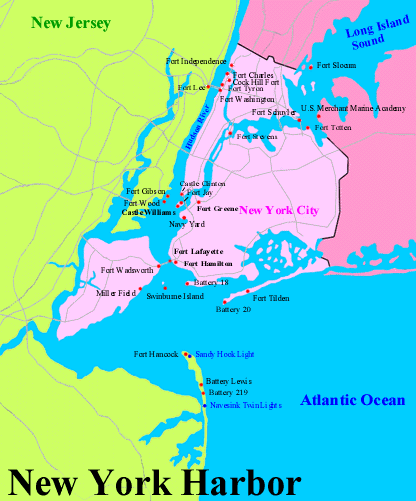
NEW YORK CITY (see also Fort Hancock, NJ)
View New York Harbor Map
� Fort Slocum
(1863 - 1928), Davids Island
Located offshore from New Rochelle. Originally built as a military hospital complex and POW camp. Nearby Hart Island was also used. First fortified in 1878. Batteries here were an unnamed 1898 battery, Battery Haskin
(1897 - 1919), Battery Overton (1897 - 1919) partially destroyed, Battery
Practice (1896 - 1899) partially buried, Battery Kinney (1904 - 1917)
destroyed, and Battery Fraser (1901 - 1917) destroyed. Became Slocum Air Force Base (NIKE Missile Base) from 1946 - 1950, and 1955 - 1966, and also used for the Armed Forces Information School, an Army Chaplain School, and a training and recruitment center (1919 - 1946). The island now sits abandoned and overgrown. A 15-inch Rodman cannon sits by the wharf.
� Fort Schuyler (4)
(1833 - 1935), Bronx
Located on the grounds of SUNY Maritime College at Throg's Neck. It is now also home to the Maritime
Industry Museum. Construction began in 1833 but the military post was not
garrisoned until 1856. Earthwork batteries were added in the 1870's. Batteries here were
Battery Gansevoort (1899 - 1935) partially destroyed and buried,
Battery Hazzard (1898 - 1930) destroyed, Battery Bell
(1900 - 1917) destroyed, and Battery Beecher (1900 - 1920) destroyed.
� Fort Totten
(1862 - 1940's/1990's), Queens
Located across the East River entrance from Fort Schuyler, guarding New York's "backdoor". It was originally known as Fort at Willet's Point. Until it was
closed in the 1990's, it was the largest Army Reserve Command in the U.S. From 1954 to 1974, this was the NIKE missile regional headquarters for New York.
Batteries here are Battery King (1900 - 1935) buried, Battery Mahan
(1900 - 1918), Battery Graham (1897 - 1918), Battery Sumner
(1899 - 1918), Battery Stuart (1899 - 1917), Battery Baker (1900
- 1940's), and Battery Burnes (1904 - 1946).
Another website at
preserve.org. Another website
at Queens, NYC.
� Fort Tilden
(Gateway National Recreation
Area)
(1917 - 1974), Queens
Located in Roxbury on Rockaway Peninsula.
Batteries here are Battery Harris (1924 - 1948), Battery Kessler
(1917 - 1947) rebuilt in 1941, Battery 220 (1942 - 1946) partially buried,
Battery Ferguson (1917 - 1942) buried. Located nearby on Rockaway Point was AMTB Battery 20 (1942 - 1946), and AMTB Battery 21 (1943 - 1946). Located at the former Rockaway NAS was an unnamed mortar battery (1917
- 1919).
Battery 117 was to be built on a point of land at nearby JFK Airport, but it
was considered to be too close to the airport. That site is now under a taxiway. From 1955 - 1974 this was a NIKE missile base. Additional WWII fire-control towers were once located at Seaside, Arverne, Atlantic Beach, Long Beach, Short Beach, and Zach's Bay.
Located near here in 1814 was American Decatur Blockhouse. It was once located at the tip of the peninsula, but the land has since moved westward. Site is probably near 137th Street.
� Fort Hamilton (2) (U.S. Army Reservation)
(1826 - present), Brooklyn
A Patriot work known as The Narrows Fort was originally here on Denyse Point. The British captured and destroyed the fort in 1776, but rebuilt it and held it throughout the war. American Fort Lewis (2) was built here in 1814. It was a blockhouse with earthworks, garrisoned by 100 men. It may also have been known as Denyse's Heights Blockhouse. Other blockhouses in the area from the War of 1812 period include Bath Beach Blockhouse (located near Bensonhurst Park, but may not have been built), and Utrecht Bay Blockhouse (same area, and also may not have been built).
Fort Hamilton was used as a POW camp during the Civil War. Exterior batteries built in 1863 and the 1870's no longer exist. Other batteries here were Battery Piper
(1901 - 1942), Battery Brown (1902 - ?), Battery Doubleday
(1900 - 1943), Battery Neary (1900 - 1937), the combined Battery
Gillmore (1899 - 1942) and Battery Spear (1898 - 1917), Battery
Burke (1903 - 1917), Battery Livingston (1905 - 1948), Battery
Johnston (1902 - 1943), Battery Mendenhall (1905 - 1917), Battery Griffin (1899 - 1946), and a WWII AA battery. All coastal batteries and fire-control towers were destroyed or buried from 1954 - 1963 to make way for the
Verrazano Narrows (I-278) Bridge and the Belt Parkway.
The Army's Harbor Defense Museum
is located here. A 20" Rodman is located outside of the north gate, and a 12" naval gun is inside the gate.
To the south, on Norton Point at Coney Island, were Battery New Catlin (AMTB 18) (1942 - 1946) buried, and AMTB Battery 19 (1943 - 1946)
buried. Other structures and towers that were here no longer exist.
� Fort Wadsworth
(Gateway National Recreation
Area)
(1810's - 1960's/1994), Staten Island
This site, known as Signal Hill, was fortified as early as 1663 by the Dutch, who built the 20-square-foot Signal Hill Blockhouse here after several settlements were destroyed by Indians. The British took it over in 1664. A Patriot garrison, Flagstaff Fort, was here in 1776 before being overrun by the British.
Historic portions of the current post contained Fort Tompkins (1) (1807, rebuilt 1847), and Fort
Richmond (2) (1847), which was originally the Water Battery (1807) for Fort Tompkins.
Both were still under repair in 1853. Fort Richmond was renamed Fort Wadsworth after the Civil War,
and renamed again, in 1902, to Battery Weed, after the entire
reservation became known as Fort Wadsworth. The south portion of the reservation was briefly named Fort Newton. Two of the oldest batteries were
Battery Hudson and Battery Morton, both from 1811, with
Hudson being used until 1944. Battery Hudson in now partially buried.
Other Batteries include: Battery Ayres (ex Miramar Battery) (1901 - 1942) partially buried,
Battery Dix (1902 - 1944), Battery Hudson (1899 - 1944) partially
buried, Battery Richmond (1899 - 1942) partially buried, Battery
Barry (ex Clifton) (1899 - 1918), Battery Upton (ex Ravenna Battery) (1899 - 1925), an unnamed battery (1898), Battery Duane (1897 - 1915) mostly
destroyed, Battery Barbour (1898 - 1920) partially buried, Battery
Mills (1900 - 1943) partially buried, Battery 218 (1943),
Battery Catlin (1904 - 1942), Battery Bacon (1899 - 1918),
Battery Turnbull (1903 - 1944) mostly buried, and Battery New
Turnbull (AMTB 14) (1942 - 1946) covered. Battery 115 was
never built. The historic fortifications were closed in
the 1960's. The short-lived New York Naval Station was here from 1990 to 1994.
To the south, at Miller Field, was AMTB Battery 11 (1943 - 1946). A fire-control tower was once here. On Swinburne Island was AMTB Battery 12 (1943 - 1946). A fire-control tower was on Hoffman Island.
Camp Winfield Scott
(1861), Westbury
A training camp. Camp Black was established here or nearby in 1898.
Fort Nonsense
(1813), Poquott
A one-gun battery on Port Jefferson Harbor.
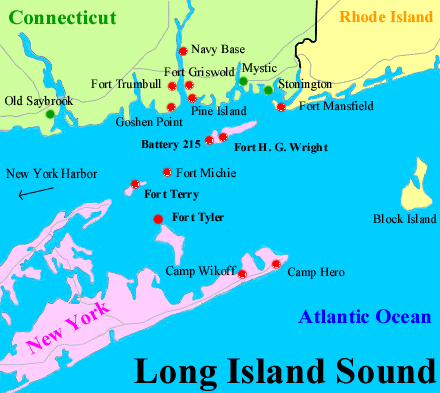
�� HARBOR DEFENSES of EASTERN LONG ISLAND SOUND (see also Fort Mansfield, RI)
World War II History
of Long Island | View Long Island Sound Map
�� Fort H.G. Wright
(1899 - 1946), Fishers Island
This was the headquarters for the Harbor Defenses of Long Island Sound. Originally located here was Camp Fishers Island from 1879 - 1888. It was also known as Camp Creedmore, Camp R. N. Scott, and Camp Stephen B. Luce.
Batteries here are Battery Clinton (1902 - 1943) partially buried,
Battery Butterfield (1901 - 1945) partially buried, Battery Barlow
(1901 - 1943) partially buried, Battery Dutton (1901 - 1945) partially
buried, Battery Hamilton (1905 - 1917), Battery Marcy (1906 - 1917),
Battery 215 (1943 - 1946) at Race Point, Battery Dynamite (pre-WW1)
at Race Point, Battery Hoffman (1906 - 1946), Battery Hoppock
(1905 - 1946), Battery 111 (1944) on Mt. Prospect, Battery 214
(1940's) at Wilderness Point and built on, Battery New Hackleman (1944 - 1946)
on North Hill, an unnamed battery (1917 - 1919/probably never built) on North Hill,
and AMTB Battery 913 (1943 - 1946), which is buried. AMTB Battery 916 was to be built at East Point. AA batteries were located at Race Point and Mt. Prospect. Several fire-control towers are still located at Race Point, four towers on Mt. Prospect, and four towers on Hill 90. Became private property in late 1950's. Other towers associated with Fort Wright were located in Rhode Island at Green Hill (no remains), Charlestown (still here), Weekapaug Point (no remains), and Watch Hill Point (no remains).
History of Fishers Island | "Guardian of the Sound" book link
�� Fort Michie
(1896 - 1948), Great Gull Island
Located between Plum Island and Fishers Island. Batteries here are Battery JMK
Davis (1923 - 1945), Battery Palmer (1900 - 1945), Battery North
(1900 - 1918) destroyed to make way for Davis, Battery Benjamin (1908 -
1947), Battery Maitland (1908 - 1947), Battery Pasco (1905 - 1934),
and AMTB Battery 912 (1943 - 1946). An AA battery was at Battery Palmer. There was a disappearing searchlight emplacement, and several observation towers remain. The entire island is owned by the American Museum of Natural History, New York City.
�� Fort Terry
(1898 - 1946), Plum Island
Batteries here are Battery Stoneman (1901 - 1943), Battery Steele
(1900 - 1942), Battery Bradford (1901 - 1944), Battery Floyd (1906 -
1917), Battery Dimick (1905 - 1917), Battery 217 (1944), Battery
Kelly (1900 - 1917) partially buried, Battery Hagner (1906 - 1932) mostly
destroyed, Battery Eldridge (1906 - 1946), Battery Dalliba (1905 -
1946), Battery Greble (1905 - 1932), Battery Campbell (1905 - 1934)
partially destroyed, AMTB Battery 911 (1943 - 1946), and a four-gun 155mm battery (1942 - 1943) on top of Battery Steele. Several towers remain. The entire island has been used by the USDA since 1954 as an animal disease research lab. Access is restricted.
�� Fort Tyler
(1896 - 1915), Gardiners Island
Located between Plum Island and Montauk Point. Battery Edmund Smith (1898 - 1915) is here. This fort was used for target practice for Navy aircraft during World War II.
It was severely damaged from the dive bombing. Now private property. A fire-control tower still remains on Whale Hill.
�� Camp Hero
(Montauk Point State Park)
(1929 - 1950), Montauk Point
Originally a US Navy installation for seaplanes. Batteries here are Battery Dunn / 113 (1944 - 1948), Battery 112 (1944 -
1948), and Battery 216 (1944 - 1947). All entrances are buried. A fire-control tower is by the lighthouse, another is in ruins in the surf. Others are located throughout the park. Additional towers associated with Camp Hero were located at Shagwong Point (still here), Ditch Plains (no remains), Hither Hills (two remain), Beach Hampton (still here), East Hampton (no remains), and at Block Island, RI (three left).
This was an Air Force Base from 1957 - 1982.
The lighthouse here was built in 1797.
The Montauk Project
Some info provided by Alex Holder of the Coast Defense Study Group.
Sag Harbor Fort
(1812 - 1860's?), Sag Harbor
A four-gun fort with a 3000-man garrison. A British fort and supply depot (1776) was located here previously.
Camp Wikoff
(1898), Montauk Point
This was a medical facility for troops returning from Cuba.
Special thanks to Col. Michael Stenzel, NYG, for information from the New York's Forts website.
Northern New York Forts: page 1 |
Eastern New York Forts: page 2 |
Southern New York Forts I: page 3 |
Central New York Forts: page 5 |
Western New York Forts: page 6
 Books about Forts in New York


 back
 back