Atlantic Highlands Res |
Old Barracks |
Fort Bergen |
Fort Billings |
Billings Redoubt |
Bull's Ferry Fort |
Cape May Res
Fort Constitution |
Fort Elfsborg |
Finn's Point Battery |
Garret Mountain Res |
Fort Gates |
Fort Hancock |
Head Quarters Fort
Fort John's |
Fort Lee |
Fort Mercer |
Fort Mott |
Fort Nassau |
Navesink Res |
Nominack Fort
Fort Nonsense |
Paulus Hook Fort |
Pavonia Outpost |
Fort Reading |
Fort at Sandy Hook |
Sandy Hook Proving Ground
Fort Shapnack |
Shipeconk Fort |
Tom's River Fort |
Van Camp's Fort |
Fort Walpack |
Fort Westbrook
Fort Lee
(park) 

(1776 - 1783), Fort
Lee
It was originally known as Fort Constitution, and was a square-bastioned earthwork up on the Palisades. Below the fort on the Hudson was Burdette's (Bourdet's) Battery. The Patriots hastily abondoned the
fort, nearly being completely overwhelmed, when the British arrived in 1776 after the capture of Fort Washington. The British partially dismantled the fort, but still used it until 1779. In 1781, Loyalist forces occupied the fort, and rebuilt it somewhat. The actual site is now located under the western approach to the George Washington Bridge. A reconstruction of the three batteries was undertaken in 1974, and a new visitors' center was completed in 1976.
Bull's Ferry Fort
(1780 - 1783), Hudson Heights
A British blockhouse that was attacked by Gen. Wayne in 1780.
Fort Bergen

(1660 - 1664?), Jersey City
This is the state's first permanent white settlement. The Dutch
established Pavonia Outpost, also in Jersey City, around 1630 but
Indian attacks prevented permanent settlement.
Paulus Hook Fort
(1776 - 1783), Jersey City
Patriot earthworks were built in 1776, but abandoned before the British, who took them over. The British built a circular redoubt mounting six heavy guns, protected by a ditch and an abatis; a second oblong redoubt armed with four guns; two blockhouses; five lines of breastworks; and three barracks. A magazine was located in the oblong redoubt. This was considered to be the principal western outpost of the British defenses of New York. Patriot forces under Light Horse Harry Lee successfully attacked the garrison in 1779, but had to retreat for fear of immediate reprisals from across the Hudson. The fort was strengthened in 1781.
Fort Gates

(1809 - 1820?), Sandy Hook
A federal fort.
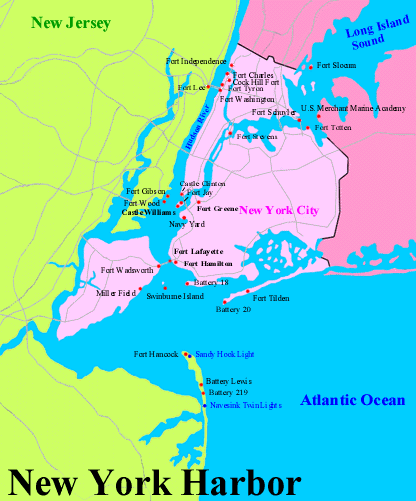
� HARBOR DEFENSES of
NEW YORK CITY (partial)
View New York Harbor Map
� Fort Hancock
(Gateway National Recreation
Area) (USCG Reservation)
(1857 - 1974), Sandy Hook
Previously known as Fort at Sandy Hook (1857 - 1885), which replaced the ruins of Fort Gates. Batteries here are Battery Potter (1890 - 1907), Battery Granger
(1898 - 1942), Battery Peck (1903 - 1946) which became Anti Motor Torpedo
Boat Battery 8, Battery Gunnison
(1905 - 1942) rebuilt and renamed Battery New Peck in 1943 and the guns were
replaced in 1974. There is also a mortar battery and a 9-gun battery {later divided into
Battery Alexander (1899 - 1943), Battery Bloomfield (1899 - 1944),
Battery Richardson (1904 - 1944), and Battery Halleck (1898 - 1944)}.
Batteries once located here (or currently on the Coast Guard base) were
Battery Dynamite (1896 - 1902), mortar Battery McCook (1898 - 1923)
which had a harbor entrance control post in 1943, mortar Battery Reynolds (1898 - 1918), Battery Kingman (1922 - 1946), Battery Mills (1922 - 1946),
Battery Arrowsmith (1909 - 1921) partially destroyed, Battery Engle
(1898 - 1917), a temporary battery possibly named Schneider (1898), Battery
Urmston (1903 - 1944), Battery Morris (1908 - 1946), Battery New Urmston (AMTB 6)(1942 - 1946) partially covered, and Anti Motor Torpedo
Boat Battery 7 (1943 - 1946). Several 12" railway mortars and 8" railguns were here in the 1930's.
The Army's Sandy Hook Proving Ground was located here along the shore from 1874 - 1919. It was previously located at Fort Monroe, VA. It then moved to Aberdeen, MD in 1920.
A lighthouse was built here in 1764, and is located next to the mortar battery.
Seasonal tours are offered for Battery Potter and the lighthouse. A museum is on site. There is a fee to enter the Gateway National Recreation Area of Sandy Hook.
� Atlantic Highlands Military Reservation
(Hartshorne Woods Park)
(1910's? - 1974), Highlands
Also known as Navesink Military Reservation. Batteries here are Battery Lewis / 116 (1944 - 1948), Battery 219 (1944 - 1949), and an unnamed mortar battery (Battery Hartshorne ? ) (1917 - 1920) covered, outside of the park by the school. Became the Highlands Air Force Station NIKE missile control center in 1948. The nearby Navesink twin lighthouse dates to 1861.
� Garret Mountain Military Reservation
(Garret Mountain Park)
(1941 - 1944), Paterson
A 1911 fire tower on Garret Mountain was used for early aircraft warning. Barracks were also built here. The tower still remains. On High Mountain (High Mountain Park Preserve) were a mobile 3-inch AA gun and a .50 cal. AA gun. Only concrete footings of the support buildings remain here. Across the Passaic River in Fairlawn, was the Columbia Heights Camp, the location of an SCR-268 radar. Site now an industrial park. This was a subpost of Fort Totten, NY.
(info courtesy of Jack Goudsward of Council of America's Military Past)
� ALSO: Additional fire-control towers associated with Fort Hancock were once located at Monmouth Beach, North Long Branch, Elberon, Shark River, and Manasquan (Seagirt).
Fort Mercer
(Red Bank Battlefield Park)
(1776 - 1777, 1778 - 1781), Red Bank, near Woodbury
An earthwork fort with 350-yards of earthen outer works. The Patriots surrendered to the British in 1777, who then abandoned it. The Patriots gained it back in 1778 and rebuilt it. Located across the river from Fort Mifflin, PA. A coastal battery was planned here in 1872.
(thanks to Adam Geibel)
Fort Billings
(1776 - 1777, 1779 - 1781), Billingsport
Also known as Billings Redoubt. It protected the cheveaux-de-frise set across the river. It was a 15-acre square earthwork with four corner bastions. It had barracks, officers' quarters, and a bakehouse. The British captured this Patriot defense near Paulsboro in 1777 and destroyed it. After the British left Philadelphia, the Patriots rebuilt the fort. The site is now
an oil tank farm.
Tom's River Fort
(1776 - 1777), near Bridgeport ?
Patriot defenses near Philadelphia on the Delaware River. (Not to be confused with the town of Tom's River on the Atlantic shore.)
Fort Nassau
(1624 - 1651), Gloucester City
Fort Elfsborg

(1643 - 1655), Salem
Nicknamed Myggenborg (Mosquito Castle). The Swedes burned down the fort when the Dutch arrived in 1655.
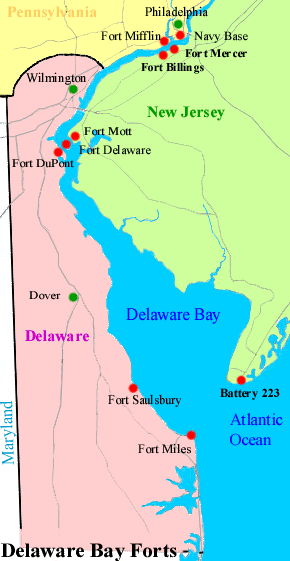
� HARBOR DEFENSES of
DELAWARE BAY (partial)
View Delaware Bay Map
� Fort Mott
(State Park)
(NJ Coastal Trail:
Salem County Trail Sites)
(1896 - 1943), near Pennsville
This installation was given its name at the end of 1897. Finns Point Battery
was first located here in 1872. Only two gun emplacements and five magazines in the
mortar battery were completed before construction was halted. One 1872 magazine remains,
and was used again during the Endicott period. The Peace Magazine was built
in 1904. Seacoast batteries here are the combined Battery Arnold (1899 - 1943)
and Battery Harker (1899 - 1941), Battery Gregg (1901 - 1910), Battery
Krayenbuhl (1900 - 1918), and Battery Edwards (1902 - 1920). Observation
stations were later installed in the gun emplacements on Batteries Krayenbuhl and Gregg.
Battery Edwards' casemates were constructed from two of the original 1872 magazines.
Two old steel observation towers are located here. The one by the river was built in 1902, and
the one by the park office was built in 1903. The fort was on caretaker status beginning
in 1922. Three of Battery Harker's guns were sold to Canada in 1941. Two of those are
are display at Fort Cape Spear in Newfoundland. The other was sent to Fort Pr�vel in Qu�bec.
� Cape May Military Reservation
(Cape May Point State Park)
(1940's), Cape May
Batteries here were Battery 223 (1944 - 1947) in the surf, Anti Motor Torpedo Boat
Battery 7 (1943 - 1946) washed away in the 1970's, and an unnamed battery (1917 - 1919)
of one 6-inch gun (destroyed) near the Coast Guard Station. There was also an unnamed
WWII battery of four Panama mounts which also washed away in the 1970's. The lighthouse at the point was
erected in 1859, replacing earlier lighthouses from 1824 and 1847. A fire-control tower was located adjacent to the lighthouse, but was torn down several years ago. Fire-control towers along the coast are still located at the former Cape May USCG Station, Wildwood Gables, and North Wildwood.
Other nearby points of intrest are: the concrete ship USS Atlantus which was
sunk by a storm in 1926, the remains of the HMS Martin which was grounded and
burned in 1813, the USCG base which was a World War II Navy base, and the Cape May
County Airport which was a World War II Naval Air Station. The Navy continued to use the
base after the war as a hydrophone station.
Old Barracks
(Museum)
(1758 - unknown), Trenton
Hessians occupied this building when the Patriots attacked the town the day
after Christmas in 1776. It was restored in 1917, and again in 1998.
Admission fee. Another
website.
Fort Nonsense
(Morristown
National Historic Park)
(1777 - 1780), Morristown
Rumored to have been built merely to keep the soldiers occupied. It is on a hill overlooking the town of Morristown, and is constructed of earthworks. This National Park includes three other units: Washington's Headquarters (1779 - 1780), Jockey Hollow Encampment Area (1779 - 1780), and the New Jersey Brigade Encampment Area (1779 - 1780).
Fort Reading
(1750's), near Brainards
A NJ colonial militia fort.
Col. Van Camp's Fort
(1750's), near Delaware Water Gap
A NJ colonial militia fort 18 miles upriver from Fort Reading.
Fort Walpack
(1750's), near Pahaquarry
A NJ colonial militia fort, 6 miles north of Van Camp's Fort.
Head Quarters Fort
(1750's), near Flatbrookville
A NJ colonial militia fort, 6 miles north of Fort Walpack.
Fort Westbrook
(unknown dates), Montague
A fortified house used as a defense against Indians. Site marked by a few stones.
Nominack Fort
(1750's), near Dingman's Ferry, PA
A NJ colonial militia fort on an island in the Delaware River, eight miles from Head Quarters Fort.
(Also spelled Namanock or Normanock).
Shipeconk Fort
(1750's), near Hainesville
A NJ colonial militia fort four miles from Nominack Fort.
Fort Shapnack
(1750's), Sussex County
A NJ colonial militia fort on the Delaware River. May possibly be located in New York.
Fort John's
(1750's), Sussex County
A NJ colonial militia fort.
NEED MORE INFO:
Towns: Fort Plains
 Books about Forts in New Jersey