Abenaki Fort |
Fort Anglesea |
Battery Cumberland |
Citadel of Safety |
Fort Constitution |
Fort Eddy
Damm Garrison |
Fort Dearborn |
Durham Garrisons |
Gilman Garrison |
Fort Hancock |
Fort Hinsdale
Jerry's Point Battery |
Camp Langdon |
Lovell's Fort |
Fort at No. 4 |
Fort Shattuck |
Shaw's Hill Fort
Fort Star |
Fort Stark |
Fort Stephens |
Strawbery Banke Garrisons |
Walbach Tower |
Fort Washington
Fort Wentworth |
Fort William and Mary
Fort Wentworth


(1755 - 1778), Northumberland
Built and used by Roger's Rangers. Used again by the Continental Army
during the Revolution. A boulder marks the possible site of this fort
between Potter House and the cemetary.
Fort Hinsdale
(1741 - unknown), Hinsdale
Built to compliment Fort Dummer just across the river in Vermont.
Fort Shattuck
(1741 - unknown), Hinsdale
A subpost of Fort Hinsdale.
Fort at No. 4
(1744 - 1760), Charlestown
Also known as No. 4 Fort, it is a reconstruction of the fortified
settlement known as Number Four Township, located on the Connecticut River
south of Claremont. Later known as Fort Stephens, and once referred to
as Old Fort. Used again during the Revolution, it served as a staging
point for Patriots heading to Bennington, Vermont in 1777. Another website
Fort Eddy
?
(unknown dates), Concord
Abenaki Fort

(1650's - 1676), Ossipee
An Abenaki one-acre palisade originally built by the British for protection against the Mohawks. It was destroyed by the colonial militia during King Philip's War. The site is now on a golf course, owned by the Ossipee Historical Society.
Lovell's Fort
(1722 - 1725), Center Ossipee
Also known as Lovewell's Fort. Read about Lovewell's War.
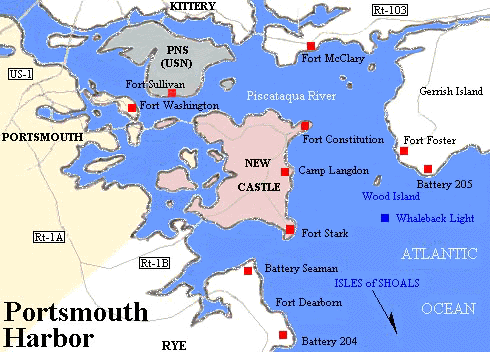
� HARBOR DEFENSES of
PORTSMOUTH (partial)
View Portsmouth Map | World War II Towers
� Fort Dearborn (State Historic Site)

(Odiorne
Point State Park)
(1942 - 1948), Rye
Batteries here are Battery Seaman / 103 (1944 - 1948) at Frost Point, a four-gun 155mm battery (1942 - 1944) on panama mounts, one mount covered, Battery 204 (1944 - 1948) at Odiorne Point, and
Anti Motor Torpedo Boat Battery 951 (1943 - 1946) partially destroyed, located at Pulpit Rock. There is a plotting room casemate and a group command bunker behind Battery
Seaman. The Air Force briefly used the site in the 1950's as a tactical radar location.
Odiorne Point Bunker Tours.
Fire-control towers associated with Fort Dearborn were located on Pulpit Rock (one still here), Rye Ledge (still here), Great Boars Head (still here), Salisbury Beach, MA (destroyed in 1950's), Plum Island, MA (destroyed in 1950's), Castle Hill, MA (removed in 1948), and at Halibut Point, MA (still here and open to the public). Others were located at Sisters Point, ME (still here), Appledore Island, ME (still here), Seal Head Point, ME (removed), Cape Neddick, ME (still here), Bald Head Cliff, ME (removed), Moody Beach, ME (still here), and Gelaspus Point, ME (removed).
Odiorne's Point was
the site of the state's first European settlement, Pannaway Plantation
(1623), which had a blockhouse named the Citadel of Safety. It was
eventually dismantled. Of interest here is the Seacoast Science Center.
� Fort Constitution
(State
Historic Site / U.S.C.G. Reservation)
(1791 - 1948, present), New Castle 
Previous names include The Castle
(1631 - 1666), and Fort
(or Castle) William and Mary (1692 - 1775). The NH colonial militia
took control in 1775 until 1778. It is possible that the fort was renamed to Fort Hancock during this time. The fort
fell into disuse and the site was called Castle Fort or Fort Castle.
U.S. Army took the site in 1791 and rebuilt the fort into a 36-gun fortress, which was
completed in 1808. Walbach Tower (or Castle Walbach) was built here in 1814. Only the
foundation still exists. In the 1850's the fort was called Camp Constitution, used mostly for training. Construction on a new outer wall was begun in 1863 adjacent
to the original wall. Construction of this wall was halted in 1867, and the fort went
into caretaker status until 1897. Coastal defense batteries were built next to the
fortress, one of which was next to the site of the Martello tower. The batteries are
Battery Farnsworth (1898 - 1917), and Battery Hackleman (1904 - 1942), which
was destroyed in 1965 to make way for the Coast Guard building. Fort Constitution was
the harbor defense headquarters in World War I. The fort was deactivated in 1948, the land
divided in 1950 between the USCG and NH State Parks.
� Fort Stark
(State Historic Site)
(1794 - 1948, intermittant), New Castle
Located on Jaffrey's Point at the southern end of the island, this site was first fortified
in 1746, known as Battery Cumberland. It was used again during the American Revolution and the War of 1812, and modified in the 1840's. A completely new battery was partially built in 1874 - 76, Jerry's Point Battery, but was demolished in 1898 in order to construct "modern" coastal batteries. Given its current name in 1900.
Seacoast batteries located here are Battery Hunter (1904 - 1944),
Battery Kirk (1904 - 1917), which was modified into the Harbor Entrance Control
Post, Battery Hays (1905 - 1942), Battery Lytle (1905 - 1942),
Battery New Lytle (1943 - 1945), and an unnamed battery (1898 - 1900), which was emplaced on the 1874 work before it was demolished. Most of the batteries here are open to the public. Visitors can get a rare
look at the insides of these relics.
Also located here was Jaffery Cottage (1682 - 1683), the meeting place of the
Provincial Assembly.
� Camp Langdon
(1909 - 1946), New Castle
Located at Great Island Common, between Fort Stark and Fort Constitution. It was originally named the New Reservation.
During World War I there were three 3-inch anti-aircraft guns (AA Battery #1) and a searchlight here.
During World War II, this was the harbor defense headquarters. In addition to
the searchlight, there were two new concrete gun pads built in 1936, but they were never armed.
The camp was sold to the town in 1963.
Strawbery Banke Garrisons
(1630's), Portsmouth
Strawbery Banke was the original name for Portsmouth from 1630 to 1653. There were at least three garrison houses here.
Shaw's Hill Fort
(1812 - 1815), New Castle
An earthwork battery constructed during the War of 1812, but never armed and never used. Site located at the top of the hill above Riverside Cemetary, across from the Naval Prison on Seavey Island.
Fort Washington
(1775 - 1778, 1812 - 1815), Portsmouth
Earthworks built to supplement Fort Sullivan to
protect the shipyard. The site is located on the eastern end of Peirce
Island (sometimes spelled "Pierce"). Earthworks remain in an overgrown
area near the water treatment plant. During the Revolution, the name of the
island was changed to Isle of Washington.
Fort Anglesea
(1777), Portsmouth
A stockade built by Edward Parry (a civilian) around the same time he built his house.
Parry felt threatened by the locals because he continued to purchase
British tea. Once located near the west end of Edward Street on South Mill Pond.
Fort Star
(site)
(1653 - 1776, intermittent), Star Island, Isles of Shoals
Built as a defense against Indians and French. The site is west of the
hotel facing the mainland. Regarrisoned in 1692 for King William's War, and
later for Queen Anne's War. Regarrisoned again in 1745 for King George's War.
In 1776, the island's residents were considered Loyalists so the
Massachusetts colonial legislature ordered the fort dismantled.
Gilman Garrison
House
(1690), Exeter
A fortified house that protected an adjacent mill. The house was expanded in 1770. Admission fee.
Damm Garrison
House
(1675), Dover
It was one of the few garrison houses to survive the 1689 Indian attack. It is the only intact garrison left remaining in Dover. It was moved to the Woodman Institute campus in the early 20th century. There
are displays of colonial tools and housewares.
See: Garrison Hill (a) or
Garrison Hill (b).
There were up to 50 garrison houses in and around Dover around 1689.
Durham Garrisons
(1680's), Durham
At least five garrison houses were here, which were destroyed during King William's War in 1694 (The Oyster River Massacre).
NOTE: For info on Portsmouth Naval Shipyard please see the page for Maine.
 Books about Forts in New Hampshire