Addison Blockhouse |
Advanced Redoubt |
Fort Ann |
Camp Atlantic Beach |
Fort Apalache
Appalachicola Arsenal |
Fort Armstrong |
Barrancas Barracks |
Fort Barrancas |
Black Creek Arsenal |
Fort Blount |
British Post
Fort Capron (1) |
Fort Caroline |
Fort Christmas |
Fort Clinch (1) |
Fort Cooper |
Fort Dade (1) |
Fort Drane
Fort Fannin |
Fort Frank-Brooke |
French Fort |
Fort Gadsden |
Fort Gatlin |
Fort George (1) |
Fort George (2)
Fort George Island Battery |
Fort Heilman |
Fort Izard |
Fort King |
Fort Maitland |
Fort Marion |
Fort Matanzas
Mayport Battery |
Fort McRee |
Fort Mellon |
Fort Micanopy |
Camp Monroe |
Fort Mose |
Negro Fort |
Old Fort
Fort Peyton |
Fort Pickens |
Fort Picolotta |
Port St. Joe Res |
Presidio de San Augustin |
St. Andrews Res
Battery San Antonio |
Fort San Carlos |
Fort San Carlos de Austria |
Fort San Carlos de Barrancas |
Fort San Diego
St. Francis Barracks |
Fort San Francisco de Pupo |
St. Johns Bluff Battery |
Fort San Luis |
Castillo de San Marcos
Fort San Marcos de Apalache |
Fort St. Mark |
Fort St. Marks |
Fort San Mateo |
Fort San Nicholas |
Fort Santa Rosa
Fort Sanderson |
Fort Scott |
Fort Shannon |
Fort Steele |
Fort Waccahootee |
Fort Walton |
Fort Ward |
Fort White |
Yellow Bluff Fort
Southern Florida Forts - page 2
FLORIDA'S COASTAL MARITIME TRAIL - FORTS
SEARCH FLORIDA'S PHOTOGRAPHIC ARCHIVES
type "Fort" for "entire collection" search
� HARBOR DEFENSES of PENSACOLA
� Fort Barrancas 


(Gulf
Islands National Seashore)
(U.S. Naval Air Station Pensacola)
(1844 - unknown), Pensacola
Originally Spanish Fuerte San Carlos de Barrancas (1698), a wooden fort. May have also been known as San Carlos de Austria. Destroyed by the French in 1719, but rebuilt the next year. Rebuilt again in 1752. The British rebuilt the fort in 1771 after taking control of West Florida from Spain. The British also built Fort George (2) in downtown Pensacola at the end of present-day Palafox Street. The Spanish again rebuilt the fort with brick after destroying the British structure and regaining control of all of Florida in 1783. The Spanish also built Bateria de San Antonio (1793), which later became the Water Battery for American Fort Barrancas. The British returned again in 1796, and occupied the fort until 1814, when the Americans destroyed the fort after defeating the British. The ruins of this fort are adjacent to the present-day fort, which was built from 1839 - 1844.
Occupied by the Confederates until 1862. It is on Navy property, but
is operated by the National Park Service. This fort also includes the Advanced Redoubt (1851) which is also located on the current Navy base. The short-lived "Barrancas System" for artillery fire-control (pre WWI) originated here. The four wooden station towers are long gone.
See also Coastal
Fortifications on the Gulf of Mexico (website courtesy of Andy Bennett).
� Fort McRee
(Gulf Islands National
Seashore)
(1843 - 1947), Perdido Key near Pensacola
A Water Battery was built on the southern face in 1851. Occupied by the Confederates from 1861 to 1862. Abandoned in 1878.
Endicott batteries located here were Battery Slemmer (1900 - 1917) partially
buried, Battery Center (1901 - 1920) partialy buried, and Battery
233 (1944) never armed. A searchlight position was built on the #1 gun platform of Battery Slemmer in the 1930's. The old fort lies in ruin and is mostly under water in the surf. The Water Battery site is long gone. A WWII fire-control tower was once located to the west at Barrancas Beach. Access is by 4x4 vehicle or by foot.
� Fort Pickens
(Gulf Islands National
Seashore)
(1845 - 1947), Santa Rosa Island near Pensacola Beach
�National
Archives MAP�
The original defense for the Naval Shipyard built nearby in 1825. Construction started in 1834. Held by the Union through the entire Civil War. Beginning
in 1862 it was used as a federal prison. The north bastion was destroyed in a magazine explosion in 1899. A mine casemate was built in the southeast bastion to control the harbor minefields in WWI and WWII. Battery Pensacola (1899 - 1933) was built inside the old fort. Batteries located adjacent to the old fort are Battery Cullum (1898 - 1933) modified in 1942 for Battery Trueman's guns,
Battery Sevier (1898 - 1933), Battery
Van Swearingen (1898 - 1921) one gun is on display at Danielsville, GA, Battery Trueman (1905 - 1942) guns moved to Battery Cullum in 1942,
Battery Payne (1904 - 1946), and an Anti Motor Torpedo Boat Battery (1943
- 1946). Two 37mm AMTB guns (1943 - 45) were located by the wharf. Located further east on the island are Battery Cooper (1906 - 1917) gun from West Point, NY transferred here in 1976, Battery Worth (1899 - 1942) became
the harbor entrance control post in 1943, Battery Langdon (1923 - 1947) casemated in 1943, near the old Coast Guard Station, Battery 234 (1944) never armed, guns came from Fort Custis, VA in 1976, with restored BC station, and a four-gun 155mm battery (1937 - 1945) located by Battery Cooper. It was sometimes referred to as Battery Cooper, as the magazines and other rooms were used. A two-gun 3-inch AA battery was built by Battery Worth (1925 - 1930), but was relocated to near Battery Langdon (1930 - 1945). There were once several positions for disappearing searchlights. A WWII fire-control tower was once located to the east at Bald Point. Admission fee. See also
Coastal
Fortifications on the Gulf of Mexico (website courtesy of Andy Bennett).
Another website at Cityshowcase.com |
Another website at Tulane.edu
� Barrancas Barracks
(1820's - 1950's), Pensacola
The garrison post area for the three forts. It evolved into the Pensacola Naval Air Station. The Pensacola Naval Shipyard was begun in 1825.
Fort Santa Rosa
(1719), Santa Rosa Beach or Santa Rosa Island
An old Spanish fort located either where Fort Pickens was built, or near where Fort Walton was built.
Fort Walton
(1835 - unknown), Fort Walton Beach
Built during the Seminole War. Used by the Confederates in the Civil War.
�� TEMPORARY HARBOR DEFENSES of PANAMA CITY
�� St. Andrews Military Reservation
(St. Andrews Beach State Recreation Area)
(1943 - 1944), Panama City
Two Panama-mount 155mm guns were once located here.
�� Port St. Joe Military Reservation
(St. Joseph Peninsula State Park)
(1943 - 1944), Port St. Joe
Two Panama-mount 155mm guns were once located here, but it was never officially activated.
Fort Gadsden
(State Historic Site)
(1818 - 1862), near Sumatra
Built on the site of Fort Blount (1814 - 1816) or British Post, which was left to former slaves and fugitive Seminoles.
The Americans from Fort Scott blew up the "Negro Fort" in 1816.
In 1818, the Americans rebuilt it and gave it its current name. Confederates
used it during the Civil War. Another website from NPS.
Fort Scott
(1816 - unknown), Chattahoochee
Built to keep watch over Fort Blount. The Spanish objected to the presence
of this fort, but they never did anything about it.
Appalachicola Arsenal
(unknown dates), Chattahoochee
In use during the 1850's.
San Marcos de Apalache
(State Historic Site)
(1679 - 1824, intermittent), St. Marks
The first Spanish fort was wooden and was burned by pirates in 1682. The
second Spanish fort was also wooden and was built in 1718. The third
Spanish fort was stone and was built in 1739. This fort changed hands
several times between the Spanish, British (Fort Apalache 1763 - 1780?), and
Americans (Fort St. Marks 1818). (Note: Not to be confused with the British Fort St. Mark (1765 - 1783) in St. Augustine.) The Confederate Fort Ward was built on the site in 1861 and lasted until
1865.
Fort San Luis
(1640 - unknown), Tallahassee
Headquarters for seven Spanish missionary settlements. Possible location at Old Fort Park.
Fort Braden
(unknown dates), Bloxham?
On Jackson Bluff Road 18 miles west of Tallahassee.
Fort Dade (1)
(Suwannee River State Park)
(1830's), Ellaville
Also the site of a Confederate fort during the Civil War.
Fort Mason
(1830's), Mason
Located south of Lake City.
Fort White
(1830's), Fort White
Fort
Clinch (1)
(State Park)
(1847 - 1900), Fernandina Beach
This was once considered to be a Georgia fort. Confederates occupied this
fort until 1862 when the Union captured it. US troops bound for Cuba trained here in 1898. An
unnamed harbor defense battery was here from 1898 to 1900.
Another
website at Nat. Park Service.
Fort San Carlos
(1784 - unknown), Fernandina Beach
A Spanish fort with some remains. This site was fortified since 1736.
Fort George (1) 
(1736 - unknown), Fort George Island
Built by Oglethorpe as a temporary headquarters in his invasion of Spanish Florida. A Spanish blockhouse may have been built here in 1568. Located across from Mayport Naval Station.
� TEMPORARY COAST and HARBOR DEFENSES of JACKSONVILLE
� Fort George Island Battery
(1917 - 1919), Fort George Island
An unnamed battery was located here across from Mayport Naval Station.
� St. Johns Bluff Battery
(1898 - 1899), Jacksonville
An unnamed harbor defense battery was built near the site of Fort Caroline. It was originally emplaced temporarily by the Ribaut Memorial, then it was moved and re-armed about one-third mile southeast, the site now located on private property.
� Mayport Battery
(1940's), St. Johns Point, Jacksonville
A four-gun 155mm battery was located here (1942 - 1944).
� Camp Atlantic Beach
(1942 - 1945), Jacksonville
The headquarters of the Temporary Harbor Defenses of Jacksonville in WWII.
Fort Steele
(1861 - 1862), Jacksonville
A Confederate fort at St. Johns Point. It was abandoned as the Union forces arrived. The site was excavated in the 1990's.
(info by Thom Parham)
Fort Caroline
(National Memorial) 
(1564 - 1568), Jacksonville
The original fort lasted only a year and a half when the French were
driven out by the Spanish. The Spanish later rebuilt it as Fort San Mateo. The French retook the fort in 1568 and destroyed it for good. The current structure is a reconstruction. The original site has washed away. A Confederate fort was located near the site during the Civil War.
Fort San Diego
(1730's), Ponte Vedra Beach
A Spanish fort on the coast. Now the site of a golf course.
(info by Thom Parham)
St. Johns River Forts
(1730's), near Jacksonville
Fort San Nicholas was built in 1740 when the British were ready to attack Spanish garrisons in the area. It was destroyed in 1812 by American settlers attacking St. Augustine.
Fort Picolotta (at Picolata) and Fort San Francisco de
Pupo (1737, at Green Cove Springs) were also in the area along the St. Johns River. Forts Picolotta and de
Pupo were attacked by the Georgia Militia in the 1741. Fort de Pupo may also be known as Fort St. Francis de Pupa.
Fort Heilman
(1837 - 1840), near Middleburg
A temporary post on Black Creek. It was the Army's Quartermaster Depot. Bad conditions here (disease, loneliness, etc.) contributed to high desertion and suicide rates among the soldiers. Located near here on the north bank of Black Creek, near Garey's Ferry, was Fort Sanderson, a Dragoon encampment. Also near here was Black Creek Arsenal, a local depot where the Army's muskets were repaired. Artifacts are on display at the Clay County and Middleburg Museum.
(info provided by Thom Parham)
Yellow Bluff Fort
(State Memorial)
(1862 - 1865), New Berlin
An earthwork fort located near Jacksonville. Abandoned by the rebels shortly after it was built, and immediately before the Union came ashore the next day. Strengthened and enlarged by the Union, consisting of a magazine, two stockades, rifle pits, and a signal tower. Abandoned after the war. Five cannon remain. The site was deeded to the state in 1950.
(info provided by ENS Will Ritcher III, USNR)
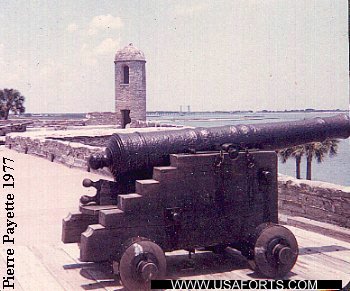
Castillo de San Marcos
(National Monument)
(1672 - 1900), St. Augustine 
This is the site of nine earlier wooden forts, all Spanish, dating back to
1565. The site of the 1565 work has been recently excavated, just north of the castle. The 1578 fort was destroyed by Sir Francis Drake in 1586. St. Augustine is the first permanent white settlement in the United
States. Castillo de San Marcos (also called
The Presidio de San Agust�n)
was built with coquina (shells and stone) and is the oldest
masonry fort in the U.S. The fort was reconfigured in 1756.
It was held from 1765 - 1783 by the British and called Fort St. Mark. (Note: Not to be confused with the American Fort St. Marks (1818 - 1824) in St. Marks.) The U.S. had the fort from 1821 - 1900, with the Confederates
briefly holding it in 1861 and 1862. The fort was known as Fort
Marion from 1825 to 1942. It was used as a prison through much of the
American period. Has been a National Monument since 1924. PHOTO
St. Francis Barracks
(1825 - unknown), St. Augustine
The garrison post for Fort Marion
Fort Capron (1)
(unknown dates), St. Augustine
Temporary works from the 1820's.
Fort Mose
(1738 - 1763), St. Augustine
A Spanish settlement of Africans, many of whom escaped enslavement in
the English colonies of Carolina and Georgia. After it was destroyed by
the British in 1740, it was rebuilt. It was officially known as El Pueblo de Gracia Real de Santa Teresa de Mose. It was the first free African settlement in North America. In 1763, the Africans abandoned the
settlement and relocated to Cuba with the rest of the Spanish colonists of
St. Augustine. Artifacts and displays are at Castillo de San Marcos. Another
website at the Nat'l Park Svc || Another NPS website
Fort Peyton
(1836 - unknown), Moultrie
A wooden fort and blockhouse was here on Moultrie Creek, south of St. Augustine proper. It's where Seminole Chief Osceola was captured under a white flag of truce.
(info by Thom Parham)
Fort
Matanzas
(National Monument)
(1742 - unknown), Cresent Beach
A coquina fort that replaced a 1736 stone tower. Library of Congress link
Fort Shannon
(1838 - unknown), Palatka
Abandoned sometime before 1853.
Fort Drane

(1830's), Irvine
Occupied by Seminole Indians, but soon recaptured in 1836. The fort was
later abandoned.
Fort Micanopy
(1830's), Micanopy
A temporary post. Battles occurred here in 1835, 1836, and 1840.
Fort Waccahootee
(1830's), Wacahoota
Listed as being not in service in 1853.
Fort Fannin
(1838 - unknown), Fanning Springs
A temporary post for the Creek and Seminole Wars. Some ruins remain. The town name was later changed to Fanning for some unknown reason.
Fort Frank-Brooke
(1830's), Steinhatchee
A temporary post.
Fort King
(1827 - unknown), Ocala
Built as a trading post in 1825. Still owned, but not in use in 1853. A battle
occurred near here in 1840.
Fort Armstrong
(1836 - unknown), Bushnell
Built on the
site of "Dade's Battleground". Troops were ambushed here in 1835, starting the Second Seminole War. In the supplies of the fallen troops were Cuban oranges. The seeds took root and thus started Florida's orange crop industry in 1846.
Addison Blockhouse
(1836), Volusia County
Old Fort
(1768 - 1777), New Smyrna Beach
The Brits were driven out by the Spanish during the American Revolution.
Fort Mellon
(unknown dates), Sanford
Listed as being not in current use in 1853. Previously called Camp
Monroe. A battle occurred near here in 1837. Sanford was originally called Mellonville.
Fort Ann
(1837 - 1838), Merritt Island
A temporary garrison and supply depot, with two bastions at opposite corners. It was abandoned. Site is located on north side of island opposite Mims.
(info by David Paterno)
French Fort
(1565), Cape Canaveral
A French stockade built by the Fort Caroline survivors, made from the timbers of their ship after they escaped the massacre at Matanzas at the hands of the Spanish. The Spanish caught up with them after one month and transported them back to Europe. The fort was then destroyed.
(info by David Paterno)
Fort Christmas
(Museum)
(1837), Christmas
A replica has been built, with living history events.
Fort Maitland
(1830's), Maitland
Fort Gatlin
(1837 - 1848), Orlando
Settlers later founded Orlando around the old fort.
Fort Cooper
(State Park)
(1836 - unknown), Inverness
A frontier fort.
NEED MORE INFO: Fort Island Beach near Crystal River. There were 150 wooden forts
used in the Seminole Wars, including the preserved site of Fort Izard (1836) (location?).
Towns: Fort Union near Suwannee River north of Live Oak; Fort McCoy; Cantonment (Clinch?) near Pensacola.
 Books about Forts in Florida