Fort Altena |
Fort Casimir |
Fort Christina |
Fort Delaware |
Fort DuPont |
Lewes Battery |
Fort Miles
New Castle Battery |
Fort Reynolds |
Fort Saulsbury |
Talbot's Fort |
Fort Trefalddighet |
Fort Union |
Fort Zwaanandael
Fort Christina
(park) 


(1638 - 1655), Wilmington
This is the site of the state's first permanent settlement where the
Swedes landed in 1638. The colony became known as New Sweden.
When the Dutch took over from 1655 to 1665 they renamed it Fort Altena.
The British then took control of the area and stationed troops at the fort. The
Swedish settlers swore allegiance to the British. The fort was eventually abandoned and fell into ruin.
Visit the
Kalmar Nyckel, a replica of
the ship that brought the first permanent settlers to the region.
Fort Union

(1813), Wilmington
A state militia fort located at or near the site of Fort Christina.
Fort Casimir
(1651 - 1655), New Castle
The Swedish captured this fort in 1654 and named it Fort
Trefalddighet (Trinity). The Dutch recaptured it and also captured
all of New Sweden in 1655. The British controlled the region beginning in
1664. Site was located on Sand Hook, now long washed away. New Castle served as Delaware's capital from 1704 to 1777.
New Castle Battery
(1813), New Castle
A state militia fort located at Battery Park.
Talbot's Fort
(1684 - 1686), Christiana
Maryland once claimed this area during a dispute with William Penn over the
northern boundary. Maryland troops garrisoned the fort for only two years and
Lord Baltimore's Charter was overthrown in 1689.
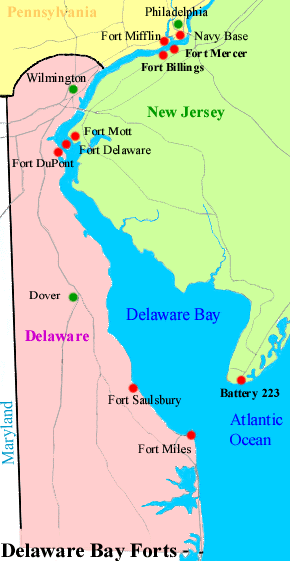
� HARBOR DEFENSES of
DELAWARE BAY (partial)
View Delaware Bay Map
�
Fort Delaware
(State Park)
(1847 - 1944), Pea Patch Island 
An earthwork fort was erected in 1813 and dismantled in 1821. A masonry fort
was built next but it was destroyed by fire in 1832. Construction on the third fort
was started in 1836 but halted in 1838 because New Jersey claimed the island. The work
was resumed in 1848. A water moat was built around the current fort in 1859.
Although armed with 131 guns, the fort was used as a POW prison during the Civil War.
Batteries here are Battery Torbert (1901 - 1942), Battery Dodd (1899 -
1918), Battery Hentig (1901 - 1942), Battery Alburtis (1901 - 1920), and
Battery Allen (1901 - 1920). Observation towers were built during World
War I. Another website at del.net.
A ferry (fee) carries passengers from Delaware City to Fort Delaware and Fort Mott
in New Jersey. Bad weather may preclude or delay ferry service.
�
Fort DuPont
(State Park)
(1860's/1896 - 1945), Delaware City
Originally this was Fort Reynolds, located at the original entrance to the Chesapeake & Delaware Canal. Earthwork batteries were built in 1873, and an unfinished mortar battery from 1872 still remains.
Coastal batteries here are Battery Rodney (1900 - 1941), Battery Best
(1900 - 1941), the combined Battery Read (1899 - 1918) and Battery
Gibson (1899 - 1917), Battery Ritchie (1900 - 1917) destroyed,
Battery Elder (1904 - 1942), which was relocated in 1922 to Delaware Beach,
and Battery Elder II (1942), which now houses the Liston Front Range
Lighthouse. One old fire-control tower that served Fort Mott is still here. This was the Harbor Defense headquarters until World War II.
German POWs were held here during World War II.
Nearby is Delaware City Battery Park.
�
Fort Saulsbury
(1896 - 1946), near Slaughter Beach
Batteries here are Battery Hall (1924 - 1945), and Battery Haslet
(1924 - 1942, transferred to Fort Miles' Battery 519). The fort is now privately owned. Fire-control towers were once located along the shoreline at South Bowers, Big Stone Beach, Mispillion River, Fowler Beach, Broadkill Beach, and West Fort Miles (near the ferry terminal).
� Fort Miles
(Cape Henlopen
State Park)
(1941 - 1962), Lewes
Batteries here
were Battery Smith / 118 (1943 - 1948), Battery 519 (1944 - 1948)
replaced #119, Battery Herring
/ 221 (1944 - 1948) uncovered, Battery Hunter / 222 (1943 - 1947), Battery Exam
(1942 - 1946) mostly buried, Anti Motor Torpedo Boat Batteries 5A, mostly buried, and 5B,
partially covered by a parking lot (both 1943 - 1946). There were three unnamed batteries;
one was a four gun 155mm battery (buried) (1942 - 1943), the other two were 8-inch railway batteries.
There was also a temporary battery of one 3-inch gun (1917 - 1918) on the cape.
Battery 119 was planned but never built. After closing, part of the base was turned over to the US Navy for use as a Naval Radio Station (1963 - 1976). The rest of the base became the Fort Miles Recreation Area. Cape Henlopen History.
Several fire-control towers still remain throughout the area, and one is open to the public. Some of them are in danger of being overtaken by the ocean. Additional towers are also located at what is now Fenwick Island State Park (one here), Delaware Seashore State Park (three here), and at Henlopen Acres (two here).
Fort Zwaanandael
(1631 - 1632), Lewes
(Also spelled "Swaanendael"). This was the first Dutch settlement in the state.
Lenni Lenape Indians massacred the settlers and burned the fort due to a
dispute over the display of the Dutch coat-of-arms. The site is marked by the
De Vries Monument.
Lewes Battery
(1813), Lewes
Located in 1812 Memorial Park, this battery defended the town from British
bombardment.
 Books about Forts in Delaware