CONNECTICUT
Belcher's Fort |
Berlin Stockade |
Fort Bird |
Black Rock Fort (1) |
Black Rock Fort (2) |
Branford Blockhouse
Bryan's Fort |
Cross' Fort |
Fort Culver |
Cupheag Plantation Fort |
Camp Danbury |
Fort Decatur |
Fort Defense
Denison's Fort |
East Fort |
Enfield Stockade |
Camp English |
Fort Fenwick |
Fort Folly |
Good Hill Fort
Fort Good Hope |
Goshen Point Res. |
Granby Blockhouse |
Grapevine Point Camp |
Fort Griswold (1)
Fort Griswold (2) |
Groton Fort |
Fort Nathan Hale |
Hall's Fort |
Camp Hamilton |
Fort Hartford |
Camp Haven
Fort Het Huys de Hoop |
Fort Hill |
Fort Hope |
Fort Kilbourn |
Litchfield Forts |
Little Fort |
Long Point Fort
Lyman's Fort |
Mansfield Forts |
Mashantucket Fort |
Matianuck Fort |
Fort Molly Rocks |
Fort Nonsense
North Fort |
Norwalk Blockhouse |
Camp Oyster Point |
Peace Farms' Fort |
Pine Island Res. |
Parade Fort
Plymouth Trading House |
Camp Putnam |
Fort Rachel |
Roxbury Forts |
Sabin's Stockade |
Salisbury Forts
Fort Saybrook |
Fort Shantok |
Shaw's Fort |
Simsbury Stockade |
South Fort |
Southington Forts
Fort Stamford |
Stone Ranch Res. |
Stonington Gun House |
Town Hill Fort |
Fort Trumbull (1)
Fort Trumbull (2) |
Fort Union |
Wallingford Fort |
Fort Waterbury |
West Fort |
Wethersfield Fort
Whitfield Garrison |
Windsor Blockhouse |
Fort Woodruff |
Fort Wooster
Native American Forts
(NOT INDEXED)
Denison's Fort 
(1675), Stonington
A settlers' palisaded fort used by the colonial militia during King Philip's War.
Long Point Fort 

(1776, 1811 - 1814, 1898 - 1899), Stonington
A Patriot water battery with barracks was originally located here. Rebuilt in 1811 as a four-gun earthwork with a brick arsenal or Gun House (1808). It was attacked by the British in 1814. A marker is on Water Street. A monument at Cannon Square has two of the original guns.
An unnamed one-gun battery (10-inch smoothbore Rodman) was emplaced here or nearby in 1898 during the Spanish-American War.
Fort Rachel
(1813 - 1815), West Mystic
A town militia fort with only one gun.
�� Colonial and Federal Forts of New London Harbor
�� Fort Griswold (2) (Battlefield State Park)
(1775 - 1900 ?), Groton
This was originally a blockhouse with earthworks, known as Groton Fort. Stone walls and bastions were added in 1776, and it was renamed. This was the site of an apparent massacre of Patriots by British troops under the command of Benedict Arnold, after the British captured the fort in 1781. Repaired in 1794, but left unfinished. In 1818 this was a 12-gun fort. The granite battlefield monument was built in 1830. In 1842 the fort was sold to the Federal government. Upgraded during the Civil War. The Water Battery was rebuilt and rearmed through 1900. Another website
�� Fort Decatur
(1813 - 1815), Gales Ferry
Commodore Decatur ordered earthworks built on Dragon Hill (or Allyn's Mountain) a few miles north of Groton in order to protect his fleet from the British blockade. He remained bottled up for the duration of the war.
�� Parade Fort
(1691 - 1781), New London
A town fort built at the river by State Street, with powder magazines and guardhouse on higher ground. It had six guns. By 1774 it had nine guns. It was not rebuilt after the 1781 British attack on the town.
�� Fort Trumbull (2) (State Park)
(1775 - 1911, 1950's - 1993), New London
Not yet completed by 1781 when Fort Griswold (2) was attacked by the British. The land face was completely open, allowing the British to easily overrun the garrison. A blockhouse was built in 1785. Repaired in 1795, 1799, and again in 1808. The fort was rebuilt in 1813, and the 18-gun fort was rebuilt again in 1839 with granite casemates. Additional outer batteries were built after the Civil War. The fort was transferred to the U.S. Coast Guard in 1911 for use as the first Coast Guard Academy (1915 - 1932). The Naval Undersea Warfare Center was later here until 1993. The granite blockhouse behind the North Battery is the last remaining intact "First System" structure on the East Coast. The visitor center is in the restored Officers' quarters. Friends of Fort Trumbull
Nearby was Patriot Fort Nonsense (1779) (aka Fort Folly) on Town Hill, which played a minor role in the 1781 British attack.
� HARBOR DEFENSES of
NEW LONDON
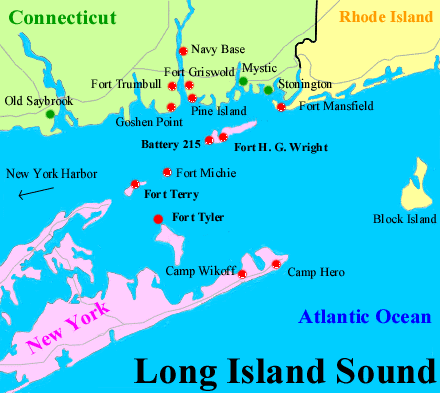
View Long Island Sound Map || PHOTOS AND INFO by Chris Wiles
� Pine Island Military Reservation
(1943 - 1946), Groton
Anti Motor Torpedo Boat Battery 915 was here. Remains overgrown.
� Goshen Point Military Reservation
(Harkness Memorial State Park)
(1943 - 1946), Seaside
Anti Motor Torpedo Boat Battery 914 was here. It is now covered over.
Stone Ranch Military Reservation
(1873 - present), East Lyme Township
A state National Guard summer training camp. Became the state muster camp during the Spanish-American War, known as Camp Haven.
Fort Saybrook
(Monument Park)
(1635 - 1647, 1648 - 1815 ?, intermittent), Old Saybrook
The original palisaded wooden fort was built to counter the Dutch fort in Hartford. It was destroyed by fire in 1647. It was rebuilt in 1648 on a new site closer to the river (restaurant now on second site). Colonials successfully defended the fort from attacking Dutch in 1675. Partially rebuilt in 1776, but never used by Patriot forces. It was partially restored again for the War of 1812 and renamed Fort Fenwick. The earthworks remained until 1871 when the site was razed for a railroad turnhouse. Excavations in 1980 revealed all traces of the original fort were destroyed in 1936 WPA projects. The park has a few monuments and markers detailing the history. CT Coastal Access Guide
Henry Whitfield Garrison
(Henry Whitfield State Museum)
(1639 - unknown), Guilford Station
This is the oldest extant stone house in New England. It was originally built as the parsonage for the Reverend Henry Whitfield, but was also used as the town's stronghold during times of crisis. It was restored and opened as a museum in 1899. Admission fee.
Branford Blockhouse
(unknown dates), Branford
The original town meetinghouse was a palisaded log blockhouse.
Bryan's Fort
(unknown dates), Branford
A settlers' fort built around the same time as Branford Blockhouse.
Black Rock Fort (2)
(Fort Nathan Hale Park)
(1776 - 1815 ?, 1861 - 1865), New Haven
Also known as Little Fort, this was originally a three-gun log fort and blockhouse. It was attacked by the British in 1779. It was rebuilt in 1809 as an elliptical brick and stone six-gun fort, and renamed Fort Nathan Hale. The original Fort Nathan Hale was demolished and rebuilt nearby in 1861 as an 18-gun earthwork. The bomb-proof magazines still remain. Became a city park in 1921. The fort was reconstructed in 1976. CT Coastal Access Guide
Fort Wooster
(park)
(1779, 1813 - 1840's, 1898 - 1899), New Haven
An unnamed Patriot earthwork fort was located here on Beacon Hill, captured by the British. Rebuilt in 1813 as an earthwork fort with a powder magazine. A six-gun battery (10-inch smoothbore Rodmans) was located here in 1898. Some ruins remain. Previously the site of a Quinnipiac Indian palisaded village.
New Haven Civil War Camps
(1861, 1862), New Haven, West Haven
Temporary Civil War training camps located in the city were Camp Hamilton and Camp English. Both locations undetermined. Located at Grapevine Point (Criscoulo Park) in 1862 was Camp at Grape Vine Point. Located in West Haven at Oyster River Point in 1862 was Camp Oyster Point.
Fort Trumbull (1)
(1776 - 1780's), Milford
A Patriot battery at West Point.
Cupheag Plantation Fort
(1636), Stratford
The town was palisaded for many years. Site located just north of West Broad Street. Excavations were done in 1977, but little was found.
Black Rock Fort (1)
(1776 - 1780's, 1813 - 1815, 1898 - 1899), Bridgeport
A Patriot fort built on Grover Hill on the west side of Black Rock Harbor. In 1813 Fort Union was built here. It is unknown whether it was used during the Civil War. A temporary four-gun battery (10-inch smoothbore Rodmans) was located here or nearby in 1898.
Fort Defense
(1812), Fairfield
A town militia earthwork built at the mouth of the harbor, probably on Sasco Hill.
Norwalk Blockhouse
(unknown dates), Norwalk
A town blockhouse built east of the Silvermine River at Old Fort Point.
Fort Molly Rocks
(1860's), Norwalk
A Civil War fort that probably never actually existed.
Fort Stamford
(1781 - 1783), Stamford
A Patriot fort built as a result of Tory raids from New York. It was 135 feet by 165 feet, with 30-by-30-foot redoubts. It was still in existence in the 1860's. The five-acre site was preserved in 1976.
Camp Putnam
(Putnam Memorial State Park)
(1778 - 1779), Redding Township
Winter quarters for the Patriot Army of New England. Known as Connecticut's "Valley Forge". Museum and reconstructed log huts are on site.
Camp Danbury
(1912), Danbury
A National Guard summer encampment during war game exercises.
Roxbury Forts
(unknown dates), Roxbury Township
Several settlers' stockaded forts were in the area, including Peace Farms' Fort and Good Hill Fort.
Salisbury Forts
(1746), Salisbury Township
A colonial militia fort was built in the northwestern section of the township. A blockhouse was constructed on the west-side of the Housatonic River, and another blockhouse was built on the north-side of Wononscopomuc Lake near Lakeville.
Litchfield Forts
(1720 - 1740's), Litchfield Township
The first fort built (unnamed) in 1720 was located at the site of the present-day courthouse. Four additional forts were built in 1723, known as North Fort or Fort Kilbourn, on Fern Ave.; East Fort or Fort Culver on Chestnut Hill; South Fort or Fort Bird in Morris; and West Fort or Fort Griswold (1) at "Harris Plains" (location ?).
Lyman's Fort
(1744), Torrington
A settlers' stockade on the western-side of town.
Town Hill Fort
(unknown dates), Town Hill
A town defense in New Hartford Township that protected the settlers from Indian attacks.
Fort Woodruff
(1700), Southington
A settlers' stone fort.
Southington Forts
(unknown dates), Southington Township
A settlers' palisaded house was located in town (Newell's Corner ?), and another fort was built at the rear of a tavern on Queen Street.
Fort Waterbury
(1770's - 1780's), Watertown Township
A series of Patriot earthworks at the "Horseneck" bend of the Naugatuck River.
Wallingford Fort
(1689), Wallingford
The town's meetinghouse was stockaded.
Belcher's Fort
(1675), Meriden
A settlers' stone house built just before King Philip's War. It had no windows, only loopholes, and one heavy door.
Berlin Stockade
(1687), Berlin
A town stockade protecting several homes.
Wethersfield Fort
(1630's), Wethersfield
A town fort located near the present-day state prison on North Main Street. The town was palisaded in 1675.
Fort Hope 
(1633 - unknown), Hartford
A Dutch trading post also known as Fort Het Huys de Hoop (House of Hope) or Fort Good Hope. Located at Dutch Point. The Dutch never settled permanently in the state. Even though Hartford was permanently settled by the British in 1635, the fort didn't become British until 1654. It was then renamed Fort Hartford.
Matianuck Fort
(1633 - unknown), Windsor
A blockhouse and trading post of the Plymouth Pilgrims, also known as Plymouth Trading House or Windsor Blockhouse, the site of which is at Town Green (Palisado Green) on Palisado Avenue. It was built to counter the Dutch at Hartford. Palisades were built around the post and around the town in 1637 during the Pequot War. The Windsor Historical Society Museum is nearby.
Simsbury Stockade
(1675 - 1700), Simsbury
The stockaded house of the town's minister, used by the colonial militia. The well may still exist, marked by a tablet in a garden on Hopemeadow Street.
Granby Blockhouse
(unknown dates), Granby
A town blockhouse located at Salmon Brook Street and Simsbury.
Shaw's Fort
(1708), Granby
A settlers' fort located near Southwick Road, north of Granby Street.
Enfield Stockade
(unknown dates), Enfield
A town stockade located on Enfield Street.
Mansfield Forts
(1704), Mansfield Center
A stockaded blockhouse was in the center of town. The foundations are still visible on the grounds of the General Cummings estate. At the north-side of town was Joseph Hall's Fort, and at the south-side of town was Peter Cross' Fort.
Sabin's Stockade
(unknown dates), Pomfret
A settlers' stockade.
Fort Hill
(1630's, 1675), Woodstock
A fort was built here, used by settlers during Indian raids.
Fort Hill 
(early 17th-century), Thompson
Used by Nipmuck Indians against attacks by the Narraganset.
Mashantucket Fort
(Mashantucket Pequot Indian Reservation)
(early 17th-century), near Ledyard
A Mashantucket Indian palisaded village. It was excavated in 1992. The Mashantucket Pequot Museum and Research Center is here.
Pequot Hill
(1630's), West Mystic
A Pequot Indian fortified village. It was raided by colonials in
1636 and 1637.
Pequot Fort
(1630's), New London
A Pequot Indian fortified village located at the Thames River entrance. It was raided by colonials in 1636 and 1637.
Fort Hill
(1660's ?), Mohegan
The Mohegan Chief Uncas built a fort here (now known as Mohegan Hill).
Fort Shantok
(State Park / Mohegan Indian Reservation)
(unknown dates), Mohegan
A Mohegan fort located on the Thames River.
Fort Hill
(1631 - unknown), East Hartford
A Podunk Indian stronghold, still in use in 1656.
Swamp Fort
(Fort Hill Park)
(unknown dates), Waterbury
Once an Indian fortified island in a swamp.
Beacon Hill Fort
(Fort Wooster Park)
(unknown dates), New Haven
The site of a Quinnipiac Indian palisaded village.
NEED MORE INFO: Fort Hill and Fort Mountain in New Milford; Fort Hill at Poquonock Bridge, Groton Township; Fort Hill near Chester (across from Gillette Castle).