Black Rock Fort |
Bridgeport Battery |
Fort Decatur |
Fort Fenwick |
Fort Good Hope |
Goshen Point Res
Fort Griswold |
Fort Hale |
Fort Hill |
Fort Hope |
Little Fort |
Mashantucket Fort |
Matianuck Fort
Fort Nonsense |
Pine Island Res |
Fort Rachel |
Fort Saybrook |
Fort Shantok |
Stonington Battery
Fort Trumbull (a) |
Fort Trumbull (b) |
Whitfield Garrison |
Fort Wooster
Native American Forts
Stonington Battery 
(1811 - unknown), Stonington
A four-gun earthwork with a brick arsenal. An unnamed battery was emplaced here or nearby in 1898.
Fort Rachel
(unknown dates), West Mystic
Fort Griswold (State Park) 

(1775 - 1900?), Groton
This was originally a blockhouse with earthworks. This was the site of an apparent massacre of
Patriots by British troops under the command of Benedict Arnold, after the Brits captured
the fort in 1781. In 1818, this was a 12-gun fort. In 1842 it was sold to the federal government. Additional batteries were built in 1898. The Water Battery was rebuilt and rearmed through 1900. Another website
Fort Trumbull (a)
(1775 - 1911), New London
Not yet completed by 1781 when nearby Fort Griswold was attacked. A blockhouse was built in 1785, and the 18-gun fort was rebuilt in 1839 with casemates of millstone granite. Additional batteries were built in 1898. It was given to the US Coast Guard in 1911 for use as the first Coast Guard Academy. This will be a State Park
in the future. A museum is in the blockhouse. Nearby was Fort Nonsense on Town Hill.
Fort Decatur
(1813 - 1815), near Groton
Commodore Decatur ordered earthworks built on Dragon Hill a few miles north of
Groton in order to protect his fleet from the British blockade.
� HARBOR DEFENSES of
NEW LONDON
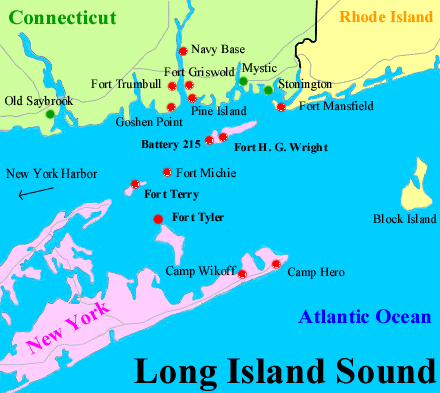
View Long Island Sound Map
� Pine Island Reservation
(1943 - 1946), Groton
Anti Motor Torpedo Boat Battery 915 was here. Remains overgrown.
� Goshen Point Reservation
(Harkness State Park)
(1943 - 1946), New London
Anti Motor Torpedo Boat Battery 914 was here. It is now covered over.
Fort Shantok
(State Park)
(unknown dates), Mohegan
Located on the Thames River.
Fort Saybrook
(park) ?
(1635 - 1815?), Old Saybrook
Colonials successfully defended the fort from attacking Dutch in 1675. This
is the state's first real fort. It was partially restored for the War of 1812 and
renamed Fort Fenwick. The mound on which the guns were emplaced remained
until 1871 when it was used as fill dirt for a nearby railroad.
Whitfield Garrison
(Henry Whitfield State Museum)
(1639 - unknown), Guilford
This is the oldest stone house in New England. It was originally built as the parsonage for the Reverend Henry Whitfield, but was also used as the town's stronghold during times of crisis. It was restored and opened as a museum in 1899. Admission fee.
Black Rock Fort
(Nathan Hale Park)
(1770's - unknown), New Haven
Also known as Little Fort, this was a 3-gun log fort and blockhouse in 1779. It was rebuilt in 1809 as an elliptical brick and stone six-gun fort. It was discontinued by 1853. Reconstructed in the mid 1970's.
Fort Nathan Hale
(Nathan Hale Park)
(1860's), New Haven
A Civil War earthwork fort built adjacent to Black Rock Fort. The magazines remain.
Fort Wooster
(park)
(1810's - 1840's), New Haven
An earthworks fort with a powder magazine. A six-gun battery in 1898 may have been located here. Located near Fort Nathan Hale.
Fort Trumbull (b)
(unknown dates), Milford
Bridgeport Battery
(park)
(1898), Bridgeport
A Spanish-American War temporary battery. Exact site uncertain.
Fort Hope 
(1633 - unknown), Hartford
Also known as Fort Good Hope and House of Hope. The Dutch never settled permanently in the state. Even though Hartford was
permanently settled by the British in 1635, the fort didn't become British
until 1654.
Matianuck Fort
(1633 - unknown), Windsor
A palisaded fort, the site of which is at Town Green (or Palisado Green) on
Palisado Avenue. The Windsor Historical Society Museum is nearby.
Fort Hill
(1630's), Woodstock
Used by settlers during Indian raids.
Fort Hill 
(early 17th-century), Thompson
Used by Nipmuck Indians against attacks by the Narraganset.
Mashantucket Fort
(Mashantucket Pequot Indian Reservation)
(early 17th-century), near Ledyard
A Mashantucket Indian palisaded village. It was excavated in 1992. The Mashantucket
Pequot Museum and Research Center is here.
Pequot Hill
(1630's), West Mystic
A Pequot Indian fortified village near Mystic. It was raided by colonials in
1636 and 1637.
Pequot Fort
(1630's), New London
A Pequot Indian fortified village located at the Thames River entrance in
New London. It was raided by colonials in 1636 and 1637.
Fort Hill
(1660's?), Mohegan
The Mohegan chief Uncas built a fort here (now known as Mohegan Hill).
(This may be Fort Shantok listed above.)
Fort Hill
(unknown dates), East Hartford
A Podunk Indian stronghold.
Swamp Fort
(Fort Hill Park)
(unknown dates), Waterbury
Once an Indian fortified island in a swamp.
NEED MORE INFO: Fort Hill & Fort Mountain at New Milford; Fort Hill at Poquonock Bridge; Fort Hill near Chester (across from Gillette Castle).
 Books about Forts in Connecticut