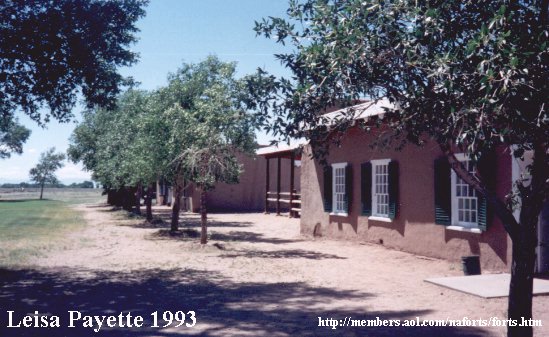
Bent's New Fort |
Bent's Old Fort |
Fort Big Spring |
Fort Boettcher |
Buzzard's Roost |
Camp Collins |
Fort Collins
Fort Crawford |
Fort Davy Crockett |
Denver Depot |
Post at Denver |
Camp Evans |
Fort Fauntleroy
Fort Francisco |
Francisco Plaza |
Franktown Stockade |
Fremont Lookout |
Fremont's Camp |
Gantt's Fort
Fort Garland |
Fort George |
Camp Gilpin |
Godfrey's Ranch Station |
Gray's Ranch Station
Fort Independence |
Fort Jackson |
Junction Station |
Fort Lancaster |
Fort Latham |
Fort Leche |
Camp Lewis
Fort Lewis |
Fort Lincoln |
Fort Logan |
Fort Lookout |
Fort Lupton |
Fort Lyon |
Fort Massachusetts
Fort Misery |
Fort Morgan |
Fort Namaqua |
Cantonment Pagosa Springs |
Parker Stockade |
Pike's Blockhouse
Pike's Stockade |
Fort El Pueblo |
Fort Pueblo |
Ben Quick Ranch & Fort |
Camp Rankin |
Fort Rankin
Fort Reynolds |
Fort St. Vrain |
Fort Sedgwick |
Camp Tyler |
Cantonment on the Uncompahgre
Fort Uncompahgre |
Valley Station |
Fort Vasquez |
Camp Wardwell |
Camp Weld |
Camp Wheeler
White River Camp |
Fort Wicked |
Fort William |
Fort Wise
Fort Sedgwick

(1865 - 1871), Julesburg
Originally Camp Rankin in 1864, and then Fort Rankin in 1865.
This fort is roughly 20 miles from the Oregon Trail, near Brule,
Nebraska.
Valley Station
(1865), Sterling
Overland stage station fortified by the Army during Cheyenne raids. The soldiers used corn bales for protection.
Godfrey's Ranch Station
(1865), Sterling
Overland stage station. Nicknamed Fort Wicked by the Cheyennes
because of the fighting spirit of the station's agent who refused to give up.
This was the only station not captured during the 1865 raids.
Gray's Ranch Station
(1864 - unknown), near Sterling
Federal troops once fortified this stage station. The exact location has not
been found.
Junction Station
(1864 - unknown), north of Fort Morgan
A fortified stage station on the Overland Trail.
Fort Morgan
(1864 - 1868), Fort Morgan
Originally Camp Tyler, and then Camp Wardwell (or Wardell ?) (1865 - 1866).
It was built to protect the Overland Mail Route.
Fort Latham
(1864 - unknown), Kersey
Fort Collins
(Old Town Historic District)
(1864 - 1871), Fort Collins
It was originally Camp Collins in Laporte in 1863. It was built to
protect stage and mail routes. It was abandoned. The officers' mess hall may still exist as a local meeting place.
Fort Namaqua
(1858 - 1870's), Loveland
A fortified stage station on the Overland Mail Route. Most of the buildings burned down in 1936.
Fort St. Vrain
(1837 - 1848), near Gilcrest
A Bent and St. Vrain Fur Co. trading post on the river. It was 125 feet by 100 feet, with walls two-feet thick and 14-feet high. Also known as
Fort Lookout and Fort George. It was abandoned after rival fur companies gave up their operations in the area.
Fort Vasquez
(1835 - 1842), Platteville
A 1936 reconstruction of an adobe trading post of the Rocky Mountain Fur Company. It was 100 sq. feet with
12-foot high walls. It was bought out by St. Vrain and closed.
Museum operated by the Colorado Historical Society. Admisson fee.
Fort Jackson
(1833 - 1838), Ione
A Pratte and Chouteau Company trading post that was bought out by St. Vrain and closed.
Fort Lupton
(site)
(1836 - 1845), Fort Lupton
A trading post that was bought out by St. Vrain and closed. It may have also
been called Fort Lancaster. The adobe ruins of this fort still exist on private property.
Camp Gilpin
(site)
(1861), Central City
This was a temporary Army post.
� Camp Weld
(1861 - 1865), Denver
A troop staging area on the South Platte River.
� Camp Evans
(1864), Denver
A temporary post.
� Camp Wheeler
(Lincoln Park)
(1864 - unknown), Denver
� Denver Depot
(1863 - unknown), Denver
� Fort Logan
(1889 - 1946), Denver
Originally Post at Denver (1887 - 1889). It was established to consolidate all other federal forts in the state. Most of the 136 buildings still exist on the 1000 acre post.
Parker Stockade
(1864), Parker
A civilian defense against Indians.
Franktown Stockade
(1864), Franktown
A civilian defense against Indians.
Ben Quick Ranch and Fort
(unknown dates), Palmer Lake
Fort Pueblo
(1842 - 1854), Pueblo
Originally a trading post until 1846 when it became Mormon Fort
Independence. It was adobe 60-yards square, with two round blockhouses at the opposite corners. Utes attacked and killed everyone in 1854.
Other names for this fort included Fort El Pueblo, and Fort Leche.
Pueblo is the first permanent American settlement in the state. A reconstruction
is located at El Pueblo Museum.
Fort William
(1824 - 1828), Pueblo
The Bent and St. Vrain Fur Company built their original stockade in this vicinity, and abandoned it when they built their new fort near Las Animas. (see listing below for Bent's Old Fort)
Gantt's Fort
(unknown dates), near Pueblo
A fur trade post located near Fort Pueblo. It was also called Gantt's Post.
Fort Reynolds
(site)
(1867 - 1872), Avondale
Buzzard's Roost
(1842 - 1843), near Las Animas
A fur trade post on the Arkansas River at Adobe Creek.
Bent's Old Fort
(National Historic Park)
(1828 - 1849), near Las Animas
This was an adobe-walled trading post built by the Bent and St. Vrain Fur
Company. It was originally called Fort William that was once in Pueblo (see listing above). It was abandoned after a failed attempt to sell it to the U.S.
Army and a cholera epidemic that nearly wiped out the Indians. It was
reconstructed in the 1930's, and again in 1975. It is located along the
Santa Fe Trail. This was the first settlement in the state.
Another website from RutNut.com | Another website from GhostTowns.com
Fort Lyon
(1852 - 1889), Fort Lyon
This was originally Bent's New Fort, at a site 8 miles west of Lamar, and was sold to the government in 1859. The Federals named it Fort Fauntleroy, but changed it to Fort Wise in 1860. It was renamed again in 1862 to Fort Lyon. The Sand Creek Massacre occurred near here in Chivington in 1864. The
post moved to its present site in 1867. The VA medical
center uses two of the original buildings.
Fort Francisco
(1862 - unknown), La Veta
A settler's fort, also known as Francisco Plaza.
Fort Garland
(1858 - 1883), Fort Garland
The fort was abandoned and the troops transferred to Fort Lewis. Its purpose was to protect settlers and roads from
Ute and Apache raiders. The current fort is a partial reconstruction. The
museum is operated by the Colorado Historical Society, and includes six of
the original buildings. PHOTO
Fort Massachusetts
(site)
(1852 - 1858), near Fort Garland
This was the first federal fort in the state, and it was built for
protection against Utes and Apaches. The troops transferred to Fort Garland
located six miles south.
Pike's Stockade
(1807), Sanford
A reconstructed log stockade where Pike and his men were captured by the
Spanish. They did not realize they were in Spanish territory. This is the
first documented fort in the state.
Pike's Blockhouse
(1806), Canon City
Built the winter before Pike's Stockade was built. Two men were left here
with supplies until the Spanish captured them and the others at the Stockade.
Fremont's Christmas Camp
(site)
(1848), near Summitville
Fort Lewis
(1879 - 1891), near Durango
Originally Camp Lewis (1878 - 1879) in Pagosa Springs. The post moved
in 1879 and was renamed Fort Lewis. The old site was then renamed Cantonment
Pagosa Springs (1879 - 1880?). The garrison of Fort Garland transferred here in 1883.
Fort Crawford
(1886 - 1890), Montrose
Originally Cantonment on the Uncompahgre (1880 - 1886).
Fort Uncompahgre

(1825? - 1845), Delta
A trading post that was abandoned. Farmers demolished it in the 1880's.
There is a living history museum here.
Camp on the White River
(1879 - 1883), Meeker
Built after the Meeker Massacre in 1879. The site is now the Rio Blanco
courthouse grounds. The White River Museum is in the Cavalry Officers
Quarters.
Fremont Lookout Fortification Site
(1845?), near Rangely
A temporary post during Fremont's expedition.
Fort Davy Crockett
(site)  ?
(1837 - 1840), Browns Park
A trading post sometimes referred to as Fort Misery. It was simply a one story log house with three wings, and no stockade. Browns Park was at the time called Brown's Hole and is
located northwest of Greystone.
Fort Lincoln
(1864 - unknown), Huntsville
NEED MORE INFO: Fort Big Spring, n. of Kit Carson; Fort Boettcher, n.w. of
Walden.
Towns: Fortification, north of Craig.
 Books about Forts in Colorado