Benicia Barracks |
Fort Bidwell |
Fort Bragg |
Capt. Jack's Stronghold |
Fort Defiance
Fort Gaston |
Fort Humboldt |
Camp Lincoln |
Camp McQuaide |
Fort Ross
San Francisco Harbor Defenses |
San Jose Garrison |
Santa Clara Garrison
Sonoma Presidio |
Sutter's Fort
Southern California Forts
CALIFORNIA MILITARY HISTORY and MUSEUM
Fort Defiance

(1863), Susanville
A log cabin built in 1853 that was defended by 100 men in 1863 in the so-called "Sagebrush War", fought to determine the California - Nevada boundary. Susanville was placed within the California boundary as a result. It is the oldest building in town.
Fort Bidwell
(1865 - 1892), Fort Bidwell
Built to protect settlers. It was a base camp for operations against the Bannock, Paiute, Snake, and Modoc tribes, and was known as Camp Bidwell during this time, until 1879. The Bureau of Indian Affairs took over the fort, and it is currently used as the tribal headquarters for the reservation.
Captain Jack's
Stronghold

(Lava Beds National Monument)
(1872 - 1873), near Newell
Captain Jack, the Modoc leader, and his followers took refuge here and held
the Army at bay. An Army base camp was also located here.
History of the Modoc War.
Camp Lincoln
(1862 - unknown), near Crescent City
Originally located in Crescent City. The Post Commander's house has been
rebuilt. Located nearby is Battery Point.
Fort Gaston
(1858 - unknown), Willow Creek
The Officers Quarters around the parade ground are now used by the Hoopa
Indian Agency.
Fort
Humboldt
(State Historic Park)
(1853 - 1870), Eureka
Built to protect settlers. It was abandoned. Only the hospital and surgeon's quarters remain, which
have been restored.
Fort Bragg
(1855 - 1859, 1860 - 1861), Fort Bragg
Abandoned when the Mendocino Indian Reservation moved.
Fort Ross
(State Historic Park)

(1812 - 1841), Jenner
Originally spelled Fort Rossiya (Russia). The fort was laid out in a rectangle enclosed by a 14-foot stockade, and guarded by two blockhouses at opposite corners. There were 59 buildings. A treaty was signed in 1824 banning the Russians from settling in this
state. But the Russians didn't actually leave until 1841. John Sutter purchased from the Russians almost everything for $30,000. He dismantled most of the buildings, and loaded up animals, weapons, and equipment onto a ship to be used for his new fort at Sacramento (Sutter's Fort). The fort's
remaining buildings were left abandoned until 1906, until restoration was begun. The chapel is a reconstruction.
Another website from MCN.org |
Another website from Coolspots.com |
Another website from Berkeley.edu
Presidio of Sonoma


(Sonoma State Historic Park)
(unknown dates), Sonoma
A fort and a mission were built here in the 1830's in an effort to
thwart the Russian traders. Later, there were Mexican barracks here which
were captured by independent Californians in 1846. The Americans gained
control later that year.
The Bear Flag Revolt
Sutter's
Fort
(State Historic Park)
(1839 - 1850's), Sacramento
Initially a civilian trading post, rivaling that of the nearest Hudson's Bay Co. post, it became the Bear Flag (independent
California) headquarters in 1846. The Americans took control later that
year. The fort was restored in 1893. The original name for the Sacramento settlement was New Helvetia.
Benicia Barracks
(1849 - 1950's), Benicia
Federal troops left in 1861, but the California Volunteers moved in for the duration of the war. The post had been used for various military functions until it was closed in the 1950's.
Benicia was the first state capital.
� HARBOR DEFENSES of
SAN FRANCISCO
Golden Gate National Recreation
Area | Seacoast
Fortifications Preservation Manual
San Francisco Defense Guns in WWII
� Fort McDowell
(Angel
Island State Park)
(1863 - 1946, 1954 - 1962), Angel Island
Camp Reynolds was originally here on the western side of the island from 1863 - 1900, with batteries at the main camp, and Point Stuart Battery, Point Knox Battery, and Point Blunt Battery. It was also known as Post at Angel Island. The eastern side of the island was fortified in 1900, and the entire island then became known as Fort McDowell. Batteries here are Battery Knox Point (1900 - 1915),
Battery Drew (1898 - 1915), Battery Wallace (1901 - 1915),
Battery Ledyard (1901 - 1915), and an Anti Motor Torpedo Boat Battery (1940's, possibly never built). The eastern batteries then became known as the Eastern Garrison, and the former Camp Reynolds area became known as the Western Garrison. The Pacific Quarantine Station (the Ellis Island of the West) was located on the northern side of the island from 1910 - 1940. It became known as the Northern Garrison from 1940 - 1946 when the Army took it over as a military prison. It was also used for Japanese and German POW's. After the war, it was also a point of return for American soldiers coming back from the
Pacific. The Eastern and Western Garrisons were closed in 1946. From 1954 - 1962 the former Eastern Garrison was used as a USAF Nike Missile Base. Two Coast Guard stations are currently located here on the island. There are many unrestored building throughout the former base, and two have been restored for public tours. Officers Quarters #11, along with the unrestored Officers Quarters #12, were originally built on Yerba Buena Island in 1868 and barged to Angel Island in 1882. The Bake House was built in 1863, and later converted to Officers Quarters around 1900.
Located on nearby Yerba Buena Island was Camp Yerba Buena Island (1871 - 1892), used as a Quartermaster Depot, and later as a Naval Training Facility. See also The Legend of Yerba Buena Island. Yerba Buena Island was officially known as Goat Island from 1895 - 1931.
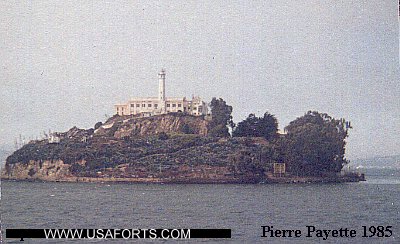
� Fortress Alcatraz
(1850 - 1933), Alcatraz Island
Alcatraz (aka The Rock) is more famous as a prison, but it first served as a fort before
the Civil War. It was first known as Camp Alcatraz. During that time it was the most heavily fortified post on the
west coast. It first housed military prisoners in 1868, and later troublesome Indian leaders. It became an official military prison in 1907. There was an unnamed harbor
defense battery here from 1900 to 1906.
Another
website at PacificHistory.com PHOTO
� Fort Mason (National Park Service)

(1863 - 1964), San Francisco
The Spanish Battery San Jose, or Battery at Yerba Buena, was originally here from 1797 - 1805. The post commander's house is from 1853. Originally named Post at Point San Jose until 1882. Black Point Battery, a Civil War 12-gun battery was here on the site of the Spanish battery. It was destroyed in 1911. Batteries here are Battery Burnham
(1900 - 1909) built on, and Battery Spanish War (1898 - 1910). Also located
here might be Battery Davis, which was built just before World War II.
Became NPS property in 1974, and is now the headquarters for the Golden Gate National Rec. Area and for the
adjacent San Francisco Maritime National Historical Park. Fort Mason Center
� Fort Winfield Scott 
(Fort Point National Historic
Site)
(1853 - 1886), San Francisco
This is the old fort on Fort Point at the Presidio (see below), built on the site of the long abandoned Spanish Castillo de San Joaquin (1793 - 1836). It was
the only Third System fort built on the west coast. First garrisoned in 1861,
it was called Fort Point until it was given its name in 1882. After
being abandoned, it was used again during World War II. The name was also used
to refer to the entire military reservation at the Presidio. The fort is under the
Golden Gate Bridge. The Officers' Club was formerly the Spanish Commandant's House, and it is the oldest building in San Francisco. Another website at Geocities
� Presidio of San
Francisco (National Park) 
(1776 - 1836, 1846 - 1995), San Francisco
Originally Presidio de Yerba Buena, it was built to protect Mission
San Francisco de Asis (aka Mission Dolores). The British Hudson's Bay Co. had a trading post in San Francisco
in 1843. The entire reservation was once called Fort Winfield Scott
(see above), but it is usually simply called The Presidio.
The Americans captured the abandoned post from the Mexicans in 1846. It was briefly abandoned between 1847 and 1851, but has been continuously occupied since then.
Endicott batteries include East Battery (1876, 1897 - 1915),
Battery Dynamite (1894 - 1904), which was converted to the harbor
entrance control post in World War II, Battery Lancaster (1899 - 1918)
partially buried for the bridge, Battery Godfrey (1895 - 1943), Battery
Saffold (1898 - 1943), Battery Howe (1895 - 1920) mostly buried,
Battery Wagner (1895 - 1920) buried, Battery Stotsenburg (1900 - 1943),
Battery McKinnon (1900 - 1943), Battery Cranston (1897 - 1943) built on,
Battery Marcus Miller (1891 - 1920), Battery Slaughter (1899 - 1917)
partially buried, Battery Crosby (1902 - 1943), Battery Chamberlin
(1904 - 1918, 1920 - 1949), Battery Boutelle (1898 - 1918), Battery
Sherwood (1900 - 1917), Battery Baldwin (1901 - 1920) partially buried,
Battery Blaney (1907 - 1920), Battery Point (1944 - 1945),
Battery Gate (1942 - 1945), and Anti Motor Torpedo Boat Battery Baker
(1943 - 1946) buried.
Another website
� Fort Miley
(1900 - 1948),
Located at Lands End. Batteries are Battery Livingston (1900 - 1943),
Battery Springer (1900 - 1943), Battery Chester (1898 - 1943),
Battery Lobos (1943 - 1945), Battery 243 (1948 - 1949),
Battery Call (1915 - 1921) destroyed, and Anti Motor Torpedo Boat Battery
Lands End (1943 - 1948). Part of the original fort is now used by the VA. The rest is owned by NPS (Golden Gate NRA).
� Fort Baker
(1850's - 1998), Sausalito
Located at Lime Point. Part of NPS Golden Gate NRA. In 1904, the reservation was split, with the western portion becoming Fort Barry (see below). Batteries
here are Battery Cavello (1870's, 1900 - 1910), Battery Spencer (1893
- 1943), Battery Kirby (1900 - 1941), Battery Duncan (1898 - 1917),
Battery Wagner (1901 - 1917), Battery Yates (1904 - 1943), Battery
Gravelly Beach (1942 - 1946), which was converted into an Anti Motor Torpedo Boat
Battery in 1943. Battery Orlando may have also been here.
� Fort Barry
(1905 - 1975), near Sausalito
Located at Point Bonita. Originally the western portion of Fort Baker. Batteries are Battery 129 (1943),
Battery Alexander (1901 - 1943), Battery Mendell (1901 - 1943),
Battery Wallace (1919 - 1948), Battery Guthrie (1905 - 1946),
Battery Smith (1905 - 1946), Battery Rathbone (1905 - 1946), Battery McIndoe (1905 - 1946), and Battery O'Rorke (1905 - 1945). Also located here is a NIKE missile site.
Kite Aerial Photography of Fort Barry.
� Fort Cronkhite
(1937 - 1975), near Sausalito
Located at Tennessee Point. Batteries were Battery Townsley (1940 - 1948), and an unnamed
battery used for training (1940's).
� Fort Funston
(1898 - 1963), San Francisco
Located on the coast, next to Lake Merced near Daly City. It was previously known as Laguna Merced Military Reservation until 1917. Batteries here were the prototype Battery
Davis (1938 - 1948), Battery Howe (1919 - 1945) destroyed, Battery Bruff (1919) destroyed, a four-gun 155mm battery (1930's) destroyed by erosion, and another four-gun 155mm battery (1942) buried. NIKE missiles were here in the 1950's and 60's. Became part of the Golden Gate National Recreation Area in 1975. NPS Federal Register Project
� Milagra Ridge Reservation
(1940's), Pacifica
Located here is Battery 244 (1948 - 1950). Battery 130 was never built.
ALSO: Hill 640 Military Reservation near Stinson State Beach, and Frank Valley Military Reservation at Muir Beach. And two-gun 155mm batteries (1940's) at Drake's Bay (Point Reyes National Seashore), Half Moon Bay (State Beach), and Moro Bay.
San Jose Garrison
(1777 - 1846), San Jose
Captured by the U.S. in 1846.
Santa Clara Garrison
(1777 - 1846), Santa Clara
Captured by the U.S. in 1846. It was built to protect Mission Santa Clara de Asis.
Camp McQuaide
(1926 - 1940's), Watsonville
Originally located a few miles north in Capitola, until it moved in 1938. Home of the 250th Coast
Artillery.
NEED MORE INFO: Fort Crook in Fall River Mills, Fort Independence
Indian Reservaton, Fort Goff near Happy Camp. Plus Mexican War-era
Fort Montgomery in San Francisco, and a
Hudson's Bay Co. Trading Post in San Francisco from 1841 to 1846.
Towns: Fort Dick, Fort Seward, Camp Richardson, Fort Jones.
 Books about Forts in California