Fort Alabama |
Fort Alexandria |
Apalachicola Fort |
Fort Armstrong |
Arnold Battery |
Fort Autrey
Battery Bailey |
Fort Bainbridge |
Fort Bell |
Fort Bibb |
Fort Blakeley |
Fort Bluff |
Fort Bowyer
Fort Browder |
Battery Buchannon |
Fort Burnt Corn |
Camel Battery |
Canal Battery |
Canby Battery
Fort Carlotta |
Cato's Fort |
Fort Charlotte |
Chinnabee Fort |
Fort Claiborne |
Camp Coffee |
Fort Coffee
Fort Cond� |
Fort Confederacion |
Battery Craven |
Fort Crawford |
Curry's Fort |
Fort Decatur
Camp Defiance |
Fort Deposit (a) |
Fort Deposit (b) |
Battery Farragut |
Fort Gaines |
Battery Gladden |
Fort Glass
Greater Naval Ordnance Depot |
Fort Huger |
Fort Jackson |
Lashley's Fort |
Fort Leslie |
Battery Lincoln |
Fort Louis
Fort Madison |
Battery McDermott |
Battery McIntosh |
Fort Mims |
Battery Misouri |
Fort Mitchell |
Fort la Mobile
Fort Mobile |
Fort Montgomery |
Fort Thomas Moorer |
Fort Morgan |
Battery Morton |
Mound Battery
Mount Vernon Arsenal |
Fort Pierce |
Fort Powell |
Fort St. Phillips |
Fort St. Stephens |
Fort Serof |
Camp Siebert
Battery Sisk |
Old Spanish Fort |
Fort Stoddard |
Fort Stoney Johnston |
Fort Strother |
Battery Tilghman
Tohopeka Village |
Fort Tombecbe |
Fort Tombigbee (1) |
Fort Tombigbee (2) |
Fort Toulouse |
Fort Tracey
Fort Tyler |
Volante Battery |
Fort Wilkinson |
Fort Williams |
Fort York
� COAST DEFENSES of MOBILE BAY
� Fort Gaines (State Historic Site)


(1821 - 1926), Dauphin Island
�National
Archives MAP�
Previously called Fort Tombigbee (2). Fort Gaines was not completed in
1861 when the Confederates took over control. The Rebels finished it in
1862. Batteries here are Battery Stanton (1901 - 1928) inside the old fort,
and Battery Terrett (1901 - 1923). There was an unnamed battery
(1898 - 1899) but it was covered over by Battery Stanton. The Fort was sold
to the City of Mobile in 1926 and was used by the National Guard for training until 1946. The property is currently used by the Coast Guard. Admission fee. Hurricane Elena damaged the fort in 1985. See also
Coastal
Fortifications on the Gulf of Mexico (website courtesy of Andy Bennett).
This is also the site of three earlier wooden forts. The first was built by the
French (1699), the second was British (1763), and the third was Spanish (1783 - 1813).
� Fort Morgan (State Historic Site)
(1818 - 1928), Fort Morgan
�National
Archives MAP�
Previously named Fort Alabama. Built over the site of Fort Bowyer (1813 - 1816), which was briefly captured by the British in 1815 after their defeat at New Orleans. The Confederates captured this pentagon-shaped fort in
1861. The Union recaptured it in 1864. The Battle of Mobile Bay took place here in August 1864. Civil War
batteries included Batteries Sisk, Farragut, Morton, Lincoln and
Bailey. This is the third largest fort in
the U.S. Coastal batteries here are Battery Dearborn (1901 - 1928),
Battery Duportail (1900 - 1928) inside the old fort, Battery Test (1916 - 1918)
mostly buried, Battery Bowyer (1898 - 1918), Battery Thomas
(1899 - 1918), and Battery Schenck (1900 - 1923). Admission fee. See also Coastal Fortifications on the Gulf of Mexico (website courtesy of Andy Bennett).
TEMPORARY HARBOR DEFENSES of MOBILE BAY
A two-gun 155mm battery (1942 - 1944) was located on top of the parapet of Fort Morgan, and which is now partially covered. A WWI fire-control tower is still located nearby.
Fort Serof

(1559 - unknown), Fort Morgan
Ruins located near Fort Morgan. Built by Spanish colonists under Tristan de Luna.
Old Spanish Fort
(1780's), Spanish Fort
Built by the Spanish after retaking the area from the British. A CSA battery would be built here in 1864.
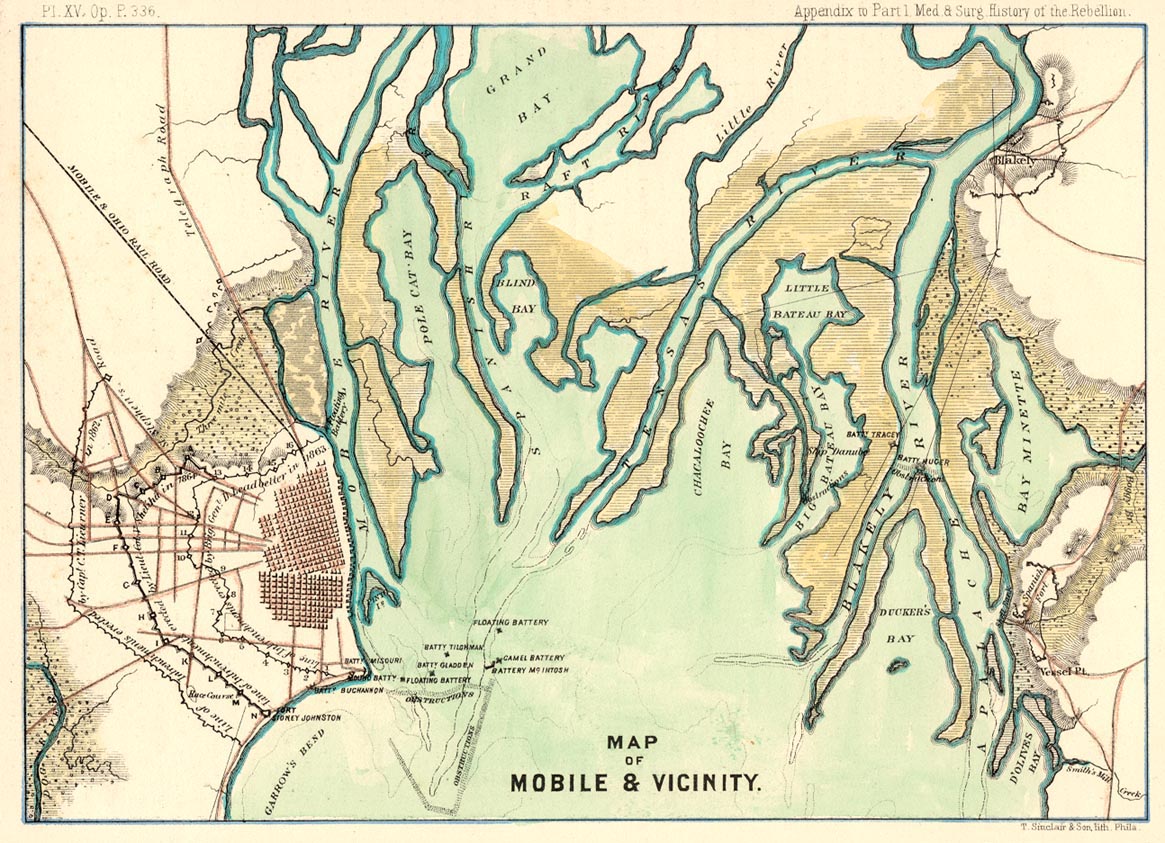
Mobile Bay Civil War Forts
(1864 - 1865), Mobile Bay
�National
Archives MAP� | Another Map
Confederate fortifications included Fort Huger, Fort Tracey,
Battery McDermott (aka Fort McDermott), and
Old Spanish Fort, all in Spanish Fort. There was also Fort Powell, Battery Craven,
Canal Battery and Fort Alexandria.
On land south of town near the mouth of Mobile River was Fort Stoney Johnston,
Battery Buchannon, Mound Battery, and Battery Misouri (sic).
On the water at the mouth of Mobile River were Battery Gladden, Battery
Tilghman, Camel Battery, Battery McIntosh, and two Floating Batteries.
In addition there was also one Floating Battery upriver north of town.
Union fortifications included Arnold Battery (1864) near Gulf Shores
and Canby Battery in Mobile.
Fort Blakeley (State Park)
(1864 - 1865), Spanish Fort
A major Confederate work, with over five miles of breastworks. Between 6000 and 9000 black Union troops fought here in 1865, making this battle the third largest fought with black troops during the Civil War. Admission fee.
Fort Cond�
(1711 - 1819), Mobile
This was the headquarters of the original French colony of Louisiana. It
was originally called Fort Louis de la Louisiane (or simply
Fort
Louis) until 1720 when it
was named Fort Cond� de la Mobile. Sometimes the brick fort was referred
to simply as Fort la Mobile. Fort Louis was
originally founded in 1702 but on a site at Le Mayne, near Axis, that
became flooded. The French moved it to Mobile, and this became the state's
first permanent white settlement. It was later used by the British (1763 - 1780) and
called Fort Charlotte, the Spanish (1780 - 1813)
renamed it Fort Carlotta or Volante Battery, and then the Americans (1813), who
also called it Fort Charlotte, and later Fort Mobile. The fort was demolished in 1819, with the debris used for marsh fill. The present structure is a partial
reconstruction and is used as the Mobile Visitor Info Center.
Fort St. Phillips
(unknown dates), Stockton
Fort Mims
(1813), Tensaw
Creek Indians massacred four-hundred people here and burned down the
blockhouse. The fort was a one-acre stockade around the garrison house, manned by two-hundred militiamen and their families
Old Fort Stoddard
(1799 - 1813), Fort Stoddard
Also spelled as Fort Stoddart. It was located near Mount Vernon. Aaron Burr was held here after his arrest in 1807.
Located in Mount Vernon was the Mount Vernon Arsenal, in use during
the 1850's.
Fort Montgomery
(1813 - unknown), Carlton
Discontinued by the early 1850's.
Fort Claiborne
(1813 - 1814), Claiborne
A temporary post used during the Creek War.
Curry's Fort
(1800's), Jackson
A settlers fort.
Fort Madison
(1813), Clarke County
On the Alabama River. This was a place of refuge for settlers after the Fort Mims Massacre. It was a 60-square yard log post stockade with trenches. Just 225 yards south of here was Fort Glass, another refuge fort. Together they held over 1000 settlers.
Fort Pierce
(1813), Clarke County
On the Alabama River near Fort Montgomery.
Fort St. Stephens
(St. Stephens State Historic Site)
(1714 - unknown), St. Stephens
Built by the French, later controlled by the Spanish. The Americans held it in 1799. Abandoned by the 1850's.
Cato's Fort
(1813), Coffeeville
A settlers fort.
Fort Tombecbe
(1735 - unknown), Epes
Built as a supply depot and trading post. Ceded to the British in 1761 and renamed Fort York. The Spanish took control in 1783 and renamed it Fort Confederacion. The Americans took control in 1802 and renamed it Fort Tombigbee (1), a corruption of the original French name.
Fort Bell
(1817), Belleville
A defense against Indians.
Fort Autrey
(1816), Conecuh County
A settlers defense against Indians.
Fort Burnt Corn
(1817), Conecuh County
A settlers defense against Indians.
Fort Crawford
(1817), East Brewton
Fort Deposit (a)
(1813), Fort Deposit
The historic fort no longer exists.
Fort Browder
(1836), Barbour County
Fort Coffee
(1836), Bullock County
Apalachicola Fort
(1689), Holy Trinity
A Spanish fort located south of the town of Fort Mitchell.
Fort Mitchell
(Fort Benning U.S. Army Reservation)
(unknown dates), Fort Mitchell
The site of the historical fort lies within the boundaries of
the modern Army base of Fort Benning. It was discontinued by the 1850's,
but it was used again as a defense for Columbus, Georgia during the Civil
War.
Fort Tyler
(1860's), Lanett
Site of one of the last Civil War battles east of the Mississippi
River in April 1865.
Fort Bainbridge
(1814), Tuskegee
A Georgia Militia fort.
Fort Decatur
(unknown dates), Milstead
Fort Toulouse
(Fort
Toulouse Jackson Park)
(1717 - 1763), Wetumpka
A French colonial fort which was rebuilt in 1749. Its official name was
Fort Toulouse aux Alibamons. The British held it in 1763. American
Fort Jackson (1814 - 1819) was built on the ruins. The current
structure is a partial reconstruction of Fort Jackson.
Fort Bibb
(1818), Pine Flat
A defense against Indians, located north of Montgomery.
Greater Naval Ordnance Works and Arsenal ?
(unknown dates), Selma
A major supplier to the Confederate cause. The Old Depot Museum is now on the site. It is a former railroad station that was built in 1890. Admission fee.
Tohopeka Village

(Horseshoe Bend National Military Park)
(1813 - 1814), near Dadeville
A fortified Indian village.
Fort Williams
(1813), Talladega Springs
Located on the Coosa River.
Fort Leslie
(unknown dates), Talladega
Also located here was a civilian or TN Militia fort called Lashley's
Fort in 1813.
Chinnabee Fort
(1813), Oxford
Also known as Chinnaby's Fort.
Fort Strother
(1813 - 1814), Ohatchee
General Jackson's base of operations during the Creek War.
Fort Armstrong
(1814), Cedar Bluff
A temporary post built during the Creek War.
Fort Deposit (b)
(1813 or 1814 - unknown), Guntersville
Fort Bluff
(1861), Florette
NEED MORE INFO: US Fort Wilkinson (1813); Fort Thomas H. Moorer in the
town of Fort Deposit; Camp Coffee at Laceys Spring; Camp Siebert at
Attalla; Camp Defiance (1814) 48 miles west of Chatahootchee River.
Towns: Fort Payne, Fort Davis, and Fort Dale north of Greenville,
Camp Hill.
Special thanks to Warren Laing for info on early Federal and settlers' forts.
 Books about Forts in Alabama