
LORRAINE - The world's largest open-air museum of fortification ...
Various
reasons - geographic, historic, economic - have combined to explain the
exceptional richness of Lorraine's heritage of fortification.
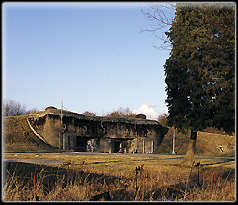
|
|
|
|
|
First, there is the topography, with two important routes of entry
and invasion, oriented north/south and consisting of the Moselle and Meuse
river valleys. Lorraine is the heir of Lotharingia established between "Francia
occidentalis (the land of the western Franks), the cradle of the kingdom
of France, and "Francia orien - talis" (the land of the eastern Franks),
cradle of the Holy Roman Empire on the occasion of the partition of the
Empire of Charlemagne by the Treaty of Verdun in 843. Lorraine historically
a land of crossroads and contact , has been a source of contention between
its powerful neighbor. The militarization of Lorraine, beginning in modern times (the 16th century) is the second reason. The progressiv outcome of a consistent policy pursued by the French kings and continued by the Republic to give France natural frontiers. |
To the remains of medieval fortifications was added an entire network of urban fortification (Verdun, Toul, Montmédy, Longwy, Metz, Thionville, Bitche, etc... ) - the era of the bastioned fortress, with Vauban and Cormontaigne. Metz necessary became the military base of France's Rhenish policy. In
the 19th century, which saw the border definitely established in 1815
by the Congress of Vienna, the pace of militarization guickened. Lorraine
become a frontier march. Metz, principal military base in France, received
a ring of detached forts on the eve of the Franco-German War in 1870,
a war which established Prussia's supremacy and a united Germany. At the
close of the 19th century, in a Lorraine cut in two by the Treaty of Frankfurt
in 1871, two formidable fortification systems emerged : |
|