 |
|
|
| Search the web with Hotbot | Host your site on Tripod |


First Manassas
July 21, 1861
After the firing on Fort Sumter in April 1861, the Union and Confederate governments quickly recruited armies. Confederates under Brigadier Generals P.G.T. Beauregard and Joseph E. Johnston assembled at Manassas, Virginia and the Shenandoah Valley to defend against a Federal invasion. In July, the Union armies began the invasion that they hoped would end the war.

Piedmont Station
In the Shenandoah Valley troops under Gen. Patterson slowly advanced on Johnston. Meanwhile, Gen. McDowell 's 35,000 men advanced from Washington toward Manassas. Patterson's slow advance allowed Johnston to reinforce Beauregard by rail. Here at Piedmont Station, now Delaplane, Johnston's men boarded trains for Manassas. Johnston's 11,000 men brought Confederate strength at Manassas up to 33,000 men. Johnston outranked Beauregard but gave him control of the battle since he was more familiar with the terrain.
On the morning of July 21st, the two armies faced each other along Bull Run creek. Beauregard attempted to attack across Bull Run and turn the Union left flank, but various mix ups sabatoged the plan. McDowell had a similar plan and sent most of his army across Bull Run at Sudley Springs Ford to move on the Confederate left flank. Col. Evans detected the Union move and put his Confederate brigade on Matthews Hill to delay the Federals. Evans' brigade was reinforced by Bee's and Bartow's brigades, but they were forced back to Henry House Hill where they joined Thomas Jonathon Jackson and his brigade.
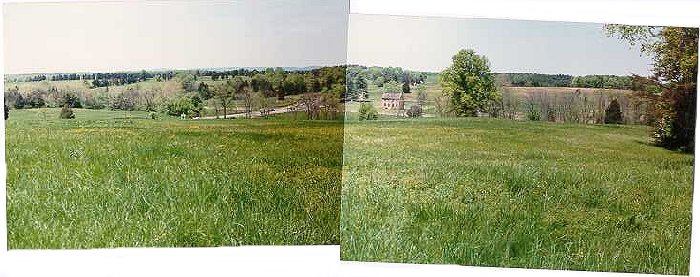
From Henry House Hill
This is the view looking north from Henry House Hill. The building in the center is the Stone House, which was used as a hospital. The hill on the left is Dogan's Ridge and to the right is Buck Hill, beyond which was Matthews Hill, where Evans, Bee, and Bartow held off the advancing Yankees in the morning. With increasing pressure, the Confederates fell back to Henry House Hill.

Imboden's Guns
Evans, Bartow, and Bee joined Jackson and Hampton with their brigades and rallied on Henry House Hill. Captain John Imboden also withdrew to Henry House Hill with his artillery batteries which totalled 13 guns. A lull settled over the field and the 85 year old widow Judith Henry returned to her house. At 2 P.M. however, the Federals resumed the advance and brought artillery batteries onto the plateau just 330 yards from Imboden.

Federal Artillery
This is the view of the Federal battery of Captain Ricketts looking north toward Henry House. McDowell ordered Captain Ricketts and Captain Griffin with their batteries to the crest of the hill. Here they dueled Imboden's guns near the treeline on the left of picture. Meanwhile, Union infantry charged across the plateau to be met with musket volleys and counterattacks. Confederate snipers in Henry House picked off Union gunners. Guns were directed against them, and the widow Henry was killed.
Back to Civil War Virtual Battlefield Tours