 |
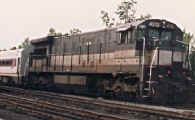
Reflections on the U34CHby Matthew Van Hattem |
The U34's are finally gone. With all of the frenzy and publicity surrounding their retirement, it's hard to believe we spent the first 20 years pretty much ignoring them.
Underrated? In the final analysis, yes. Maybe it was because they were so commonplace that we forgot how unique they really were. Erie Lackawanna's commuter lines were the only track in the country that hosted these engines. No other railroad had them. But even for local train enthusiasts, the U-Boats were just too familiar to be popular. They didn't get much press -- you rarely saw them in books or magazines, despite their distinctiveness. They were just tacitly overlooked.
The uphill battle for recognition began on day one. Look at what they replaced, after all : E8s and Alco's in the timeless Erie Lackawanna paint scheme, not to mention the last of the vintage Stillwell coaches, one of the few remaining links back to the mighty Erie Railroad. The daily commuters were happy to see the old equipment go, but fans of the EL sorely missed the cab units and color scheme.
As Erie Lackawanna folded into bankruptcy and Conrail routed most of its remaining freight traffic through Selkirk or Allentown, the U34's powered the only predictable trains on the formal EL lines, save for a handful of through freights and locals. They were always there, hauling passengers in and out of Hoboken six days a week. But we wanted something else at the time, something different, something to break the monotony of it all. Twenty years later, the U-boats became the "something different" we waited to see. They finally began to receive some of the attention they deserved. It's time to go back and take one last look.
The U34CH's came on the scene long before the commuter rail boom of the late eighties. For better or worse, these engines headed the first fleet of push-pull commuter trains outside of the Chicago area. (This may partially explain why we didn't see them much in pictures, since half the opportunities for photography were effectively cut in half. And who wants to shoot the passenger cab car?!) Many of the survivors could claim the distinction of being the last NJ TRANSIT locomotives in revenue service to escape repainting into the disco stripe livery.
Although not the first engines with head-end-power, they were the first to run the HEP generator directly off the crankshaft of the locomotive's prime mover, the method that EMD would later adopt for the F40PH. The U34's were also powerful and versatile enough to be used in freight service -- on the weekends, of course -- that is, until NJDOT got angry at Conrail for using up all of DOT's diesel fuel on long-haul trips to Binghamton and returning the engines virtually empty.
It's fitting that these locomotives were bought for commuter service, because they put on their best show when pulling out of a station. It would start with a short electric buzz from the conductor, a signal to the engineer that the doors were shut and the train was ready to move. The engine, which had been idling loudly, would suddenly get even louder. A long hiss of air followed as the brakes were released.
Then it would start. That staccato barking. As the steel pistons came to life, the engine's frame would shake; heck, the ground would shake. The pounding and barking got louder and a bit faster as the 3430 h.p. prime movers struggled to overcome the starting friction of a six car train filled with commuters. All of that effort seemed to convert directly into noise. On quiet summer evenings, you could gear the engines a half a mile away, sounding as if they were right in front of you.
With the sound came the smoke. Black smoke. And fire too, occasionally. As the engine began to move you could sometimes see a thin but wide orange flame protruding a few of inches out of the exhaust stack -- an eerie sight, particularly in the winter when darkness came early. The smoke shot straight out of the stack and into the air, creating a billowing plume that soared over the engine, above the trees, and into the sky where it eventually thinned out and disappeared. The smell of diesel exhaust became apparent soon after, as some of the smoke quickly settled back down over the tracks.
The barking, however, remained, echoing off the trees and buildings that lined the right of way. The train would recede into the distance and eventually drop out of sight around a curve, but you could still hear the pounding U34, as pronounced as ever, interrupted only by a momentary blast of the horn as it approached a crossing somewhere.
Then suddenly, the barking would stop. The engineer had cut out the engine, letting the train coast into the next station. The faint rumble of the idling locomotive could still be heard, along with the banging of the wheels over the jointed rail. But they would eventually fade into stillness, replaced by the sound of crickets and automobiles bumping over a nearby road crossing.
Although they may never have received the attention they deserved while in service, the U34's were still a big part of the railroad scene in Northern New Jersey. They headed only the regularly scheduled passenger trains in Bergen, Passaic, and Rockland counties. For a generation of residents and children along the EL commuter lines, they were the representative symbol of what a train was. (This was before Thomas the Tank Engine, remember.) The U34CH's were both unique and ubiquitous. We're going to miss them.
Matt Van Hattem is a member of the Bergen-Rockland Chapter of the National Railway Historical Society. This article was written during the last months of U34CH service. It appeared in the September 1994 issue of the Bergen-Rockland newsletter, The Stoker.