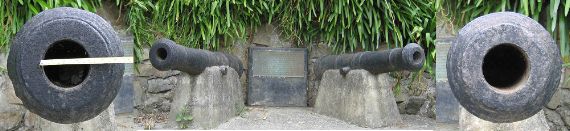
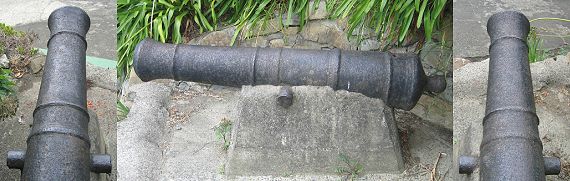
4 pdr Armstrong design c1770 / Blomefield modified - bored up
to 9pdrs c1830
These Kohukohu cannons have a history associated with George
Frederick Russell (1809-1855). Russell sailed from Sydney to Horeke in 1831 and
purchased his Kohukohu properties in 1839 (including the property overlooking
Kohukohu and the inlet (refer image below) and later owned by the Yarborough
family) setting up his own business as a timber trader, shipping kauri spars
and squared timber to London and other markets. Russell’s business rapidly
expanded, Kohukohu succeeding Horeke as the centre of the Hokianga timber
trade
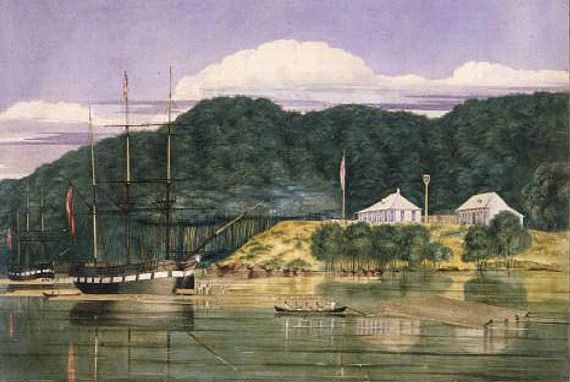
Painting by Charles Heaphy c1839
titled “Kahukahu” of George
Russell’s house and a long boat towing squared kauri for loading and
shipping. Courtesy Kohukohu Conservation and Restoration Society
Being “small in size and quick in movement” Russell was
known to the Maoris as “Piwakawaka”, he married a close relative of paramount
Maori Chief Tamati Waka Nene who did much to promote colonization and to
establish Queen Victoria’s
authority. When George Grey was knighted he chose Nene (c1785-1871) as one of
his esquires. Then when he returned to New
Zealand for his second term of Governorship
in 1860 he brought Nene a silver cup from Queen Victoria.
In 1845 Russell helped to supply arms and cannon to Nene and
the Hokianga Maori War Parties opposing Chief Hone Heke. Kohukohu was in Ihutai
tribe territory led by Chief Te Wharepapa who had sided with Heke.
Heke and Kawiti were only defeated once in the conflict at
the Battle of Te Ahu Ahu on 12 June
1845, by Nene with no help from the British.
HMS Osprey Captained by Fredrick Patten then employed in the
East Indies to locate and destroy Pirate Ships and shore bases was, following a
request from Governor Robert Fitzroy ordered to policing duties in war-threatened
Northern New Zealand, Patten’s orders were to show the flag in Hokianga and
enforce a blockade of the Northland coast. Blockading included stopping foreign
whalers from smuggling arms and ammunition into Northern New Zealand.
On arrival in Hokianga September 1845 Patten was for a short time the senior
Naval Officer in New Zealand,
he announced his intention of attacking the nearby Ihutai
Pa (Fort). Russell called the European
Settlers together and dissuaded Patten from action which would have jeopardized
European lives and property and ended their neutrality in the Hokianga.
After the siege on Ruapekapeka Pa Heke and Kawiti, still
unbeaten by the British were ready for peace and negotiated terms with Nene.
Nene went to Auckland (then New
Zealand’s Capital) and told the Government
the war was over.
Tamati Waka Nene died 4
August 1871 and is buried at Russell, the then Governor, George
Bowen said that Nene did more than any other Maori to promote colonization and
to establish the Queens authority.
One of Russell’s sons, Frederick Nene Russell, was elected
unopposed as the first member of the New Zealand House of Representatives for
Northern Maori.
After George Frederick Russell’s death in 1855 age 46 his
Kohukohu business was carried on by John Webster who married Russell’s eldest
daughter.
For many years these cannons stood overlooking the Town of Kohukohu
in the garden of the Yarborough property. After the death of the late Mr G. C.
Yarborough J.P. on the 6th July 1969 the cannons were re-sited on their present
position by the Hokianga County Council in recognition of the services given to
the people of Hokianga by this family and in particular by the late Mr A. C.
Yarborough who was the first chairman of the county from 1876 onwards and the
late Mr A. G. C. Yarborough who was chairman from 1927 to 1952. (from the
inscription on the bronze plaque at rear)
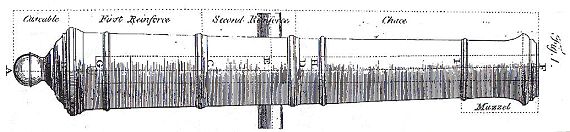
From 1716 the British cast iron barrel pattern was
standardized by General John Armstrong, Chief Engineer to the Duke of
Marlborough refer Fig 1 above (from a contemporary gunnery notebook), full size
drawings and copper cores were sent to foundries. By about 1760 the British
excelled in the refinement of iron, barrels were cast solid and bored out
making them stronger and more accurate. Cannon barrels were proved by double
charging with powder and testing twice, this normally revealed any
manufacturing flaws. Improvement to gunpowder allowed a decrease in barrel
length and barrel proportions were altered for strength, becoming thicker at
the breech and lighter in the chase without adding extra weight. The cannon
design required the diameter and length of the side trunnions to be the same as
the bore diameter. Fig’s 2 and 3 above, side elevation and plan of the Sea
Service Truck (wheeled) Gun Carriage c1760. Captain James Cook employed this
pattern and size of gun on the 10 gun HMS Endeavour during his Voyage of
Discovery including New Zealand
in 1768-1771
In 1780 Captain Thomas Blomefield was appointed Inspector of
Artillery at Woolwich, London. Blomefield
effected great improvements in inspection and manufacture. By 1830 it was
established that well made British barrels were so strong they could be “Bored
Up” enlarging the bore of a gun to the next or second higher caliber with a
reduction in windage.
Note “Windage” means the clearance between the smaller
diameter round ball projectile shot and the barrel bore. Advantages:- this made
the guns more efficient, more accurate and giving better penetration from 400
yards out. Disadvantages:- greater recoil, some guns unsafe when double
shotted, reduction in muzzle velocity with corresponding change in trajectory.
These 5 foot Kohukohu Cannons appear to be bored up two calibers from 4
pounders 3.25” bore (size of the trunnions) to 9 pdrs 4.1” bore. There is no
provision to attach a flintlock igniter on the vent piece which was introduced
during the 1790’s. These two high quality guns appear to be made for private /
merchant use.
Copyright retained by author reviewed
10 April 2006 research continuing
Special thanks, acknowledgments and for more information
Big Guns in New Zealand,
guns of HMS Osprey, by John Osborne, published in Guns Review, UK,
July 1996Far North District Council www.fndc.govt.nz
An Encyclopaedia of New Zealand 1966 www.teara.govt.nz
Wikipedia, the free encyclopedia, www.wikipedia.org also Tamati Waka Nene www.fact-index.com
Royal Engineers
Museum, www.remuseum.org.uk
British Gunnery Note Book, c1760 author unknown. losthistory.net/gunsmithsociety
John Wigglesworth and Peter Huckle, Kohukohu Conservation
and Restoration Society, www.kohukohu.com