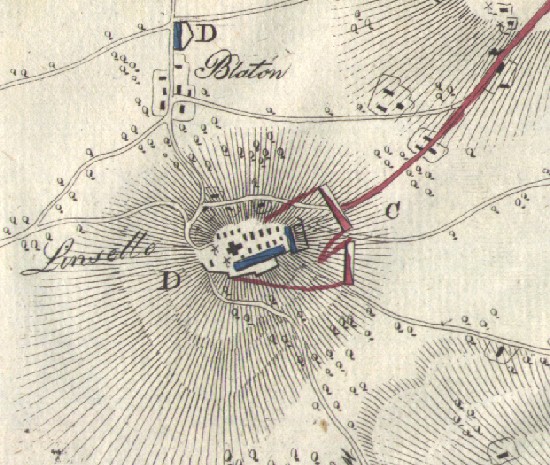
An example of the French use of artillery during the Revolutionary Wars:
Lincelles, 18 August 1793
by Geert van Uythoven
The fortified village of Lincelles had been taken by the Dutch army, but a French counterattack had driven them out again. The British Guards recaptured Lincelles:
XXXXXXXX
Source: Anonymous, "Feldzug der Verbündeten in Braband und Flandern im Jahr 1793", in Hoyers' 'Neues Militairisches Magazin, 2. Band, 2. Stück (Leipzig 1801) pp. 37-38:
"The rumour [of the Dutch thrown out of Lincelles again] had just become common knowledge in the English army, when at three o'clock in the afternoon totally unexpectedly the British guards struck camp, leaving behind their tents and baggage. No one knew where they went too. They were followed at half past six by the Hessian 'Erbprinz', 'Prinz Carl', and 'Von Kosboth' Regiments, including their artillery, taking the road to Lincelles. Just before Lincelles we already heard the news. The English General Lake had debouched out of the woods on this side of Lincelles with the three battalions of English guards, formed up, and marched against the heavily fortified village Lincelles (situated on a height, from which the surrounding terrain can be overseen), with much speed and in perfect order. The French let the English come into canister range, and then they blasted away at the English with 12-pdr to 16-pdr cannon and a very effective musketry. The English lost 350 men killed and wounded in this barrage, including 13 officers. However, without flinching, these 3 battalions with exemplary bravery stormed the entrenchments, stabbing to death every one of the fleeing enemy they could catch. The loss of the enemy seems to have been heavy; around 9 o'clock in the evening, one found in several corners of the entrenched village 20 to 30 dead Frenchmen lying side by side. We have made 60 prisoners, and reckon that the enemy has lost over 1,200 men. The victors captured twelve 16-pdr cannon, and their loss totalled 850 dead and wounded." 1)
1) [This account is probably used to describe this action in Jomini's "Histoire critique et militaire des Guerres de la Revolution" Tome 4me (Paris, new edition 1820), which is been copied again in Panckoucke's "Victoires, conquêtes, désastres, revers et guerres civiles des français de 1792 à 1815" Tome 1er (Paris 1817), as it is identical].
It is interesting to look at some more accounts of this engagement, as it gives a good impression of the way different sources describe the same event, as well as giving an idea if the bias that certain sources have.
XXXXXXXX
British accounts:
Source: Robert Brown (Corporal in the Coldstream Guards), "An Impartial Journal of a Detachment from the Brigade of Foot Guards, commencing 25th February, 1793, and ending 9th May, 1795" (London 1795) pp. 65-67:
"The Dutch troops having been driven from the post of Lincelles
this day, it was deemed necessary to retake it; upon which the three battalions
if the guards, under the command of Major-General Lake, were ordered immediately
on that service; accordingly we marched about two o'clock P.M. and about six
o'clock reached the village of Lincelles, where we found the enemy strongly
entrenched, and well prepared for their defence.General Lake having made the
proper disposition, the attack began. The 1st regiment being in front of the
column, began the attack, and the 3rd regiment and Coldstream forming on their
left with the utmost celerity, the whole line then rushed in upon the enemy
with irresistible force, amidst showers of grape shot from their redoubts; and
after discharging a volley or two of musketry, made a furious charge, accompanied
with a loud huzza, mounted their batteries in the face of the enemy, and devoted
all they met with to the bayonet.
The French, who had been accustomed to the cold lifeless attacks of the Dutch
[sic!], were amazed at the spirit and intrepidity of the British, and not much
relishing the manner of our salute, immediately gave way, abandoning all that
was in the place, and in their flight threw away both arms and accoutrements.We
took one stand of colours, ten pieces of cannon, with two pieces which they
had taken from the Dutch, and a number of prisoners. We suppose the number of
troops in that place to have amounted to between 5 and 6,000; ours were short
of 1,200.
The following is a Return of
our Loss, in Killed and Wounded:
| Battalions |
Captains
|
Lieutenants
|
Ensigns
|
Sergeants
|
Drummer
|
R. & F.
|
||||||
|
k
|
w
|
k
|
w
|
k
|
w
|
k
|
w
|
k
|
w
|
k
|
w
|
|
| 1st Regiment |
-
|
2
|
-
|
3
|
-
|
-
|
2
|
2
|
-
|
-
|
19
|
42
|
| Coldstream |
1
|
1
|
-
|
-
|
-
|
1
|
-
|
2
|
-
|
-
|
8
|
40
|
| 3rd Regiment |
-
|
-
|
-
|
1
|
-
|
-
|
-
|
2
|
1
|
-
|
7
|
43
|
|
Total
|
1
|
3
|
-
|
4
|
-
|
1
|
2
|
6
|
1
|
-
|
34
|
125
|
Lieutenant-colonel Bosville of the Coldstream was killed, a man of an amiable disposition, much regretted by all who knew him."
XXXXXXXX
Source: J.W. Fortescue, "British Campaigns in Flanders 1690-1794, being extracts from 'A History of the British Army'" vol. IV (London 1918) pp. 225-226:
"About mid-day the French returned with five thousand men
and drove out the Dutch; and an hour or two later an aide-de-camp came galloping
into Menin to ask for help. The Duke of York at once ordered out the brigade
of Guards, which had just arrived at Menin after a severe march, with a few
guns, under General Lake. The three battalions, without their flank companies,
and therefore little over eleven hundred strong, at once turned out, and traversed
the six miles to Linselles in little more than an hour, but, on reaching it,
found not a Dutchman there. They were, however, saluted by a heavy fire of grape
from batteries which they had supposed to be in possession of the Dutch; and
thereupon Lake determined to attack at once.
The hill, on which the village of Linselles stands, is fairly steep on its northern
face, and was further strengthened by two redoubts before the village itself
and by a barrier of palisades on the road, while its flanks were secured by
woods and ditches. Lake at once deployed into line under a heavy fire of grape,
and, after firing three or four volleys, charged with the bayonet and drove
the French from the redoubts and village. He then halted and re-formed on the
southern side of the hill, not without apprehensions lest the enemy should rally
and make a counter attack while he was still unsupported. Fortunately, however,
the French were not equal to the attempt, being still of the inferior quality
which was inevitable under the foolish administration of the Jacobins, and so
puny in stature that the Guards cuffed and jostled them like a London mob, without
condescending to kill them 1). Lake was therefore left unmolested on his ground,
until at nightfall six battalions of Hessians arrived, in reply to his urgent
messages for reinforcement, to relieve him. His trophies were twelve guns, seventy
prisoners, and a colour, but his losses amounted to one hundred and eighty-seven
officers and men killed and wounded."
1) Hamilton, History of the Grenadier Guards, ii. 285.
XXXXXXXX
Netherlands (Dutch) accounts:
Source: Journaal der Armée onder de orders van zyne Doorlugtige Hoogheid den Heere Generaal Erfprince van Orange etc. ['Journal of the army, commanded by his royal highness the hereditary Prince of Organe]; headquarters, 18 August 1793:
"(…) In the afternoon his royal higness [at Menin] received message that Lincelles and Blaton were attached again, with such might that, if no support was send, a retreat would be inevitable. Lord the Duke of York was requested to send some of his troops, after which three battalions English Guards marched to Lincelles. When the Prince of Orange arrived at Lincelles, the post was abandoned again, being stormed and captured by the troops mentioned."
XXXXXXXX
Source: J.P. van Ginkel, "Het leven van Willem George Frederik van Orange" (Rotterdam 1802) p. 104:
"[The French advanced on Lincelles again] with a numerous
force, and after heavy fighting they became masters of that post. Now three
English battalions advanced, which attacked the enemy and retook the post by
storm again. But these also would not have been able to maintain their position
alone, because of which they were supported by the [Dutch units] Bataljon
Zwitsers van May, Bataljon van Welderen, and two squadrons of the
[Dutch] guard which arrived with speed to keep this post."
XXXXXXXX
Source: J. Bosscha, "Neerland's heldendaden te land, van de vroegste tijden af tot op onze dagen" deel 3 (Rotterdam 1842) pp. 44-45:
"These two posts were very strong [i.e. the villages Blaton and Lincelles], and it was to expect that the Dutch forces would need support, of which Prince William [of Orange] assured himself with a promise by the Duke of York. (…) the enemy returned strongly reinforced in the afternoon, and retook Blaton and Lincelles. Now reinforcements arrived, consisting of two battalions of the English Guard which, followed by two Dutch battalions, drove the enemy out of Lincelles again, after which the entrenchments were demolished. Enemy loss was estimated 1,700 men, while the Dutch forces had lost ten officers deadly wounded or taken prisoner."
XXXXXXXX
Source: F. de Bas, "Prins Frederik der Nederlanden en zijn tijd" deel 1 (Schiedam 1887) p. 202:
"But the [Dutch] column of Lincelles, led by the hereditary prince himself, would have been beaten after having gained some advantages, when the English Guard had not arrived in time. These recaptured the lost post by storm and [the Prince of] Orange stayed victorious, although with great loss of officers and other."
XXXXXXXX

French accounts:
[as already has been stated, Jomini's and Panckoucke's accounts are identical to the first one]
Source: J.P.G. Viennet, "Histoire des guerres de la Révolution - Campagnes du Nord 1792-1794" Tome 1er (Paris 1827) p. 200:
"But the Duke of York, who was in Menin at that time, ordered
General Lake with his English guards to the rescue of the Prince of Orange.
Three Hessian regiments followed in reserve to support the new attack when necessary.
But they were not needed; the guard sufficed. Wavering from the fire of our
batteries, they were rallied by the undauntedness of General Lake, and stormed
our entrenchments, becoming master of both villages [i.e. Blaton and Lincelles]"
XXXXXXXX
Source: Baron Gay de Vernon (officier d'état-major), "Mémoire sur les opérations militaires des généraux en chef Custine et Houchard, pendant les années 1792 et 1793" (Paris 1844) p. 239:
"The second affair of that day was murderous and execute with much force: the 12me de ligne showed good conduct and much valour in the attack on Lincelles. The Duke of York detached the English Guards brigade and three Hessian regiments to rescue the Prince of Orange. General Lake, commanding this force, reached the village in the evening and stayed master of Lincelles."
XXXXXXXX
Prussian account:
Source: Albrecht Reichs-Burggrafen zu Dohna (General-Adjudant of General Knobelsdorff, CIC of the Prussian forces in the Netherlands), "Der Feldzug der Preussen gegen die Franzosen in den Niederlanden im Jahr 1793" 3. Band (Stendal 1798) p.224:
"At half past three in the afternoon, the enemy advanced
again and the Dutch left the post [Lincelles] to them, abandoning a large part
of their muskets, two howitzers, a 12-pdr and five 3-pdr's. The Duke of York
was already in the vicinity of the fighting with his corps, and hurried to aid
the Dutch forces. The post was again captured, the enemy thrown out of it and
10 cannon taken from him.The Dutch cannon had already been removed, and it was
not possible to retrieve them again."
XXXXXXXX
Austrian account:
Source: Hauptmann Schels, "Die Eroberung der Niederlande durch den Prinzen von Sachsen-Koburg, k.k. Feldmarschall, im Jahre 1793", in 'Neue Militärische Zeitschrift' I, 2. Heft (Wien 1813) p.11:
"In the afternoon 7 to 8,000 Frenchmen left the Camp of
Madelaine, and forced the Dutch to abandon Lincelles again. After having received
message of this, the Duke of York hurried thre with two English Grenadier battalions,
stormed the place again, and captured 10 cannon."
© Geert van Uythoven