BLATON AND LINCELLES, 18 AUGUST 1793
by Geert van
Uythoven
As described
in my piece about Lincelles, on 18 August the fortified village of Lincelles
had been taken by the Dutch army, but a French counterattack had driven them out
again. The British Guards recaptured Lincelles. A few kilometres from Lincelles
the village Blaton was situated, also fortified by the French. The attack by
the Dutch on Lincelles and Blaton was coordinated and simultaneously, and
therefore I decided to describe what happened at both places on this day. Also
to give some more background information to my piece on Lincelles. To start
with, I will translate the complete after action report taken from the Journal
from the Dutch commander in chief the Hereditary Prince of Orange:
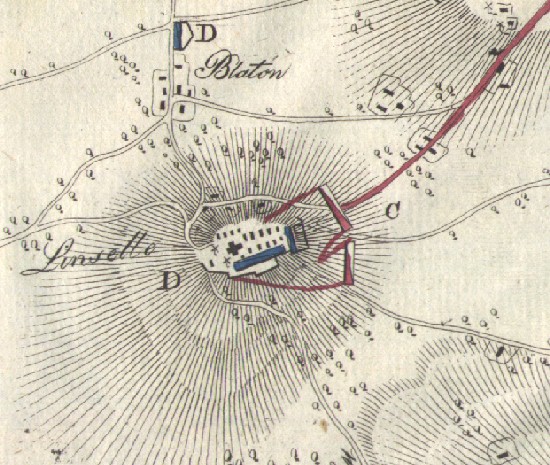
Source:
Journaal der Armée onder de orders van zyne Doorlugtige Hoogheid den Heere
Generaal Erfprince van Orange etc. ['Journal of the army, commanded by his
royal highness the hereditary Prince of Organe]; headquarters, 18 August 1793:
"His
Royal Highness having agreed upon attacking the enemy posts Lincelles and
Blaton, the following disposition was carried out, in agreement with the Duke
of York, and planned by the Hereditary Prince in cooperation with
Lieutenant-Colonel Gomez and Colonel Schöller in Imperial [i.e. Austrian]
respectively Prussian service. The Duke of York has given the assurance that,
if necessary, he would support the attack with troops.
Therefore in
the morning, commanded by Major-General Van Drachstädt, from Werwick marched
the 1st bat/Waldeck Regiment No.1 [German] with its battalion guns and
the howitzer present there, beside the 1st squadron/Cavalerie Regiment ‘(Van
der Duijn) van ‘s Gravemoer’, one light infantry company of the Korps
van Béon [French émigrés], and the Jagers van Bylandt [light
infantry].
These received
the order to be in position on the height near the windmill of Blaton at five
o’clock in the morning. At the same time, the following troops had to be
present there: the Infanterie Bataljon Nassau-Usingen [Walloon], [the
Infantry Regiment] ‘May’ [Swiss] and Infanterie Regiment No.1 ‘De
Schepper’ [one battalion each], beside two squadrons of the Regiment
Garde Dragonders [guard dragoons]. These troops march from the army under
command of Major-General van ‘s Gravemoer, crossing the Lys using the pontoon
bridge at Boesbeck.
This whole
column is commanded by Lieutenant-General Fuerst of Waldeck, destined to
capture the Blaton post. Attached to this column would, beside the battalion
guns, two howitzers and two 12-pdr cannon.
The main
column, commanded by the Commander in Chief General the Hereditary Prince of
Orange, consisted of the battalion Hollandsche Gardes [Dutch Guards],
the Garde Zwitsers [Swiss Guards], and the grenadier battalions ‘Van
Breydenbach’ and ‘Van Plettenberg’; beside a battalion of the Infanterie
Regiment No.6 ‘Van Welderen’, with its battalion guns, to which was
attached two howitzers, two 12-pdr cannon, beside the Lijf-Eskadron [Life-squadron]
of the Regiment Garde Dragonders, three squadrons Hollandsche Gardes
te Paard [Dutch Horse Guards], and one squadron of the dragoon regiment ‘Hessen-Kassel’.
To this main column the volunteers of Captain Matthieu were attached, to form
the advance guard and the flank patrols, in addition Lieutenant-General van
Mönster, and the Major-Generals Van Golowkin, Trebra, Rouse, Saumaise, and Van
Nostitz. The main column was destined to capture the Lincelles post, and for
this purpose they left their encampment near Menin at half past four in the
morning, passing through this city and through Halluin village, en then to the
right to Lincelles.
The jaeger,
hussars and infantry march with their cannon from the post at Ronck under the
command of Colonel Count Van Bylandt; he has to take up position on the heights
near Blanc four, in an effort to try to cut off the enemy from
Lincelles, and further to detach jaeger with some infantry on the road from
Lincelles to Bonduës. The main post of this column however has to remain on the
chaussee of Ronck, to prevent the enemy to debouch from Bonduës.
The column
of the Prince van Waldeck has become master of Blaton without encountering much
resistance. However, the main column attacking Lincelles met with more
resistance. The Battaillon Hollandsche Gardes was deployed to the left,
and except for its battalion guns to support its attack on the entrenchments,
for which it was destined, it received a 12-pdr cannon and a howitzer. The Battaillon
Garde Zwitsers was more to the right, and received orders to turn
Lincelles, while the Hollandsche Gardes marched straight towards the
village. After having fired heavily, the enemy was forced to retreat because
both battalions broke into the village; one through the entrenchments, the
other from behind, and according to the received reports enemy loss was
substantial. While this attack was executed, the three remaining battalions
were deployed in order of battle on a height between two windmills, beside part
of the cavalry, while the other part was send out on patrol.
The column
commanded by the Count van Bylandt, after having left behind a strong
detachment on the height, advanced further and pursued the enemy up to Bonduës,
after having already forced two entrenchments. Arriving in front of the third
however they were obliged to retreat, because the canon was not capable to pass
the second one.
Lincelles
and Blaton both taken, in the first place the grenadier battalions ‘Van
Breydenbach’ and ‘Van Plettenberg’, and the battalion of the Infanterie
Regiment No.1 ‘De Schepper’, beside two squadrons of the Regiment Garde
Dragonders, remaining there beside their battalion guns two 12-pdr and two
6-pdr cannon, all under command of Major-General van Nostitz. To this an
engineer and a few labourers were attached, in order to erect entrenchments to
the side of the enemy, and to demolish those on our side.
At Blaton
remained Major-General Van Drachstädt, with the 1st bat/Waldeck Regiment
No.1 and the Infanterie Bataljon Nassau-Usingen with their battalion
guns, two 12-pdr cannon and two howitzers, beside one squadron of the dragoon
regiment ‘Hessen-Kassel’, and one of the Cavalerie Regiment ‘(Van der
Duijn) van ‘s Gravemoer’.
His Royal
Highness beside the other generals and the remaining troops returned to Menin.
But in the afternoon His Royal Highness [at Menin] received message that Lincelles
and Blaton were attacked again, with such superior force that, if no support
was send, a retreat would be inevitable. Lord the Duke of York was requested to
send some of his troops, after which three battalions English Guards marched to
Lincelles. When the Prince of Orange arrived at Lincelles the post was
abandoned again, being stormed and captured by the troops mentioned.
In the
meantime His Royal Highness as support had send back to Lincelles the battalion
of the Swiss Infantry Regiment ‘May’, the battalion of the Infanterie
Regiment No.6 ‘Van Welderen’, and two squadrons of the Hollandsche
Gardes te Paard. They arrived in time to support the English, the
battalions staying there with the English during the night.
The post
Blaton, which was attacked at the same time by a numerically very superior
enemy, was also evacuated by our troops.
On the same
day, the enemy post Mouveaux was also attacked from Tourcoing. For this
purpose, Major-General De Geuse marched along the road to Rijssel with four battalions,
while Colonel Pfister marched along the road of Hautcarlier with a few hundred
men. However, the enemy was so strong in numbers and entrenched on all sides,
that it was not possible to capture this place. On the contrary, the
Major-General mentioned was himself attacked in Tourcoing, with such a
numerically superior force, that he had to request for support to headquarters.
For this purpose, two guard battalions from the army were dispatched to
Tourcoing, returning to camp the next day.
The same
morning Colonel van Horn commanding the 5th battalion Van Waldeck
[German], occupied a favourable position outside Roubaix village to await the
enemy, which he attacked fiercely that morning, the mentioned colonel leaving
behind a captain and fifty men of the Infanterie Regiment No.9 ‘Van
Randwijck’ to cover his retreat, but the enemy was driven back with heavy
loss.
On the same
day a battalion of the Waldeck Regiment No.2 arrived to reinforce
Roubaix, which was heavily under attack again at four o’clock. We were not able
to gain any ground because of the heavy fire of the enemy. And as with the
coming night a lack of ammunition had to be feared, Lieutenant-Colonel Von
Haake proposed to attack the enemy with the bayonet. This was executed by all
troops, while shouting fiercely. This had the lucky result that the enemy was
disordered and subsequently routed, driven back inside a village behind
Roubaix. When Lieutenant-Colonel Von Haake returned with his men, enemy fire to
the left of the city was still heavy. Therefore, Lieutenant-Colonel Von Haake
again requested his men to attack the enemy in the left flank with the bayonet.
Again the attack was executed and very successful. Only darkness prevented that
many prisoners would have been taken. Colonel van Horn is full of praise of the
Waldeck battalion, but also of the battalion of the Infanterie Regiment No.9
‘Van Randwijck’ which was present there, an also of the artillerymen.
The
excellent behaviour of the troops during all these different attacks deserve all
praise. His Royal Highness has already stated his satisfaction, and attached is
a list of the officers which had the opportunity to distinguish themselves by
their ardour and bravery.
According to
the reports that have been received the enemy loss is substantial, estimated at
1,700 men.
List of
officers which had the opportunity to distinguish themselves by their ardour
and bravery during the affair on 18 August 1793, the battalions having executed
their attacks with much order and undaunted, especially the Hollandsche
Gardes, the Swiss Guards, the 5th battalion Van Waldeck and ‘Van
Welderen’ No.6.
Lieutenant-General
Baron Van Mönster
Major-General
Van Golowkin
Colonel Van
Kretschmar van Wyck, major of the Hollandsche Gardes, commanding the
battalion
Colonel
Constant, major of the Swiss Guards, commanding the battalion
Colonel C.
Bentinck, major of the Hollandsche Gardes
Colonel Van
Straubensee, Infanterie Regiment No.6 ‘Van Welderen’
Colonel Van
Horn, 5th battalion Van Waldeck
[Lieutenant-]Colonel
Von Haake, 5th battalion Van Waldeck
Colonel
Muyson, Hollandsche Gardes te Paard
Colonel
Yvoy, Hollandsche Gardes te Paard
Colonel
d’Oultremont, Regiment Garde Dragonders
Major Prince
Von Solms, with the grenadier battalion ‘Van Plettenberg’
Captain
Matthieu, of the volunteers
Lieutenant
Lasberg, of the volunteers
Captain Von
Lowenstern, 5th battalion Van Waldeck
Lieutenant
Fagel of the Hollandsche Gardes, as adjutant with General Lake
Lieutenant
Zwicky of the Swiss Guards, has stormed the battery first
Lieutenant
Torxicella, of the Infanterie Bataljon Nassau-Usingen
Cadet
Kerseboom, of the Hollandsche Gardes te Paard, serving with the English
patrols
Cadet de
Jong, of Infanterie Regiment No.1 ‘De Schepper’, with the Infanterie Regiment No.6
‘Van Welderen’ during the second attack on Lincelles
Cadet
Hartjelief, of Infanterie Regiment No.18 ‘Van Wartensleben’
Sergeant
Krieg, Willekes, and Werth, of the Hollandsche Gardes
Was
signed,
W.F.
Hereditary Prince of Orange
P.S.:
All officers of the battalions of the Hollandse Gardes and Swiss Guards,
and those of the volunteer Corps of Matthieu have behaved outstandingly, and
cannot be singled out.
Source:
Letter to the States-General of the Dutch Republic; headquarters at Menin, 22
August 1793:
Honourable Gentlemen,
It is with
much sorrow, that I have the honour to report to You that Major-General Nostitz
has died of the wound which he received in the affair at Lincelles. Also I have
the honour to send to you the list of dead and wounded, which we have sustained
in the several attacks. Grenadier battalion ‘Van Plettenberg’ will march
to Antwerp, leaving behind two companies in Courtrai to secure the magazine and
the hospital.
After which
I have the honour to be,
Your
Honourable Gentlemen submissive servant
Signed,
W.F.
Heriditary Prince of Orange
Commanding
General
List of
dead, wounded, and missing officers, NCO’s, and other on 18 August 1793, in the
actions at Tourcoing and Roubaix
Killed:
Captain Van
Horn; 9 privates
Wounded:
Captain van
den Heuvel
Lieutenant
Muller
Lieutenant
van Troxel
Ensign von
Reineck
7 NCO’s; 68
corporals and privates
Missing:
3 privates
Signed,
W.F.
Heriditary Prince of Orange
Commanding
General
List of
dead, wounded, and missing officers, NCO’s, and other on 18 August 1793, in the
actions at Lincelles and Blaton
Killed:
Major-General
Von Nostitz
Major Van
der Feltz
Major Muller
Captain
Herman van Sonneberg
Lieutenant
Leuckel
Ensign
Severyn
Ensign
Schminke
Ensign
Hartjelief
2 NCO’s; 2
drummers; 55 corporals and privates
Wounded:
Colonel Van
Burmania
Colonel
Cornabé
Lieutenant-Colonel
Harring
Major
Panneboeter
Major De
Bellangé
Major De
Herrenschwandt
Captain
Franc. Count Van Bylandt
Captain Van
Quadt
Captain
Count van Goltz
Captain De
Vreé, senior
Captain Bom
Lieutenant
Schmidt
Lieutenant
Matthieu
Lieutenant
Van Lasberg
Lieutenant
Evers
Lieutenant
Torricella
Lieutenant
Scherer
Lieutenant
Tuyll
Ensign de
Vries
Ensign
Cremer
Ensign
Sabatier
Ensign
Crommelin
Ensign
Beurkin
Ensign
Dolleman
12 NCO’s; 1
drummer; 161 corporals and privates
P.S. Among
the wounded, many have such minor wounds that they are already doing service
again.
Missing:
Lieutenant-Colonel
Breydenbach
Captain
Engineer Berg
Lieutenant
Scheffer, senior
Ensign and
adjutant Cageling
Ensign Bos
9 NCO’s, 7
drummers, 106 corporals and privates
Signed,
W.F.
Heriditary Prince of Orange
Commanding
General
XXXXXXXXXXXXXXXXXXXXXXXXXXX
Interpretation:
Here it is,
a clear picture of the affairs at Lincelles and Blaton. However, looking at the
above piece, and information deriving from other sources, some things have to
be explained, clarified, and will lead to a somewhat different view as is
depicted here. First it is important to ascertain why these actions took place.
During the
previous period, the Dutch troops in this area had constantly been harassed and
disturbed by French attacks which in most cases held a numerical superiority
making good their lack of training. Although every time beaten back with severe
loss, the fighting and the necessity to stay under arms fatigued the Dutch
troops enormously. In addition, losses were sustained which were difficult to
make good again. Examples are the combats near Tourcoing and Lannoy, which
lasted for five hours. According to Van Ginkel, the attacks of 18 August were
undertaken to get rid of the continuous French attacks, while De Bas states
that the posts at Lincelles and Blaton had to be captured to improve the Dutch
positions. At first glance these seems very plausible reasons. However, after
both posts had been captured, they were voluntarily abandoned again the next
day, as described and the reason why given by an anonymous German writer, most
probably Von Porbeck:
“The French
were not prepared to try to capture Lincelles again. The scenes of the previous
day had been too painful for them to wish to repeat it again. Around noon [of
the 19th], Lieutenant-General Von Wurmb [now occupying Lincelles with six
Hessian battalions] to demolish all entrenchments, and to leave the place with
music playing (‘mit klingendem Spiel’). This happened and in the
afternoon around two o’clock the Hessians marched into camp near Menin again. (…)
The Dutch did not occupy Lincelles again –The French however already the same
day, and erected the entrenchments again. Despite the best intentions of the
Duke of York, despite the excellent measures of the Hessian general, and
despite the great bravery of the Hessians, the position on the height of
Lincelles was very risky: on nearly all sides this post was surrounded by thickets
and fields surrounded by brushwood. In the direction of the enemy the height had
not a steep slope, and the terrain was open here; the general neither the
English quartermaster-lieutenant, neither the adjutant, had been able to
reconnoitre the terrain during the night despite all efforts. In front, on the
left as well as on the right, were chaussee’s to Lille, and more secondary
roads to the same place. The inhabitants were very republican, all spies, and
had betrayed the Dutch. If the French in Werwick had thrown 500 tirailleurs
inside the forest of Bousbeck during the night, to block any support from the
camp, and would have attacked the Hessians frontally and on both flanks, as
well as in the back; which means of saving them would have been left? Even with
the greatest effort, it would have taken at least three and a half hours for
any support from the camp [at Menin] to arrive. Therefore, the Hessians would
have been sacrificed at this forward post without any purpose. It was pure luck
that the enemy had so much respect [for them], and let them retreat safely.” 1)
From the
above it seems that the Allies were not informed about the situation of both
posts, and their exposed position caused by the layout of the terrain. So as it
turned out later, because of a serious misjudgement of Allied high command,
triggered by the continuous irritating attacks initiated by the French, an
affair was fought without any gains at all, for the loss of hundreds of
soldiers which were difficult to replace. Blame for all this could easily laid
with the Commander in Chief of the Allied forces in this part of the Austrian
Netherlands, the Duke of York. However, it seems that the whole idea for it was
Dutch, and that the Hereditary Prince of Orange is the most responsible person
for the debacle.
Conclusions:
1. A bloody
battle was fought, initiated by the Allies, without any gains.
2.
Cooperation between the Dutch and the Anglo-Allied armies was very good.
3. The Dutch
army at this time had no rigid organisation or command structure; units were
assigned to commanding officers forming ad hoc brigades and divisions which
were adjusted according to the circumstances. This is in resemblance with the ‘Austrian
System’ as described by Roland Kessinger in his piece ‘Managing Armies in the
2nd Coalition War 1799-1800 –The Austrian and French Approaches’ in First
Empire magazine No.71 (July/August 2003). Placed by Roland in 1799-1800, one
should not that rather curious the system the Dutch used was six years earlier!
So is it possible the Austrians used the Dutch as an example? Or did the ‘Austrian
System’ develop much earlier as 1799? The battle of Aldenhoven on 1 March 1793
2), and in addition the battle of Neerwinden a few weeks later, already show
some kind of flexibility which resemble the ‘Austrian System’ as described by
Roland. More research would be needed to come to a more definite conclusion.
1) Anonymous
[Probably Von Porbeck]: "Feldzug der Verbündeten in Braband und Flandern
im Jahr 1793", in Hoyers' 'Neues Militairisches Magazin, 2. Band, 2. Stück
(Leipzig 1801) pp. 39-40.
2) See my
article about this battle, that has appeared in First Empire magazine No. 68,
Jan/Feb 2003.
Main sources used:
Bas, F. de: "Prins
Frederik der Nederlanden en zijn tijd" deel 1 (Schiedam 1887)
Ginkel, J.P. van: "Het
leven van Willem George Frederik van Orange" (Rotterdam 1802)
© Geert van Uythoven