PRINCE (WILLIAM) FREDERICK CARL VAN
ORANJE-NASSAU
by
Geert van Uythoven
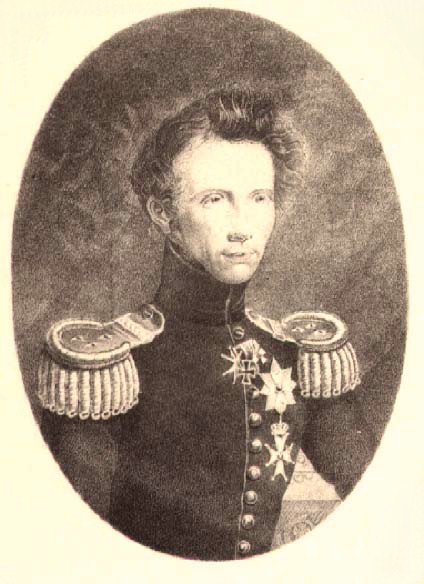
Prince Frederick
was born on 28 February 1797 in Berlin, son of the later King William I of the
Netherlands and Her Royal Highness Frederika Wilhelmina Louisa, born Princess
of Prussia. His youth was eventful. With his father fighting against the
French, commanding a Division in the Prussian army, on 18 October 1806 his
mother had to flee from Berlin with the children, his sister Pauline dying two
months later, only six years old.
On 23 March
1813 Prince Frederick was appointed by Wilhelm IV an officer in the Prussian
2nd Foot Guards Regiment. On 14 April he left for Altenburg, where the
headquarters of Blucher were established. He was present in the battles of
Lützen (Groß-Görschen, 2 May) and Bautzen (20 – 21 May). On 11 August, Prince
Frederick transferred to Zieten’s Division on its way to Bohemia. On 22 August
present with the fighting along the Saxon border. Also present at the battles
of Dresden (26 and 27 August) and Kulm (30 August), and in September at the
combats at Kulm and Telnitz (both on the 17th). From 16 to 19 October 1813 he
was present at Leipzig, taking part in the recapture of Wachau and the combat
at Probstheyda. On 18 October he received his patent as Stabs-Capitain of the
infantry. With Kleist’s Corps, he took part in the pursuit of the French over
Naumburg, Auerstädt and Weimar to Gotha. From 28 October – 22 November he was
present at the blockade and bombardment of Erfurt. On 17 November 1813 he is
again transferred, this time to the 3rd Prussian Army Corps (Bülow). He was on
29 November promoted to captain of the 2nd Prussian Foot Guards Regiment.
On 6
December, Prince Frederick crossed the Netherlands border near Aalten, arriving
in The Hague on the 8th. On 19 December he was before the fortress-city of ‘s
Hertogenbosch. On 26 December appointed colonel of infantry in Netherlands
service. He had a good start in 1814, when he was in Breda on 8 January, where
the next day council of war was held together with Bülow and Lord Graham who
commanded the British troops in the Netherlands. Although it was concluded that
the forces at their disposal were to weak to undertake a serious attempt to
capture Antwerp, it was still decided to continue the advance further. Prince
Frederick joined the Prussians and was present at the small combats at Brecht
and Westmalle (11 January). On 13 January the advance continued, with Prince
Frederick joining the British which fought a combat at Austruweel, after which
the British started an ineffective bombardment of the fleet and the harbour of
Antwerp. On 1 and 2 February he was present at the combats near Deurne and
Burgerhout. After that, with Bülow, Prince Frederick marched to Brussels and
together they entered the ‘capital’ of the southern Netherlands. Crossing the
French border on 18 February, he was present during the attack on and the
capitulation of Soissons.
Joining
Marshal Blücher and present at the battle of Laon (9 – 10 March), Prince
Frederick was slightly wounded in the face by splinters, when a cannonball hit
a wagon near by. On 11 march promoted lieutenant-general in the Netherlands
army, on the 19th he was ordered to return to the Netherlands, as there was a
lot of work to do to build the army. To that purpose, Prince Frederick was
appointed Grand Master of the Artillery 14 March 1814. After having been present
at the opening of the bombardment of Naarden, a fortress-city near Amsterdam
still occupied by the French, Prince Frederick returned to the south on 11
April 1814, appointed second in command of the Netherlands Army Corps, and
commanding officer of the 1st Netherlands Division which was supporting the
British in Flanders and before Antwerp.
On 4 April
1815, Prince Frederick resumed commanded of the Netherlands Mobile Army. On 2
May he handed over command to the Hereditary Prince of Orange, instead receiving
command of the Netherlands Indian Brigade and the Netherlands 1st Division,
part of the 2nd Anglo-Allied Army Corps (Lord Hill). On 17 June after the
battles of Ligny and Quatre-Bras had been fought Prince Frederick marched to
Halle, taking up position there. Remaining there during the battle of Waterloo
on the 18th, he advanced into France crossing the border on the 21st.
Commanding the Netherlands Mobile Army during the absence of the Hereditary
Prince of Orange who was wounded at Waterloo, he received orders from
Wellington to blockade the nearby French fortresses and to maintain
communications between the Netherlands and the Allied troops advancing on
Paris, using the newly created 2nd Netherlands Army Corps.
The 1st
Netherlands Army Corps participated in the advance on Paris. From 22 to 29
June, the 2nd Netherlands Army Corps besieged the fortress-city Quesnoy, which
capitulated on the 29th. On that same day, Prince Frederick started blockading
Valenciennes, changing the blockade in a proper siege on 1 July, bombarding the
fortress-city which lasted to 10 July. On 8 July, he received the
commanders-cross of the Militaire Willemsorde (‘Military Order of William’). On
16 July, the Heriditary Prince of Orange returned, resuming overall command of
the Netherlands troops and the 1st Netherlands Army Corps in particular,
leaving Prince Frederick in command of the 2nd Netherlands Army Corps. After
the second abdication of Napoleon, Prince Frederick received command of
Netherlands troops in France being part of the Allied occupation force,
returning home in September 1815.
On 21 July
1816 Prince Frederick, still holding a rank in the Prussian army as well ( a
colonel with the Infantry Regiment No.15 since 1 October 1815), was appointed
Inhaber of the Infantry Regiment No.15. Continuing his Prussian career, he was
promoted to lieutenant-general of the Prussian army on 18 June 1825, and
general of the infantry on 10 September 1840. Finally he was promoted
General-Feldmarschall on 1 July 1874. But there was another Prussian bond.
Prince Frederick married on 21 May 1825 with Her Royal Highness Louise Augusta
Wilhelmina Amalia, Princess of Prussia (born 1 February 1808; died 6 December
1870). Together they would have four children. Back to his Netherlands military
career now. Promoted general of the artillery on 15 June 1826, he became
General-Commissary of War on 1 July 1826, Admiral of the fleet, and
Colonel-General of the various arms of the Netherlands army on 25 December
1829. Honourably discharged from both latter positions on 6 July 1839.
On 24 August
1830 a rising in Brussels started, which finally would lead to the independence
of Belgium. Both princes left for the south, commanding the Netherlands army,
to put down the rising. On 22 September Prince Frederick fought a combat with
the rebels near Evere. Next day he was present at the affair at the
Schaarbeeksche gate of Brussels, participating in the confused fighting that
took place until the 26th of that month next day the royal troops abandoned
Brussels, the rebels having the opportunity to form some kind of independent
government for the southern provinces. On 22 March 1831 Prince Frederick was
appointed commander in chief of the Mobile Army. On 29 July, he himself
proposed to King William for the Hereditary Prince of Orange to take over
command, which was passed over to him on 1 August, Prince Frederick remaining
as an adjoint. Next day the so called ‘Ten Day Campaign’ (Tiendaagse Veldtocht)
started, with the Netherlands army easily brushing away all resistance put up
by the untrained Belgian army. On 12 August a truce was closed when a French
army came to the aid of the Belgians, with the Netherlands Mobile Army
returning to the province of Noord-Brabant on the 14th. Until 1834, Prince
Frederick remained with the Mobile Army, with King William only ceding his
Belgian provinces and making peace with Belgium on 19 April 1839.
Prince
Frederick was promoted Field Marshal of the Netherlands army on 28 November
1840. On 8 April 1849 as such he received supervision over all arms of the
Netherlands army, as well as the Koninklijke Militaire Akademie (Royal Military
Academy). In September 1856 he represented the Netherlands King at the crowning
of Tsar Nicolas I in Moscow. Appointed Inhaber of the Russian Rostow Grenadier
Regiment No.2. On 17 March 1863; the King of Prussia gave the name ‘Prinz
Friedrich der Niederlanden’ to the 2nd Westphalian Infantry Regiment. On
request of Prince Frederick himself, he was on 28 June 1868 honourably
discharged from his task of supervising all arms of the Netherlands army. He
died on 8 September 1881 in Wassenaar, and was buried in Delft on the 23rd of
that month.
© Geert van Uythoven