
General Jan Willem Janssens
LIEUTENANT-GENERAL JAN WILLEM JANSSENS
by Geert van Uythoven
Early career
Jan Willem 1) Janssens was born on 12 October 1762 in the city Nijmegen in the
eastern part of the Dutch Republic. His military career began when he was nine
years old, when he entered the Dutch army as a cadet in the infantry Regiment
'Van Aylva' in 1771. The regiment renamed 'Van Burmania' on 24 December 1772,
Janssens entered 'real' service when he was eleven years old, March 1775. His
presence with the regiment lasted longer as its colonels; on 12 September the
regiment was renamed 'Prince Frederik van Oranje-Nassau', and in this regiment
Janssens became an ensign on 5 February 1777. Again, the regiment was renamed,
and became on 5 November 1784 Regiment No. 1 'De Schepper'. On 5 April 1785
Janssens became quartermaster of the 2nd battalion of his regiment. During the
patriot rising in Holland in 1787, the regiment choose the side of the Stadtholder,
and remained in the province Noord-Brabant during the Prussian invasion, missing
action 2). Probably because of staying on the victorious side, on 31 December
1787 Janssens was promoted 1st lieutenant. However, finally he would leave the
regiment, to become a captain on 12 December 1788, commanding the grenadier-company
of the 2nd battalion / Infantry Regiment No. 18 'Van Pabst'. His rank became
effective two years later, on 25 February 1790. Regarding the colonels, the
same pattern continued; in April 1793 the regiment was renamed 'Von Wartensleben'.
Janssens served during 1793-'94 with the regiment in Flanders, in the campaign
against the French. On 13 September 1793 he was wounded by a musket ball in
his right shoulder, during the capture of Menin. He took part in the siege of
Lanrécies (20-30 April 1794), and the battle of Fleurus on 26 June 1794.
After the defeat of the Dutch and British troops by the French in the beginning
of 1795, the Dutch Republic was changed in the Batavian Republic, a French satellite
state. The Batavian army was reorganised along French lines, and Janssens regiment,
much depleted by the heavy fighting, became the 3rd battalion of the 1st Halve
Brigade ('Demi-Brigade'). However because of his wounds, received during
the above campaign, Janssens was pensioned out of the standing army, and assigned
to the administration of the French troops present in the Batavian Republic
on 16 June 1796 3). His administrative capabilities soon came to the surface,
and already the next year, on 11 March 1797, Janssens became First-Commissary
of the administration, and entrusted with a number of missions to France in
1797, 1798 and 1800. On 29 March 1800 he became secretary of the Department
of War, but resigned this post on 10 October 1800, staying advisor of the Agent
of War. On 29 January 1801 he resumed the function as First-Commissary of the
administration of the French troops in the Batavian Republic.
General Jan Willem Janssens
Cape of Good Hope, 1802 - 1810
Following the Peace of Amiens on 25 March 1802, the Cape of Good Hope, captured
by the British, would be returned to the Batavian Republic. Already during the
preliminaries before the peace was signed, on 18 February 1802, 39 years old
Janssens was appointed Governor-General and Commander in Chief of the Batavian
colony at the Cape of Good Hope. He received the rank of Lieutenant-General
in the Batavian Army and a salary of 50,000 guilders, a big achievement for
someone so young, even during this era, and in addition promoted from Captain
to Lieutenant-General after having fulfilled only administrative functions!
Discharged honourable from his function as First-Commissary on 28 May, it would
last until 5 August before he left for the Cape of Good Hope, sailing on the
'Bato', part of the squadron commanded by Rear-Admiral Dekker. The squadron
arrived at the roads of Capetown on 24 December 1802, and on 21 February 1803
Janssens took over government from the British. Expecting that peace would not
last long, he immediately ordered defence works to be raised and existing ones
strengthened. And as he expected, the Peace of Amiens was short-lived and on
16 May the British declared war again. Janssens was however ordered to send
most of his garrison to Java, which possession was estimated of more importance
by the Batavian Government then the Cape of Good Hope. All that was left to
him were 1,900 men, Batavians and a battalion of the Regiment Waldeck in Batavian
service, augmented by a few hundred trained Hottentots 4). However, it took
some time before the British would return. Only on 4 January 1806, General Baird
landed with 10,000 men at the Tafelbaai, near Capetown. Capetown, defended by
the Waldeck battalion, surrendered and was occupied by the British. Janssens
retreated with about 1,500 men remaining, making himself no illusions about
his chance to defeat the British. On 18 January, a battle was fought between
the British invaders and Janssens, at the plain of Blauwberg. Janssens lost,
receiving a concussion to his right hip by a musket ball during the battle,
and was forced to capitulate on 23 January. Permitted to leave for the Batavian
Republic with his garrison on British ships Janssens left Capetown on 5 March.
He arrived in his homeland at The Hague on 8 June 1806.
Things had changed during his absence. Napoleon had decided to abolish the Batavian
Republic and to create the Kingdom of Holland, to be ruled by his brother, Louis
Napoleon, who would be known as Koning Lodewijk by the Dutch. King Louis,
needing all the support he could get, immediately recognised the benefits he
could get by winning over Janssens to his side. Offered on 11 July 1806 to become
Secretary-General of the Department of War, and Privy Council Extraordinary
with the 4th Section ('War') of the State Council 5) for the year 1806, Janssens
had no reluctance to accept. One after the other, Janssens received and fulfilled
a number of appointments, but saw no active duty: 24 September 1806, Quartermaster-General
of the Expeditionary Army, destined for Germany; 7 October, Quartermaster-General
of the Army of the North in Germany under King Louis; 4 November, Governor-General
of Westphalia occupied by the Dutch troops; 15 December, Director-General of
the war administration; 1 January 1807, Privy Council in normal service with
the 3rd Section ('War and Navy') of the State Council for the year 1807, and
on 6 March also Privy Council in normal service with the 4th Section ('War').
In addition, Janssens was distinguished for his good conduct by being appointed
a Knight in the Koninklijke Orde van Verdienste ('Royal Order of Merit')
on 1 January 1807 6). On 28 May 1807 he was confirmed in his rank of Lieutenant-General
on half-pay, receiving his payment from 19 January 1806. His career continued:
on 26 June 1807 he was appointed President of the 3rd Section ('War and Navy')
of the Sate Council, replacing Dirk van Hogendorp, who fell in disgrace because
of his pro-Napoleonic feelings. Again Janssens was distinguished by being appointed
Commander in the Koninklijke Orde der Unie on 25 November 1807. And again
replacing Dirk van Hogendorp, Janssens became on 7 December Minister of War
of the Kingdom of Holland. As a Lieutenant-General he was pensioned on 1 January
1808. While continuing being Minister of War, in addition for the years 1808
and 1809 he was appointed Privy Council Extraordinary with the 3rd Section ('War
and Marine') of the State Council. On 27 March 1809, Janssens was replaced as
Minister of War because of his ill health. On his own request, because of the
same reason, on 22 May of the same year he was pensioned as Minister of War,
receiving a pension of 8,000 guilders, and retaining his rank as Lieutenant-General
and his function as Privy Council Extraordinary.
The East Indies, 1811
Now Janssens' life would become directly influenced by Napoleon, when he was
chosen, taking the place of Vice-Admiral Verhuell who refused, to bring the
message of King Louis' abdication of the throne of the Kingdom of Holland to
Paris on 3 July 1810. After his arrival on 22 July, Napoleon made him a member
of the Council of the Affairs of Holland. After the incorporation of the Kingdom
of Holland into the French Empire Janssens became général de
division in active French service on 11 November 1810. He was appointed
by Napoleon Governor-General of all French possessions east of the Ile de France
(in fact the former Dutch East Indies), instead of Daendels, by Imperial decree
of 16 November, and distinguished by being appointed grand officier de la
Légion d'honneur, effective the day he would accept the appointment,
which was on the 19th. On the 21st, the day of his departure, he was made a
Commander in the same Order, again changed in Knight on the 25th. He left for
the East Indies from Maindin in France on 29 December, sailing with the frigate
"La Méduse". Arriving in Batavia on Java, the main island of
the East Indies, on 15 May 1811, the next day Janssens took over from Daendels.
Janssens negative reports about the situation he found when he took over in
my opinion do not justice to everything Daendels had done during the previous
years. Although Daendels had his mistakes, he had achieved much, and especially
had made an tremendous effort for the defence of the colony entrusted to him,
as far as it was possible with the scarce means he had. This all was ready for
use to Janssens, who would not have to wait very long.

General Jan Willem Janssens talking with native sovereigns
On 30 July a British invasion fleet arrived north of Java. The
British war fleet consisted of 43 smaller and bigger warships, commanded by
Vice-Admiral Stopford. He protected a transport fleet of 57 ships, which transported
an army of 11,000 men and 500 horses, commanded by Lieutenant-General Samuel
Auchmuty, and accompanied by the Governor-General of the British East Indies,
Lord Minto. The army consisted for the greater part of veteran troops, and were
divided in four brigades, of which one formed the advance guard and one the
reserve. Lieutenant-General Janssens forces inherited from Daendels consisted
of 11 infantry battalions, 2 jäger battalions, 4 cavalry squadrons, a foot
artillery battalion, and 3 horse artillery companies. On paper these formed
a total of 17,774 men, of which only about 12% were European, supported by an
additional 2,500 native auxiliaries. However, in reality strength was much less,
and many strategic positions had to be garrisoned. In addition, their quality
was doubtful. The field army counted about 8,000 men, of which most were natives,
with none or minor experience. many of them were forced to enter the Dutch army
and hated all Europeans, and would try to run as soon as they had a chance.
There was a huge shortage of officers, and therefore many NCO's, mostly incapable
for the task, had been promoted to fill the vacancies. Furthermore, by orders
of Napoleon, the army was commanded by général de brigade
Jean-Marie Jumel, a mediocre commander, who spoke no word Dutch or Malay.
After careful reconnaissance of the coast Lieutenant-General Auchmuty decided
to land his troops near the village Tjilintjing, about three hours east of Batavia.
The careful preparations for the landing, with intensive support from the navy,
appeared to be unnecessary because the landing of the advance guard on 4 August
1811 was unopposed. In accordance with the defence plans of Daendels the 'French'
army 7) was concentrated between Weltevreden and Meester Cornelis, where at
the latter place an entrenched camp was constructed. Janssens had his headquarters
at Jacatra while Batavia was only defended by an insignificant detachment. The
British advance guard moved along the road to Meester Cornelis to protect the
landing of the remaining infantry. During the 5th the cavalry and artillery
was disembarked. When Auchmuty received a report that an enemy column was advancing
from Meester Cornelis -although later it became clear that this column was nothing
more then a reconnaissance patrol- his advance guard was ordered to move about
ten kilometres south to the Kapel van Suyranah. During the march, several dead
were caused by sun-stroke. This made Auchmuty change his decision; instead of
advancing inland he decided to advance on Batavia along the coast, hoping that
the advance of his troops to the Kapel van Suyranah would let Janssens believe
-as occurred- that the British would go that way. Therefore, during the evening
of the 6th, the British advance guard was relieved by the reserve brigade, and
advanced along the road to Tjanjong Priok. Several bridges were destroyed by
Daendels, but during the months that followed his relieve most of these were
replaced by bamboo made passages by the natives. Because of this the British
advance was unexpectedly swift, and during the same evening their advanced patrols
reached the place were the road crossed the Anjol river. Arriving there, they
observed that the bridge across the river was burned, and French outposts present
on the other side. To take this obstacle in the evening of the 7th a number
of navy sloops rowed upstream and created a passage, across which between 22.00
and 24.00 hours the infantry of the advance guard crossed the river. On the
8th, at break of day, they arrived in front of the suburbs of Batavia led by
General Auchmuty, who demanded the immediate surrender of the city. The mayor
of the city Hillebrink himself made his appearance with Auchmuty, declaring
himself willing to co-operate and asking to spare the city and its inhabitants,
in addition telling him that only a few cavalry were left. Nevertheless, the
situation of the British advance guard was not very bright. Most of the houses
were abandoned by their occupants, and there was no drinking water available
because the water-works were destroyed. In addition, there was a real chance
for a French attack from the direction of Weltevreden. However, when the first
British companies entered the city proper the French cavalrymen retreated, and
the British were not disturbed while they extinguished the fires of the magazines,
which were set on fire by order of Janssens. In Batavia many guns and provisions
were captured. During the evening most of the British advance guard entered
the city and took up positions for its defence. It was an uneasy night for them,
because the had to stay under arms during the night, and had to repulse an attack
from a strong French column.
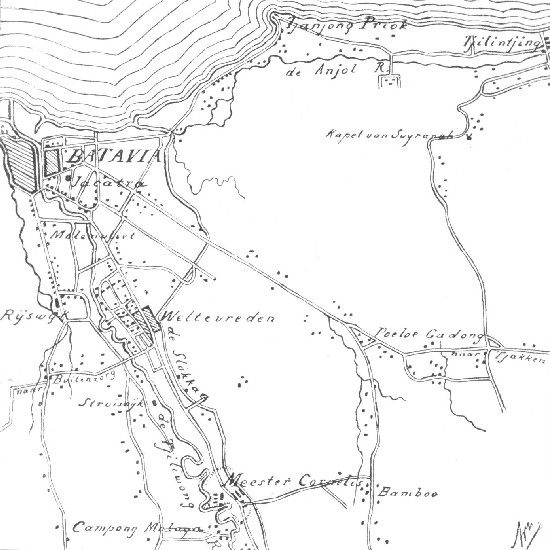
Map of Batavia and surroundings
Already on the 8th Lord Minto had send an envoy to Janssens -who had moved his
headquarters from Jacatra to Meester Cornelis- to demand the surrender of the
colony. Janssens bluntly refused. As a result, Auchmuty was ordered to continue
his offensive. On the 9th, the British outposts were moved forward to Rijswijk.
The next day, the bridge across the Anjol river was finished, enabling the cavalry
and artillery to cross, and the main force and the reserve to enter Batavia
also. During the following night the British advance guard moved to Weltevreden.
South of this village part of Janssens' army, commanded by général
de brigade Jumel, occupied good defensive positions, strengthened by abatis,
with the right flank protected by the Slokkan canal. The left wing was however
left undefended by Jumel, who had burned the bridge across the Tjiliwong but
had not occupied the terrain. The British advanced in the centre under heavy
musketry and gunfire, but could make not much progress because of the broken
terrain and the obstacles. But then they managed to turn the left flank, and
took an artillery battery consisting of four guns, despite the fierce resistance
of the gunners who died on the spot defending their guns. Brigadier von Rantzau
had pointed out the vulnerable position of the artillery, without any infantry
cover, but this was ignored by Jumel. With their flank turned the French army
was in disorder. it is said that at this moment Jumel yelled "lari!
lari!", intending to order a counterattack. These Malay words however
have the meaning of "Get out of here!" True or not, the complete French
army took flight, leaving behind an enormous amount of provisions and 280 (!)
guns. The French were hotly pursued by a squadron of dragoons, who made many
prisoners and badly wounded the able French chief of staff, Colonel Alberti.
The French were pursued all the way to the entrenched camp at Meester Cornelis.
The British took 6,000 prisoners, loosing only 520 killed and wounded, and the
victory enabled them to leave the unhealthy and marshy region around Batavia,
and to advance to the more healthy highland. They had now reached the entrenched
camp at Meester Cornelis, but it was clear to Auchmuty that he needed heavy
guns to bombard the French positions before he could attack with a real chance
of success. Therefore, Auchmuty gave up his positions at Tjilintjing and ordered
the fleet to move to Batavia were his siege train was disembarked. The Governor-General
Lord Minto in the meanwhile again dispatched an envoy to Janssens, again demanding
the surrender of the Dutch East Indies. Again, Janssens refused. In addition,
Lord Minto proclaimed to all the Dutch present on Java that the British had
come to end French rule, and that he would take the island under the protection
of the British Crown.
Janssens used the time the British left him to strengthen his defences. The surrounding terrain was inundated and additional batteries were thrown up. He tried also to hamper British activities as much as possible by firing at them whenever a suitable target was presented. During the night from 20 to 21 August, the British broke ground, and threw up their batteries north of the entrenched camp. During the morning of the 22nd, the batteries were finished and sailors started hauling up the guns to arm them, when their labour was disturbed by a sortie from the French. The sortie was however badly prepared, with troops getting lost following difficult tracks in the wrong direction, and completely failed. During the next days, a heavy cannonade was maintained on both sides. The British guns were outnumbered, but this was made good by their better trained gunners. The bombardment of the French positions lasted until the 25th. On this day the redoubts no. 1 and 2 north of the entrenched camp were so badly damaged that General Auchmuty decided to order a general attack on the camp, starting during the night. While making his plan of attack he was greatly assisted by information he received from a deserted sergeant. This sergeant marked out a road leading through covered terrain, right up to another redoubt, no. 3. This redoubt was situated on the right bank of the Slokkan canal and defended an intact bridge across it. The main column, consisting of the brigade forming the advance guard, and one brigade of the main army, would advance along this road, take redoubt no. 3, and attack the entrenched camp: the advance guard would attack south in the direction of redoubt no. 4; the other brigade west in the direction of redoubt no. 2. To keep the French in the centre busy, another column would make a feint attack from the north, to let the French believe that the main attack would come from this direction. A third small column would take redoubt no. 1. Finally, a fourth column would make a flank movement, by advancing west of the Tjiliwong river as far as Campong Malaya, and then attack the French from this direction. The attack of the first three columns would take place at 3 o'clock in the morning of the 26th, while the flanking column would leave around midnight.
The British attack came not as a surprise for Lieutenant-General
Janssens; he was informed about the upcoming attack by a Scottish deserter.
Therefore, he had given orders to prevent a surprise attack. In addition, général
de brigade Jumel was ordered to take care that at 3 o'clock in the morning,
all troops would be in position. Around this time Janssens himself appeared
at the northern defences, asking Jumel if his orders of the previous day were
carried out. It became soon clear that they were not! Janssens harsh words to
Jumel were drowned in the noise of muskets fired and the shouts of the advancing
British. Led by the deserted sergeant the British advance guard arrived before
redoubt no. 3 unnoticed. The outposts were run over, and the gunners managed
to fire only one shot before the British were amongst them, who captured the
redoubt and the bridge behind it. Alarmed by the shots the French ran to their
positions in great confusion, but before they had time too react the British
advance guard also captured redoubt no. 4 at bayonet point. The British brigade
following the advance guard directed its attack on redoubt no. 2. But by now
the French were in position, and while they were climbing the walls they were
met by a withering fire. In spite of this they managed to enter the redoubt,
fighting hand-to-hand with the defenders. At this moment the following event
occurred. The Dutch Major of the artillery F.X. Muller and Captain Osman were
determined not to give up the redoubt entrusted to them without the utmost resistance.
So when it was clear the redoubt could not be held they threw a fuse in the
powder magazine. With an enormous explosion the whole redoubt blew up, with
friend and foe alike. The British were stunned and confused, and their advance
halted for a while. Now the time was there for the French to counterattack,
but their troops were not ready for this, unprepared as they were for the attack.
The right moment passed and the British resumed their advance, capturing also
redoubt no. 1. The British advanced along the whole line, driving before them
the defenders. When they reached the park, général de brigade
Jumel order all available cavalry to counterattack, in a last effort to stop
the British advance and to give the French time to rally. However, at the same
time he order the infantry to open fire. As a result, the attacking cavalry
was caught between two fires and repulsed by the British, receiving heavy losses.
Now all hope for Janssens was gone. During the battle he tried several times,
with danger to his own life, to restore order, but now he had no other choice
then to order the retreat. But at this moment the British column that had outflanked
the French positions appeared at Kampong Malaya, and only a single file was
open for the French to retreat. The retreating French infantry was forced off
the road by the remaining horse artillery who moved at the gallop, followed
by troops of wild buffalo's, draught-animals of the train. The refugees were
driven back by the British infantry, right in front of the now attacking dragoons.
These rode on much bigger horses then the natives were used to, and these threw
away their arms and surrendered en masse. The British made six thousand prisoners,
including two hundred officers. Their pursuit ended at Tjanjong-Oost, about
ten kilometres south of Meester Cornelis. They took the greatest care for the
wounded of both sides. A number of 'gentlemen', on their way from Batavia in
their carriages to sight-see the battlefield, were ordered to hand over their
carriages to transport the wounded, much to their chagrin!
Lieutenant-General Janssens was one of the last to leave the battlefield. Nearly
captured, and after a difficult journey, he reached Buitenzorg were he met part
of his staff and the few remains of his army. Also there was an envoy from Lord
Minto, to demand for the third time his capitulation. Janssens' answer was 'that
the British had captured no more then a tenth of the island Java, and that he
would not capitulate before he had not one soldier left to resist! War has its
luck, and until now it was not at the side of the French. But this will change
and will decide the final outcome.' Janssens ordered Colonel Motman to rally
the troops and to send them to Samarang under the orders of reliable officers.
In addition, he summoned all native sovereigns to fulfil the obligations they
were bound to by treaty, and to send their contingents of auxiliaries also to
Samarang. Discipline however was bad among his native soldiers; most of them
had enough and deserted in droves, murdering the officers trying to stop them.
But instead of leaving for home they followed the retreating French column,
killing stragglers and firing their muskets at them -if they still had them.
The time come for them to take revenge. Finally, the retreating army was down
to about forty European infantry, a hundred dragoons and the remaining officers.
On the 29th they were attacked by about five hundred native deserters, but these
were repulsed by especially the officers, which had armed themselves with muskets.
Lieutenant-General Janssens refused to see général
de brigade Jumel, whom he held responsible for the disaster. Jumel accompanied
the retreating column for a few days but no-one followed his orders anymore.
Therefore he decided to leave by carriage and to go to Cheribon, to prepare
the fortress there for defence. Cheribon was strategically very important, as
it controlled communications between the eastern and western part of Java. However,
General Auchmuty knew this also, and had dispatched an infantry battalion embarked
on some frigates to capture the place. Arriving in front of the city, it was
occupied without resistance after Lieutenant van der Werf, who was in command
at the fortress, had taken a commission in the British army! So when Jumel arrived
he was immediately taken prisoner. Another part of the British army was send
to Karang Sambong, to prevent a retreat of the defeated French army to the west.
They managed to cut of a column retreating in that direction. Outnumbered and
without artillery and nowhere else to go the troops surrendered. As a result,
all French resistance west of Cheribon ceased. However, Auchmuty was in the
dark about the plans and location of Janssens. He thought that Janssens was
at Soerabaya, more specific at the fortress 'Lodewijk', to defend this region.
Therefore on 5 September he embarked part of his army, to land at Sadajo, near
this fortress. However, when he had reached Cheribon, he learned from a captured
letter that Janssens was at Samarang, not at Soerabaya. Accordingly, Auchmuty
changed his plans and decided to land there, to repulse Janssens to Soerakarta
and then to undertake the occupation of eastern Java. Arriving before Samarang
on the 9th, again an envoy was send to Janssens, who again refused to surrender.
When Lieutenant-General Janssens arrived at Samarang, he really found that a
number of native sovereigns had fulfilled their obligations and had send their
contingents of auxiliaries. However the contingent of the Sultan of Madoera
almost immediately had to return, because the island was threatened by the British
fleet. Their remained about 6,000 men, consisting of the contingents of the
Emperor of Soerakarta, the Sultan of Djoejokarta and the Prince Prang Wedono.
Quality of these auxiliaries was bad; their armament consisted mainly of pikes
and sticks, morale and discipline were bad. With the garrison battalions of
Samarang and Soerabaya added, Janssens had about 8,000 men at his disposal.
It was clear to him that he would stand no chance in defending Samarang, which
was without defences and could be bombarded by the British fleet. Therefore
he took up a strong position at Oengaran, waiting for the arrival of Auchmuty.
His position was on a series of heights with steep slopes, both wings resting
on impassable terrain. Turning the position was only possible by a very long
detour, through very heavy terrain. When General Auchmuty, in the morning of
the 12th, noticed that Janssens had evacuated Samarang and removed the guns
of the coastal defences, he immediately started landing his troops, which lasted
until the morning of the 13th. He met however a serious setback, because Vice-Admiral
Stopford had sailed further east with the fleet and most of the transports,
in order to capture the 'Lodewijk' fortress and Soerabaya, which had safe roads
for his fleet during the upcoming monsoon. Therefore, General Auchmuty was left
with 1,200 men and six field guns only. Nevertheless he decided to attack immediately,
while the enemy was still demoralised and his weakness unknown to them. Taking
in regard the position taken up by Janssens and thrusting the quality of his
soldiers he decided on a frontal attack, led by Colonel Gibbs. This decision
proved to be right. Janssens' troops were completely taken by surprise and the
undisciplined auxiliary troops, already weakened by mass desertions, took flight,
killing the European officers who tried to stop them. Victory was complete.
With only slight losses the British had taken an enormously strong position.
This proved to be decisive, Janssens army was completely defeated. Accompanied
only by a few officers Janssens retreated to the Salitaga fortress. During the
night he despatched a request to General Auchmuty for a cease-fire, in order
to open negotiations with Lord Minto in Batavia. Auchmuty refused, not wanting
to loose any more time, and declared that negotiations had to take place with
himself. On 18 September at Toentang Janssens capitulated, the remains of the
French army lying down their arms before Auchmuty. According to Wüppermann
this was not very difficult; only one musket was left! All French forces on
Java became prisoner of war. On 18 October 1811 Janssens sailed from Batavia
to England as a prisoner of war. During his imprisonment, on 22 February 1812
Janssens received the Great cross of the Order of the Reunion.
The Final years, 1812 - 1838
After giving his word of honour not to fight against the British and their allies
until exchanged properly the British brought Janssens back to France, putting
him ashore at Morlaix on 11 November 1812. On 15 January 1813 he was appointed
Commander of the 31st Military Division at Groningen, in the former Kingdom
of Holland. Two months later, on 5 march 1813, he was ordered to go to Coevorden,
situated on the southern border of his Military Division, to prepare this fortress
for defence. On 24 March he was appointed Commander of the 2nd Military Division
at Mézières. On 30 March Janssens was exchanged properly, but
for the time being stayed as Commander at Mézières. On 5 March
1814 he received orders from Napoleon to collect all available troops of the
Ardennes fortressesto attack Blücher's rear at Laon, and then to join the
army in Champagne. On 14 March he reached the army near Reims with 3,000 men,
and two days later was incorporated with the troops commanded by Marshall Ney.
During the battle of Arcis-sur-Aube on 20 March Janssens was wounded, and received
permission to leave the army and to go to Paris, to be employed again by the
Minister of War. However, on 9 April Janssens asked and received his dismissal
from the French Army.
Leaving France for the Netherlands, on 9 May 1814 Janssens joined the Netherlands
army in the rank of Lieutenant-General, the same rank he held in the French
army, and was by William of Orange charged with the direction of personnel with
the Department of War. This gave him a lot of trouble. Many officers tried to
obtain a position in the new Netherlands army. Aged Orangist officers who saw
no service since 1795, former Batavian and former French officers, and officers
and civilians which only experience was their conduct during 1813, in the 'liberation
war' of the Netherlands. In addition, Janssens was asked to 'lobby' with William
of Orange by a number of officers that had fought with distinction in the French
army under Napoleon, to receive a place in the Netherlands army. Among these
were the Generals Daendels and Dumonceau. Not surprisingly, in these cases,
Janssens did nothing, in order not to compromise himself, and also to keep all
able possible rivals far away from his own position. As a result, his relations
with many officers was worsening, making his position even more troublesome.
Furthermore, bringing the Netherlands army on full strength was a problem. On
3 July 1814, of the 53,607 men that were needed to bring the army at full strength,
only 34,097 were present. And of these many had to send away because they were
unfit for duty. But that is another story…
On 8 July, Janssens was also appointed President of the Commission for the Organisation
of the Colonial Army. On the 24th of the same month, Janssens became President
of the Commission for the Organisation of the Netherlands Army. Already four
days later, on the 28th, he became provisional Commissary-General of War. For
the third time, Janssens was ordered to create an army! On 31 August, he was
appointed Commissary-General of War of the Southern Provinces. However, Janssens
had other plans for himself. A new Governor-General for the Dutch East Indies
was needed, and Janssens was highly interested in this profitable position.
However, the loss of Java during his leadership and the problems he had in the
relations with the natives were the cause that he was not chosen for this important
position 8). Angered by this, on 19 September Janssens asked for his dismissal,
which was ignored by William of Orange. Asking for his dismissal again on 8
December, it was again refused; the young Kingdom could not do without his experience
right now. On 11 December this function was combined with that for the Netherlands,
and Janssens was offered to become Commissary-General of the United Departments
of War, with the rank of Secretary of State. Beginning in this quality on 1
January 1815, Janssens finally received his resignation on 22 May 1815, ending
his active duty at the age of 52.
Two days later, on 24 May 1815, Janssens was appointed President of the Commission for the Design of the Regulations of Administration and Discipline for the Militaire Willemsorde ('Military Order of William'). On 8 July he was distinguished by being made a knight of the great-cross of the Militaire Willemsorde, and appointed Chancellor of the Order. On 7 November 1816 he was authorized to wear his decoration of grand officier de la Légion d'honneur, to be confirmed by the King of France on 6 October 1817. Finally, Janssens became also a member of the Netherlands nobility when he was made a Jonkheer by Royal Order of 24 November 1816. On 10 November 1828 he was also promoted to General of Infantry, the highest rank existing in the Netherlands army. On 9 January 1834 Janssens was charged with the function of Chancellor of the Orde van de Nederlandse Leeuw ('Order of the Netherlands Lion'). This would be his last appointment; he died on 23 May 1838 in The Hague, 75 years old.
Assessment
Jan Willem Janssens was a soldier his whole life. Although brave, his qualities
on the battlefield were mediocre. Doing his best on Java he was not able to
withstand the British invasion with the troops he had at his disposal. A job
I think Daendels would have done much better. Since Janssens relieved Daendels
as Governor-General of the Dutch East Indies, relations with him were -not surprisingly-
very bad. Janssens however served much better in administrative duties This
was duly recognised by Louis Bonaparte -who also needed all the Dutch support
he could get- and later also by William of Orange. William gave him the task
to create the Netherlands army, something even more difficult to accomplish
because of the incorporation of the 'Belgians' and the problems already described.
That Janssens succeeded in creating a useful military force out of the scarce
resources, with so many men trying to obtain the best for themselves, with or
without the right capabilities, became clear during the Waterloo Campaign. During
this campaign, and looking at the circumstances, the green Netherlands army
gave a very good account of themselves. It was characteristic however that Janssens
held no field command during this campaign, and already in May received his
dismissal. Rather strange, one of the most experienced Dutch officers was not
present with the army during the most critical moment of the existence of the
Netherlands nation.
Bibliography
- Aa, A.J. van der, Biographisch Woordenboek der Nederlanden
(Haarlem 1855)
- Bas, F. de, Prins Frederik der Nederlanden en zijn tijd (Schiedam 1887-1913)
- Colenbrander, Dr. H.T., Gedenkstukken der Algemeene Geschiedenis van Nederland
van 1795 tot 1840, Part 7; Vestiging van het Koninkrijk 1813-1815 ('s-Gravenhage
1914)
- Dronkers, Mr.J.M.G.A., De Generaals van het Koninkrijk Holland, 1806-1810
('s Gravenhage 1968)
- Six, Georges, Dictionnaire Biographique des Généraux &
Amiraux Français de la Révolution et de l'Empire (1792-1814)
Tome I (Paris 1934 / 1974)
- Wüppermann, Generaal, Nederland voor Honderd Jaren, 1795-1813
(Amsterdam / Utrecht 1813)
© Geert van Uythoven
Footnotes:
1) In French, his first names are 'Jean-Guillaume'.
2) For details on the 1787 campaign, see my articles "The Prussian Campaign in Holland 1787", part I - IV, which appeared in the magazine First Empire, issue No. 44 - 47 (1999).
3) One of the conditions stipulated in the treaty of The Hague (16 May 1795) was, that an army of 25,000 French would remain in the Batavian Republic to protect it against the 'aggression of the Allies and to guarantee its independence'. This army would have to be fed, clothed and paid by the Batavians. The French developed a special system for the 25,000 troops the Batavian Republic had to feed, clothe and pay. Ragged troops from the front line armies were send to the Batavian Republic, were they were fed, paid, and clothed again. After some time, the troops moved to the front, fully equipped and rested, and a new ragged and hungry contingent arrived. This situation stimulated the hatred against the French.
4) Order of battle of the forces at the disposal of General Janssens.
5) The latter appointment was seven days later changed in Privy Council in normal service.
6) This Order was on 14 February 1807 changed in the Koninklijke Orde van Holland ('Royal Order of Holland'), and again changed on 23 November in the Koninklijke Orde der Unie ('Royal Order of the Union').
7) Although the army was formed of Dutch and Malayans, I will call it 'French' because from 1810 until 1813, as already told, the Netherlands were part of the French Empire.
8) Not surprisingly, General Daendels was one of those who advised strongly against Janssens as being appointed Governor-General of the Dutch East Indies.