
BOOK REVIEWS
 |
Publications of the Great
War Collected, designed and edited by Ted Smith |
This is a new collection of a number of out-of-print publications originally published during the war or in the 1920s and '30s. The collection will be expanded in due course, to include first edition booklets by modern students of the war.
GHELUVELT
This booklet, (A5, 16 pages, card covers) was originally published in June,
1915, by the Stationery Department of Worcester County Council. It commemorates
and describes the attack of the four companies of the 2nd Battalion, the
Worcestershire Regiment, on 31st October, 1914, at Gheluvelt, near Ypres.
The advancing Germans had managed to force a break in the thinly-held British line, and the situation looked critical. In a sunken road just beyond the village of Gheluvelt, the 2nd South Wales Borderers found themselves fighting off repeated attacks as the Germans advanced to capture the village and prepared to deliver further blows to break through towards Ypres and, eventually, the Channel ports.
At Hooge, the Commander in Chief, Sir John French was discussing the day's situation with Sir Douglas Haig when news came that the line was broken, that Gheluvelt was taken and that the enemy was continuing to advance. It seemed that the only option was to retreat and hope to reform a hold a line farther back. But as these orders were being prepared, new messages arrived; the break in the line had been filled, the enemy driven back, and the line was holding.
What had made the difference was the heroic charge of the Worcesters from their reserve position in the wood near the chateau. Crossing the open, exposed ground in front of the chateau itself they had braved the enemy fire, reached the road, forced the enemy back to the village and beyond and filled the gap in the line.
Sir John French recorded later that he regarded this action as "the most critical moment in this great battle." (First Battle of Ypres.)
This little booklet is a no-frills account of the action, written shortly
afterwards. Two useful maps.
ISBN 1-902185-00-5
THE WELSH AT YPRES
Originally published in 1918 by the Swansea Mabinogion Society, this is another
little booklet (A5, 12 pages, card covers) which essentially covers the same
ground as the "Gheluvelt" booklet and draws heavily on it. This booklet,
however, concentrates on the part played by the Welsh soldiers in the 31st
October, 1914 action at Gheluvelt. It is written in that peculiarly Welsh
heroic/poetic style which was popular at the time.
ISBN 1-902185-01-3
BIOGRAPHY OF A BATMAN
by Graham Seton
This booklet (A5, 16 pages, card covers) is a reprint of an article which
originally appeared in "The English Review" in August, 1929. The Author,
Graham Seton, was Lieut. Colonel Graham Seton Hutchison, author of "Warrior,"
"Footslogger," "Pilgrimage," etc. There are many examples in Great War literature
of the devotion which officers' batmen showed towards the officers they cared
for, and this is a very personal view of this kind of special relationship.
In some ways, the officer/batman relationship was one example of the breaking
down of class barriers which the war brought with it, although it has to
be said that the relationship was still of the master/servant pattern.
Nevertheless, it is unlikely, without the intervention of the war, that well
set-up young men like Graham Seton would ever had much to do with the likes
of young, orphaned Piper Peter McLintock of the 2nd Argyll and Sutherland
Highlanders who now sleeps, forever young, in Ration Farm Military Cemetery,
la Chappelle-d'Armentieres, France.
ISBN 1-902185-02-1
SOUVENIR OF A SOLDIER
When Private Edward Loxdale (Civil Service Rifles) was killed
near Loos on January 1st., 1916, his former office companions had a little
book printed in his memory, of which this little booklet (A5, 24 pages, card
covers) is a reprint.
Essentially it consists of various writings, from amusing letters to quite
serious poems, sent home by Pte. Loxdale. The items are all
cheerful, as one would expect from a soldier writing to friends
at home, but never painfully so. There is not a bad word to be said about
our chaps, and not a good word to be said about the frightful Huns - that
sort of thing. I particularly like the last item - "Madame" - which describes
the owner of Pte. Loxdale's billet near Loos. "Madame" is a second mother,
a tireless carer, exactly like my own friend who lives in Mailly Maillet
on the Somme and whom I never call anything but - "Madame."
ISBN 1-902185-03-X
HIGH ALTARS
By John Oxenham
John Oxenham was a prodgious author, whose writing embraced novels, poetry
and even hymns ("In Christ there is no East or West" was written by him.)
His words are also read by every visitor to the Newfoundland Memorial Park,
at Beaumont Hamel, because his poem, which begins, "Tread softly here! Go
Reverently and slow!" is the first memorial which visitors to the Park pass
as they enter.
In 1917, along with a small number of other "literary men" Oxenham was invited to visit the Western Front. This little book, (A5, 38 pages, card covers) contains 5 articles and 5 poems describing his impressions of the visit and was originally published in 1918.
The style of the articles is typical of the times. "Our boys" are always
"fresh-faced and clean shaven" and there is never a good word to be said
for the brutish Hun. Oxenham felt that he had really tasted the experience
of war, arriving back at his chateau after a long drive each evening exhausted
and extremely hungry after a day peering into mine-craters or looking at
derelict and long-abandoned trenches in safe areas, hopping from one "officers'
club" to another for snacks. The book may be a historical document, but there
is not much history here. Oxenham is not to be blamed for this, though.
Even 80 years on, we perhaps know much more about the war than he was
allowed to see and know. Even though he never saw the worst, he drew three
conclusions with which we, with our hindsight-enhanced view of the war in
France and Flanders, would probably agree; he recognised the bravery of the
men who endured it all; he was moved by the stories he heard about the men's
living conditions; he marvelled at the vast juggernaut war-machine and the
non-stop activity, the unsleeping city of destruction which the Western Front
had become.
ISBN 1-982185-04-8
LISTENING IN
By Olive C. B. Pixley
Captain J, N, F. Pixley, 4th Batalion, Grenadier Guards, was killed by a
sniper near Houthulst Forest in October, 1917 while visiting his advanced
posts. This booklet (A5, 16 pages, card covers) which was first published
in 1928 by Capt. Pixley's sister, describes her psychic experiences over
the couple of years years following the Captain's death, when his spirit
is said to have contacted her on everal occasions. There is little of Great
War historical interest here, but I was interested to read
"Listening In" as it a rare illustration of the role played by spiritualism
in the years during and immediately after the war.
ISBN 1-902185-08-0
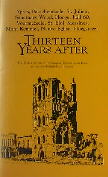
THIRTEEN YEARS AFTER
By W. J. Bird
This little book (A5, 46 pages, card covers) was originally published in
the 1930s. W. J. Bird, a Canadian Veteran, wrote the book following a visit
to the areas around Ypres where he had suffered 13 years earlier. I
am very interested in visiting the battlefields as they are today, and I
looked forward to reading this book, as the observations of earlier visitors,
written when the battlefields still retained many of their wartime features
which have now gone, are very hard to come by.
This is a very welcome reprint, which entirely lived up to my expectation.
It's small, (A5, 47 pages, card covers) but full of interesting observations.W.
J. Bird spent some time talking to the locals and these conversations brought
out many interesting snippets of information, little details which can add
to our knowledge and understanding of the area today. And of course, there
are the finely-drawn descriptions of Great War sites around Ypres as
he saw them - Ypres itself, Passchendaele, St. Julien, Sanctuary Wood, Hooge,
Hill 60, Voormezeele, St. Eloi, Messines, Mont Kemmel, Neuve Eglise and
Ploegsteert. Anyone who knows these places today will learn a lot from this
book.
ISBN 1-902185-06-4
IN THE YPRES SALIENT
By Beckles Willson
Subtitled "The Story of a Fortnight's Canadian Fighting," this book is another
account of Canada's involvement in the Ypres area, concentrating this time
on the fighting around Hooge from June 2nd to 16th, 1916, and published while
the war was still in progress.
These items from the "Publications of the Great War" series are available from :
IMCC Ltd.,
Riverdream,
21, Tagg's Island,
Hampton,
TW12 2HA.
And there is a WEB SITE with more details
Return to the Hellfire Corner Contents Section