Oberst a.D.
Rudolf Witzig
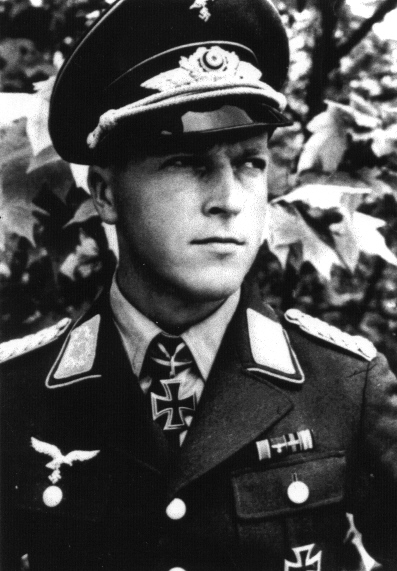
Oberst a.D. Rudolf
Witzig
Born - 14th August
1916, Westphalia, Germany
Died - 3rd October
2001
Rudolf Witzig was born into a working
class family on 14th August 1916, Westphalia, Germany. He joined the post
war 100 000 man army at the age of 18 in April 1935. He was an officer
candidate and by the beginning of 1938 had attained the rank of Leutnant.
Also that year (August) he joined the fledgling Fallschirmtruppe
and served in a battalion commanded by Major (later General) Richard
Heidrich.
By the start of the second world
war he had been promoted to Oberleutnant and was serving as the commander
of the Fallschirm-Pioneer Kompanie of the 2nd Battalion, 1st Parachute
Regiment. His Kompanie was amalgamated with the 1st Battalion, 1st Parachute
Regiment under the command of Hauptmann Walter Koch in May 1940 for the
assault on Eben Emael, the fortress on the Albert Canal. This was his most
famous action. Witzig was in command of Group Granite who were to land
on top of the fortress in gliders. The rest of Para assault detachment
Koch was to take the 3 bridges over the Albert Canal. Witzig’s glider came
down in Germany after the tow broke. He rejoined the group a couple
of hours later when he commandeered a new tow. The assault was a
complete success and he was awarded the Knights Cross personally by Hitler
for his exploits.
In May 1942 he was given command
of the 7th Airborne Divisions Pioneer Battalion and in August of that year
was promoted to Major. He next saw action in North Africa when he and his
Pioneers were airlifted into Tunis in November 1942 to help in the defence
line around the city from the allied advance. After being in action with
the spearhead units of the allied forces heading eastwards into Tunisia,
his pioneers were pulled out of the line for special training. In December
1942, the 3rd Kompanie of the Pioneer Battalion was air dropped behind
the British lines to disrupt supply lines by destroying airfields and bridges.
This was an unsuccessful mission and most were killed or captured. The
remnants of Witzig’s Battalion were removed from Afrika before the general
surrender in May 1943.
In June 1944, as the Allies were
pouring ashore in Normandy he was given command of the 21st Fallschirm-Pioneer
Regiment. Their next action would be in July 1944 when they were sent to
Lithuania. They took up positions around the Dunaburg-Kovno road and awaited
the Soviet advance. They took heavy casualties during this action but they
succeeded in destroying many Russian tanks in the process and inflicting
heavy casualties on the enemy infantry.
They were forced to withdraw from
their positions and were eventually returned to Germany in October 1944
to regroup.
Rudolf Witzig was then given command
of the 18th Regiment, 6th Parachute Division stationed in Holland.On November
25th he was awarded the Oakleaves to his Knights Cross and his name was
placed on the Luftwaffe roll of honour.
The 18th Regiment saw heavy action
in the Reichswald Forest between February and March against stronger British
and Canadian forces. His regiment withdrew to defend the Rhine in March
but due to allied armour was forced to withdraw ever deeper into Germany.
With his Regiment fragmented by the allied advance the survivors of the
18th Regiment surrendered to the allies on the 8th May 1945.
After the war he settled in Western
Germany. In the fifties he re-joined the armed forces of the post war Bundeswehr
where he rose to the rank of Colonel in the Pioneers.
Rudolf Witzig passed away in October
2001.
Return
to Commanders of the Fallschirmtruppe