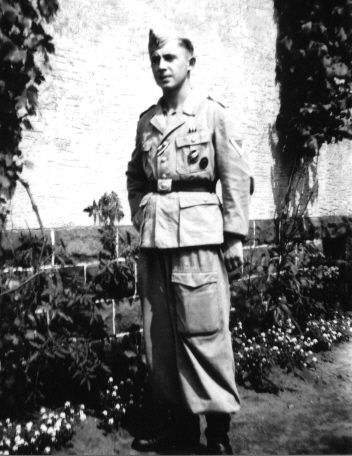
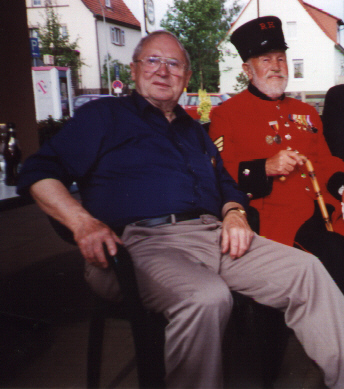
Gefreiter Wilfried Diehl-Tunisia 1943 Wilfried Diehl at the Sturmregiment reunion-Lich.June 2000
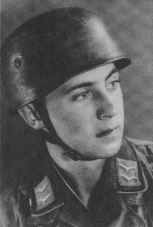
Oberjäger Wilfried Diehl
Born - 9th February 1924.
Wilfried Diehl was born
on 09.02.1924.
On 15.4.1942, at the age
of 18, Wilfried Diehl volunteered for service in the Fallschirmtruppe and
was subsequently posted to Fallschirmjäger Ersatz Battalion 1 at Stendal-Altmark.
After 12 weeks of training
he was posted to FJR5 at Hildesheim. The regiment was sent by train through
Holland and Belgium to its destination at the Fallschirmspringerschule
Chateaudun, near Bonneval in France. It was at Chateaudun that the regiment
carried out more training, notably parachute jumps.
In November 1942, FJR5 was
flown by JU52 to Tunisia to help counter the Allied landings in North Africa.
The account below is from Wilfried Diehl's experience in El Aroussa.
On the night of April 28th
1943, Wilfried Diehl was wounded in the fighting for Hill 107. He was subsequently
evacuated and transported on the ship >Giovanna Principessa<
to Naples in Italy, where he arrived on May 5th 1943. He spent the next
8 days in Naples recovering from his wounds.
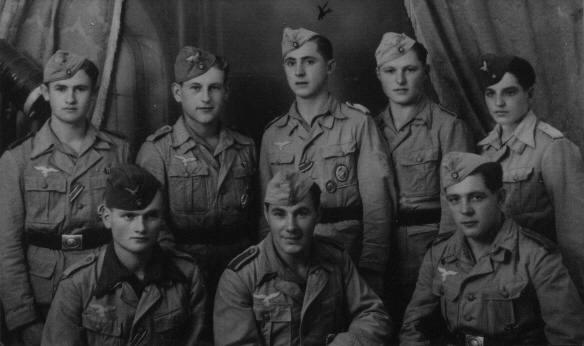
Gruppe Koch. Taken in Rome in October 1943.
Back row from left: Hans Suchan +, Roßnitscheck, Wilfried Diehl, Werner Neumann, Fritz Aubel +
Front row from left: Heinz Maurer +, "Gruppenführer" - Oberjäger Vincenz Koch +, Erhard Kolb +
+ Gefallen.
Wilfried Diehl later
saw service with FJR16 ost (Schirmer) in France, Lithuania and later
in the Harz Mountains, Germany.
On April 18th 1945, Wilfried
Diehl was captured in Germany and made a POW. During his time as a Fallschirmjäger
he was awarded the Parachute Riflemans Badge, the Iron Cross 2nd Class
and the Wound Badge in Silver.
He currently resides in
Homburg, Germany.


Both of these photographs have been well publicised over the years and both of them are connected to Wilfried Diehl.
Above left: The caption that often accompanies this photograph simply says, 2 Fallschirmjäger climb aboard a JU52. I have even read that it was taken before the drop on Crete. The photo was actually taken on 18th August 1942 at Chateaudun in France and shows Jäger Franz Höllein (above) and Jäger Wilfried Diehl (below), about to board a JU52 to carry out a training jump.
Above right: This photo was taken near Depienne in Tunisia on 29th November 1942 and shows Hauptmann Hans Jungwirth of I./FJR5 (left) an Obergefreiter (centre), whose name is not available, and British Paratrooper, Corporal Gavin Cadden (right). Cpl Cadden had been captured along with several wounded Paras after fighting near Depienne.
The connection with Wilfried Diehl....he was standing 2m away from the man who took the photograph..
El Aroussa-Tunisia,
November 1942
"In November 1942 we were
in Bou Arada, Tunisia. We received orders to drive the enemy from El Aroussa
approximately 18km away.
Under the command of
Leutnant Günter Frost, 14 men travelled toward El Aroussa in a small
truck. When we were 300m from El Aroussa, Leutnant Frost proceeded with
9 men on the right hand side of the road. Feldwebel Sternhoffer along with
the MG Trupp proceeded on the left. Nearby was a farmstead, which we searched
and found to be clear of enemy troops.
Subsequently we carefully
proceeded toward El Aroussa. Soon after our advance began, English flares
shot up into the sky, lighting up the surrounding area. It was now clear
that El Aroussa was filled with English troops.
At 2330 hours, it became
very lively. Tracer bullets were being fired all around us. Yellow from
us and red from the English guns. A short while later we heard the sound
of tank engines from the direction of El Aroussa and we assumed that the
English had armour in the town.
From our left we received
MG fire. This went on for quite a while, I cannot estimate how long. Suddenly
I saw red tracer fire coming from our rear. Clearly, the farmstead was
now in English hands. I moved in the direction of the farm, running, taking
cover and running again.
Beside me on the right
was Heini Breitfuß, my number 3 MG man. He suddenly cried out and
shot at the same time with his gun. A moment later an English soldier fell
on top of me. I immediately threw myself clear. He raised his bayonet and
I kicked it away with my left foot. The English soldier had begun his bayonet
charge from the farmstead against the MG men, notably me.
The English soldier was
wounded in the head, left arm and the left side of his body. I shouted
several times to the Englishman "hands up, hands up", he replied
accordingly "yes, yes". On scanning for weapons, I found his papers,
which I took from his breast pocket.
I tried to calm the wounded
man by tapping his shoulder and saying "all right, all right". He
understood my calming words. I then dressed his wounds. Heini Breitfuß
passed me a dressing for his arm. All of this happened in the bright light
of flares and tracer fire from the English positions. The English soldiers
at the farmstead were witnesses to these events.
As I was kneeling down
dressing the mans wounds, we heard more engine noises from El Aroussa.
They became louder and louder. Feldwebel Sternhoffer said "we cannot
hold for much longer, we must storm the farmstead".
He gave me the order
to storm the farm with my MG and that MG 2 and 3 will give covering fire
to the rest of the group. I jumped up and ran toward the farm, all the
time firing my MG. At the same time, I shouted "hands up, hands up,
stop fire, stop fire".
As we reached the farm,
5 English soldiers came out from their cover and raised their hands. I
had never expected this. My comrades immediately ran toward the Englishmen
and disarmed them. After this, I shouted loudly "I'm going back to the
wounded Englishman". Feldwebel Sternhoffer replied "why". Fortunately
I did not hear him, if I had answered him he would have forbidden me to
go. It was an additional risk to me, returning in the direction of El Aroussa.
On my return to the wounded
soldier, I ran like lightning. I ran as fast as I could so that I would
not be an easy target for the English gunners. I threw myself down beside
the wounded Tommy and called to him "El Aroussa, Englishman you help,
help, help". The Englishman immediately cried out "help, help",
he must have misunderstood my intentions and drew the attention of the
nearby English positions. As fast as I had arrived I ran back toward my
comrades at the farm, hoping once again not to be a target for the Tommies.
Together with the prisoners,
we marched back in the direction of Bou Arada. As we left, we still heard
the shouts from the wounded Englishman. We could see English soldiers moving
around in his proximity. I am sure they saved him.
The next day we attacked
El Aroussa once again. I returned to the place where I had left the English
soldier. He was no longer there. To this day, it would make me happy to
know that the English soldier survived".
"Of my number 2 and 3
MG men, Hans Schmeh currently resides in Germany and Heini Breitfuß
lives in Austria.
After the war, Feldwebel
Sternhoffer became a Landgerichtpräsident in Schleswig Holstein and
lived in Itzehohe. I corresponded with him until his death on 6.2.1996".
